Context
- The article argues that governance of the moon, especially over resource extraction and access, should not be shaped by unilateral or bloc-based rule-making but through inclusive multilateral frameworks.
- Source: “Lunar governance should be multilateral”, The Hindu, April 22.
Core Argument: Space Leadership and Credibility
- Main Claim: The article questions whether a country accused of repeated disregard for human rights, due process, and international law can credibly shape the governance architecture of the moon.
- Symbolic Contrast: It juxtaposes celebrated U.S. lunar missions with contemporary U.S. conduct in war, migration policy, and trade measures.
- Central Concern: A state invoking universal human achievement in space is portrayed as simultaneously weakening universal legal norms on Earth.
Moon Resources and Emerging Legal Contestation
- 2015 U.S. Law: The article highlights a U.S. law allowing its citizens to possess, use, and sell resources extracted from the moon.
- Artemis Accords Concern: It argues that the Artemis Accords adopt this approach as a governing norm.
- Resource Significance: Water ice at the lunar south pole is identified as a strategically important resource because it can be converted into rocket fuel for deeper-space missions.
- Scarcity Issue: These resources are finite and concentrated in only a few locations, raising the stakes of early control.
- Legal Risk: The article suggests the current framework on lunar resource management remains underdeveloped.
Problem with “Safety Zones”
- Official Justification: Safety zones are presented in the Accords as a way to prevent harmful interference.
- Practical Effect: The article argues that they could function as exclusion zones around resource-rich sites.
- Early-Mover Advantage: This may allow states reaching the moon first to consolidate control without formally breaching the Outer Space Treaty.
- Governance Gap: The concern is that informal practices may harden into effective claims before universal rules are agreed.
Why Unilateral Rule-Making Is Opposed
- Beyond U.S. vs China: The article argues that the issue is not simply whether the U.S. or China should lead, but whether either power should unilaterally define rules for a domain belonging to all humanity.
- Bypassing Multilateralism: The Artemis Accords are criticised for privileging bilateral agreements over the UN Committee on the Peaceful Uses of Outer Space, even while formally recognising the Committee.
- Norm-Setting Risk: Practices among a limited group of states may become de facto industry rules before broader international consensus emerges.
- Strategic Warning: A governance model that excludes China is seen as increasing the risk of confrontation.
The Multilateral Alternative
- Treaty-Level Rules: The article calls for treaty-based rules on lunar resources that give all nations a stake.
- Moon Agreement Relevance: It argues that the U.S. should engage with the 1979 Moon Agreement, which envisages an international regime for governing exploitation of lunar resources.
- Investment Objection Acknowledged: The claim that the Moon Agreement may deter private investment is noted, but not accepted as a reason to shut down multilateral rule-making.
- Final Position: The article favours inclusive global governance rather than unilateral or bloc-based control over the moon.
Lunar Governance: Legal Principles, Competing Approaches, and Resource Rights
Conceptual Divide
- Two governing philosophies: Lunar governance is presented as a clash between the idea of space as a Global Commons shared by all and space as a Frontier open for development.
Legal Foundations
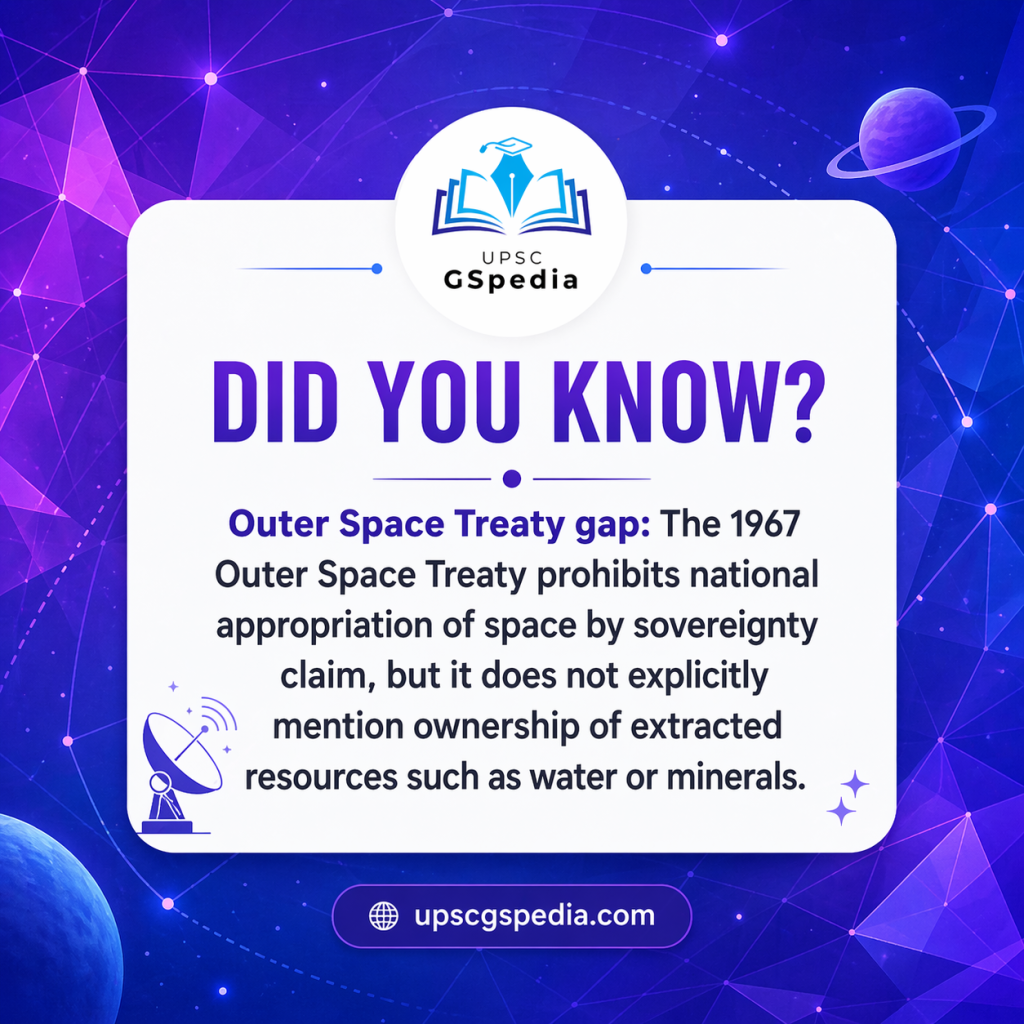
- Outer Space Treaty (OST), 1967: The OST is treated as the basic legal framework governing outer space.
- Core principle of OST: Outer space is described as the province of all mankind.
- Key rule under OST: The treaty prohibits national appropriation of outer space through claims of sovereignty.
- Legal gap in OST: The treaty does not explicitly address ownership or extraction of resources such as water or minerals.
- Main criticism of current practice: Critics argue that present lunar plans may follow the formal wording of the OST while bypassing its broader spirit of equality.
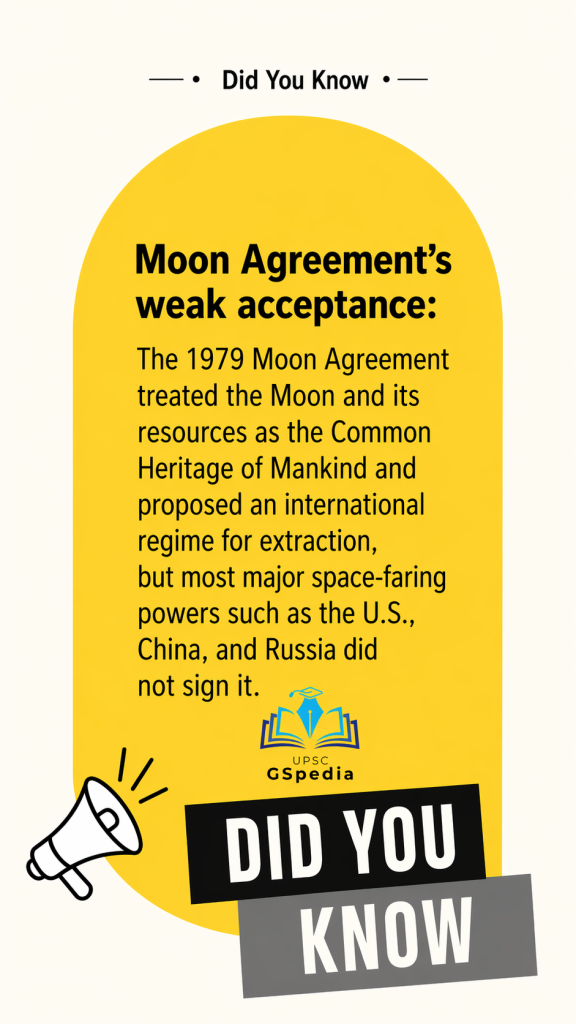
- Moon Agreement, 1979: This agreement was framed as an effort to regulate lunar resources directly.
- Core principle of Moon Agreement: The Moon and its resources are treated as the Common Heritage of Mankind.
- Key objective of Moon Agreement: It sought to establish an international regime for supervising resource extraction.
- Practical limitation of Moon Agreement: Most major space-faring powers, including the United States, China, and Russia, did not sign it.
- Broader debate: The agreement represents a multilateral model that is seen by many as being sidelined in favour of simpler bilateral arrangements.
Modern Frameworks and Tactics
- Artemis Accords: These are described as a non-binding set of principles led by the United States through NASA.
- Purpose of Artemis Accords: They aim to create a common rules framework for lunar exploration.
- Operational method: Countries join by signing separate bilateral agreements with the United States.
- Main critique: This approach is seen as allowing the United States to shape lunar norms through a coalition of partners rather than through a global vote at the United Nations.
- Safety Zones: These are designated areas around lunar bases or equipment.
- Declared purpose of Safety Zones: They are intended to prevent harmful interference, such as damage caused by dust or nearby activity.
- Underlying concern: If placed over scarce water-ice deposits, Safety Zones may function as de facto exclusion zones.
- Strategic implication: Such zones could effectively grant control over a resource without a formal sovereignty claim.
Economics of Space
- Lunar resource rights: The key economic focus is on valuable lunar resources, especially water ice in permanently shadowed craters near the South Pole.
- Why water ice matters: Water can be split into hydrogen and oxygen and used to produce rocket fuel.
- Core legal ambiguity: A central question is whether extracted resources can be owned even if the Moon itself cannot be claimed.
- U.S. interpretation: The U.S. position is that extracting resources does not amount to national appropriation or sovereignty.
- Global concern: If private actors are allowed to sell lunar resources, a first-come, first-served order may emerge that advantages wealthy nations.
UPSC Prelims Quiz
Practice exam-oriented current affairs questions daily and track your preparation effectively.
Attempt Quiz →