
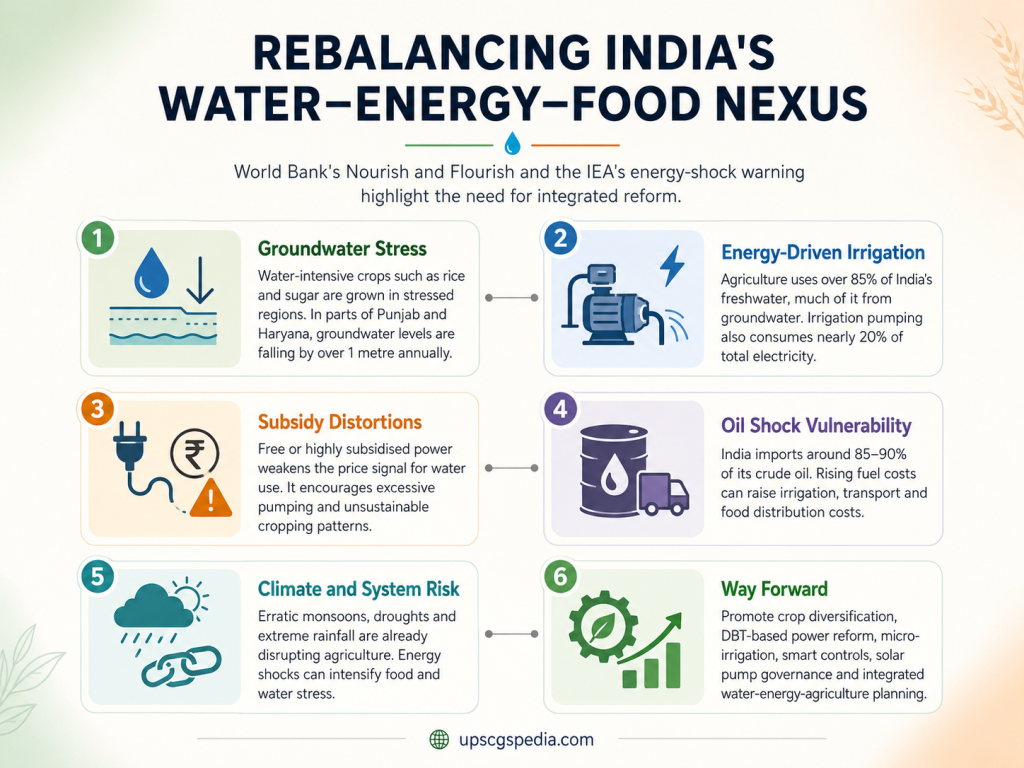
The World Bank’s report Nourish and Flourish warns that global food systems are increasingly misaligned with hydrological realities, creating serious risks for food security. For India, this warning is especially urgent because agricultural growth, groundwater extraction, subsidised electricity and water-intensive cropping patterns are deeply connected.
The concern becomes sharper when viewed alongside the International Energy Agency’s warning that energy shocks can quickly cascade into food and water crises.
Understanding The Water–Energy–Food Nexus
- Resource Interdependence: The Water–Energy–Food nexus captures the close dependence of food production on water availability and energy supply. Any disruption in one part of this chain can weaken the stability of the others.
- World Bank Context: The World Bank estimates that if inefficiencies continue, current agricultural water systems can sustainably support food production for only about one-third of the projected global population by 2050. This makes water management central to the future of food security.
- Agriculture’s Water Dependence: Agriculture accounts for more than 85% of India’s total water use. A major share of this water comes from groundwater extraction.
- Energy Behind Irrigation: Groundwater irrigation depends heavily on electricity and diesel. Agricultural pumping alone uses nearly 20% of India’s total electricity.
- Misaligned Incentives: Free or heavily subsidised power removes the economic restraint on groundwater pumping. This allows excessive extraction to continue, particularly where water-intensive crops are cultivated in already stressed regions.
India’s Groundwater and Cropping Imbalance
- Food Production Under Water Stress: India grows water-intensive crops such as rice and sugar even in areas facing groundwater depletion. This makes the country a major agricultural producer while also placing severe pressure on its own water reserves.
- Virtual Water Exports: Exports of rice and sugar also mean the export of large volumes of embedded water. This transfers domestic water stress into the global food trade.
- Punjab–Haryana Crisis: The paddy-based agricultural model in Punjab and Haryana has placed unsustainable pressure on aquifers. In several areas, groundwater levels are falling by more than one metre every year.
- Mismanagement Over Scarcity: The crisis is not only about absolute water shortage. It is equally about the inefficient and distorted use of water within agricultural systems.
Energy Shocks and Food System Risks
- IEA Warning: The International Energy Agency’s Sheltering from Oil Shocks plan highlights how energy disruptions can trigger wider food and water crises. This shows that agricultural resilience depends on energy stability.
- Oil Import Vulnerability: India imports around 85–90% of its crude oil. This dependence exposes irrigation, transport and food distribution to global fuel price shocks.
- Diesel Cost Transmission: A rise in diesel prices directly increases the cost of pumping water, moving produce and maintaining food supply chains. Energy volatility therefore becomes an agricultural risk.
- Power Disruption Risk: Fuel-related stress can also affect electricity supply. Any power disruption can interfere with irrigation schedules and farm operations.
- Cascading Resource Stress: Energy shocks can quickly move through the food and water systems. Food security therefore depends not only on harvests, but also on energy stability.
Distorted Agricultural Incentives
- Rice-Wheat Bias: MSP and open-ended procurement favour rice and wheat. This keeps farmers tied to crops that may not match local ecological conditions.
- Pressure on Water-Scarce Regions: Paddy and sugarcane cultivation in water-stressed regions intensifies groundwater extraction. This weakens long-term agricultural sustainability.
- Neglected Alternatives: Pulses, oilseeds and millets offer more ecologically suitable choices in several regions. However, existing incentives often fail to make diversification attractive.
- From Output to Suitability: Agricultural policy needs to move beyond production volume alone. Cropping decisions must be aligned with water availability and agro-climatic realities.
Urban Energy Management and Rural Resilience
Public transport, remote work and efficient logistics can reduce oil demand. Lower pressure on fuel systems can help stabilise inflation and indirectly support agricultural resilience.
Fiscal and Economic Strain
- Electricity Subsidy Load: India spends more than ₹1.5 lakh crore annually on agricultural electricity subsidies. Much of this spending sustains inefficient water and energy use.
- Agricultural Support Imbalance: Large agricultural support outlays often reinforce existing patterns instead of correcting resource misuse. This weakens the fiscal logic of farm support.
- Low Irrigation Investment: Globally, nearly ₹55 lakh crore was spent on agriculture in 2023, but only about ₹2.2 lakh crore went toward irrigation infrastructure. The imbalance reflects limited investment in efficient water-use systems.
- DISCOM Stress: Subsidised or free farm power burdens state-owned power distribution companies. This contributes to debt accumulation and poor infrastructure maintenance.
- Macroeconomic Exposure: Oil price spikes increase India’s import bill, fiscal deficit and inflation. Inefficient irrigation therefore links groundwater depletion with wider economic vulnerability.
Climate Change and Compounded Vulnerability
- Unstable Rainfall Patterns: Erratic monsoons are already disrupting agricultural cycles. This makes groundwater-dependent farming even more fragile.
- Extreme Weather Pressure: Droughts and intense rainfall events add further uncertainty to food production. These risks become sharper when combined with higher fuel costs or supply disruptions.
- Demand Management as Resilience: Reducing non-essential transport, improving efficiency and managing energy demand can reduce system-wide pressure during crises. Such measures support broader stability, even when they appear urban-focused.
Reforming the Crop and Subsidy Regime
- Crop Diversification: Moving away from water-intensive crops in stressed regions must become a core policy priority. It would reduce groundwater pressure and lower energy demand for irrigation.
- Ecological Security: India needs to shift from a narrow calorie-security approach to one based on nutritional and ecological security. This requires aligning incentives with local resource conditions.
- MSP Reorientation: MSP support should encourage crops suited to agro-climatic zones. Millets can be promoted in arid regions such as Rajasthan and the Deccan plateau.
- Direct Benefit Transfers: Free electricity should be replaced with targeted Direct Benefit Transfers. A fixed subsidy can protect farmer income while encouraging savings in electricity and water.
- Smart Metering: Smart meters can restore accountability in electricity use without removing farmer support. They can also help reduce unchecked pumping.
Irrigation, Solar Power and Technology
- Micro-Irrigation: Drip and sprinkler systems should be expanded under Pradhan Mantri Krishi Sinchayee Yojana’s “Per Drop More Crop” approach. These methods can improve water-use efficiency.
- Precision Farming: Traditional flood irrigation should be replaced with more precise water application. IoT-based soil moisture monitoring can support better irrigation decisions.
- Solar Pump Risks: Solar pumps can reduce pressure on DISCOMs and provide cleaner energy. However, free daytime solar power can encourage even more groundwater extraction if left unregulated.
- Electricity as a Cash Crop: Farmers should be encouraged to sell surplus solar power to the grid under PM-KUSUM. This can make power conservation financially rewarding.
- Governed Solarisation: Solar irrigation must be combined with smart controls, water accounting and grid-linked incentives. Otherwise, clean energy may still produce unsustainable water use.
Regenerative Farming And Local Water Governance
- Soil-Centred Practices: Zero tillage, Direct Seeded Rice and organic farming can improve soil health and water retention. These practices also reduce dependence on chemical fertilisers that require high energy inputs.
- Water Budgeting: Village-level water budgeting should be scaled up. Local cropping decisions can then be based on available water rather than only market or subsidy signals.
- Aquifer Management: Communities must be empowered to manage local aquifers. Atal Bhujal Yojana reflects the importance of decentralised groundwater governance.
- Institutional Integration: Water, energy and agriculture cannot remain separate policy domains. India needs a nexus-based framework that brings ministries, data systems and planning processes together.
Conclusion
The World Bank’s warning on hydrological misalignment and the IEA’s warning on energy shocks point to the same central lesson: India’s food security cannot be protected through fragmented policymaking.
A durable pathway requires crop choices suited to ecological realities, subsidies that reward efficiency, irrigation technologies governed by water limits and institutions that treat water, energy and food as one connected system.
Such an approach can protect farmer livelihoods while building a more climate-resilient and resource-secure economy.
UPSC Prelims Quiz
Practice exam-oriented current affairs questions daily and track your preparation effectively.
Attempt Quiz →