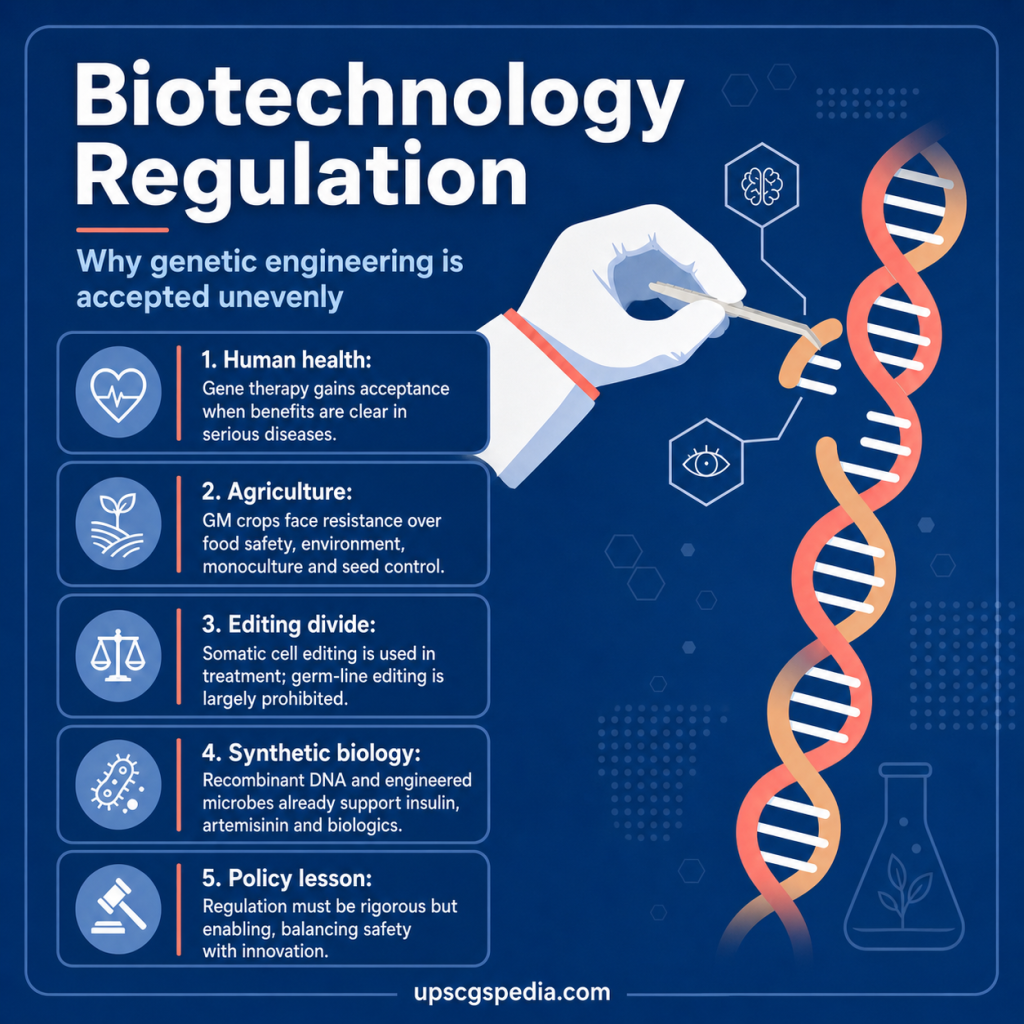
The article examines why societies accept genetic engineering in human medicine and synthetic biology but resist similar interventions in agriculture.
Source: Societies embrace gene therapy but resist genetic change in crops, The Hindu, April 23
Biotechnology as a Transformative Field
Beyond AI: Biotechnology is advancing rapidly but receives less public attention than artificial intelligence.
Long History of Biological Change: Humans have modified plants, animals and microbes for thousands of years through breeding and domestication.
Modern Shift: Laboratory-based genome engineering allows faster and more precise biological modification than traditional breeding.
Genome Engineering Across Sectors
Three Broad Areas: Genome engineering can be understood across humans, plants and microbes.
Different Public Responses: Acceptance varies across sectors due to science, culture, market, politics and risk perception.
Germ-Line Editing: Editing sperm or egg cells to transmit genetic changes to future generations is not legally permitted in most countries.
Somatic Cell Editing: Editing body cells that do not pass changes to offspring is regulated and allowed in medical treatment.
Acceptance in Human Health
Gene Therapy Use: Somatic cell engineering is used in cases such as cancer treatment, where immune cells may be modified to attack cancer cells.
Risk-Benefit Logic: Public acceptance is higher when patients face severe illness and potential benefits outweigh risks.
Inherited Diseases: Gene therapies are demanded for conditions such as sickle-cell disease, thalassemia and potentially muscular dystrophies, Huntington’s disease and other familial disorders.
Main Constraints: Cost, safety, efficacy, research timelines and market forces limit wider access.
Resistance in Agriculture
GM Crop Use: In the U.S. and Canada, maize, soybean, cotton and canola are widely grown using genetically engineered varieties.
Uneven Global Acceptance: These crops are exported globally, including to regions where cultivation is restricted.
Major Concerns: Opposition focuses on food safety, environmental release, monoculture, loss of diversity and corporate control over seeds.
Author’s Distinction: Monoculture and seed-company dominance are not unique to genetic engineering and existed even with conventional high-yielding varieties.
Core Point: Societies accept genetic innovation quickly in some domains but slowly or not at all in closely related domains.
Synthetic Biology and Biotechnology Applications
Recombinant DNA Products: Insulin and several other drugs are produced through recombinant DNA technology.
Microbial Production: Artemisinin can be produced using engineered microbes instead of extraction from plants.
Biologics: Genetically engineered antibodies and proteins are used in cancer and other disease treatment.
Semaglutide Example: Synthetic biology enables production of long-acting versions of biological molecules used in drugs such as Ozempic and Wegovy.
Public Response: Opposition is limited in medical use, though cost and access remain concerns.
Regulation, Innovation and Scientific Ideas
Ideas and Innovation Link: Transformative innovation requires freedom to generate, test, challenge and discard ideas.
Risk of Suppression: Blocking scientific ideas can damage innovation, as shown by the Lysenko episode in Soviet agriculture.
Risk-Averse Regulation: Excessively cautious regulation permits only technologies already tested elsewhere, encouraging imitation rather than original innovation.
Under-Regulation Risk: Weak regulation may allow unsafe or poorly directed technological use.
Required Approach: Biotechnology needs rigorous but enabling regulation that balances safety with space for new ideas.
Research and Policy Direction
Fundamental and Applied Research: Both are necessary; weakening either limits the innovation system.
Computational Biology: Genome sequencing, environmental data and advanced analysis can generate new biological insights and applications.
Avoid Narrow Application Pressure: Demanding only immediate applications can discourage bold scientific thinking.
Wise Regulation: Regulation should address present risks while enabling preparedness for uncertain future challenges.
Quick Concept Box: Biotechnology and Genetic Technologies
Gene Therapy
Definition: Gene therapy treats or prevents disease by inserting, altering or replacing genetic material within a patient’s cells.
Delivery Method: Viral vectors are commonly used to deliver therapeutic genes, while non-viral delivery methods are also used.
CRISPR Therapy: Casgevy became the first approved CRISPR-based therapy for sickle cell disease.
Indian Context: India launched NexCAR19 in 2024 as its first indigenous CAR-T cell therapy for cancer treatment.
Key Linkage: CAR-T cell therapy is a gene-modified immunotherapy in which a patient’s T cells are engineered to attack cancer cells.
Definition: Genome engineering involves inserting, deleting or replacing DNA at specific locations in the genome.
Core Tool: CRISPR-Cas9 is a leading genome-editing tool often described as genetic scissors.
Prime Editing: Prime editing enables precise DNA changes without requiring double-strand DNA breaks.
Indian Regulation: India has eased regulatory requirements for SDN1 and SDN2 genome-edited plants when they are free from exogenous introduced DNA.
GMO Distinction: SDN1 and SDN2 plants are treated differently from transgenic GMOs because they do not necessarily contain foreign DNA.
Genetically Modified Crops
Definition: GM crops are agricultural plants whose DNA has been modified through genetic engineering.
Purpose: They are developed for traits such as pest resistance, herbicide tolerance, improved yield or nutritional enhancement.
Biofortification Link: A newer focus is biofortification, which increases vitamins or minerals within crops.
Indian Context: Bt cotton remains India’s only GM crop approved for commercial cultivation.
DMH-11 Status: Dhara Mustard Hybrid-11 has received regulatory attention for environmental release, but commercial cultivation remains legally contested.