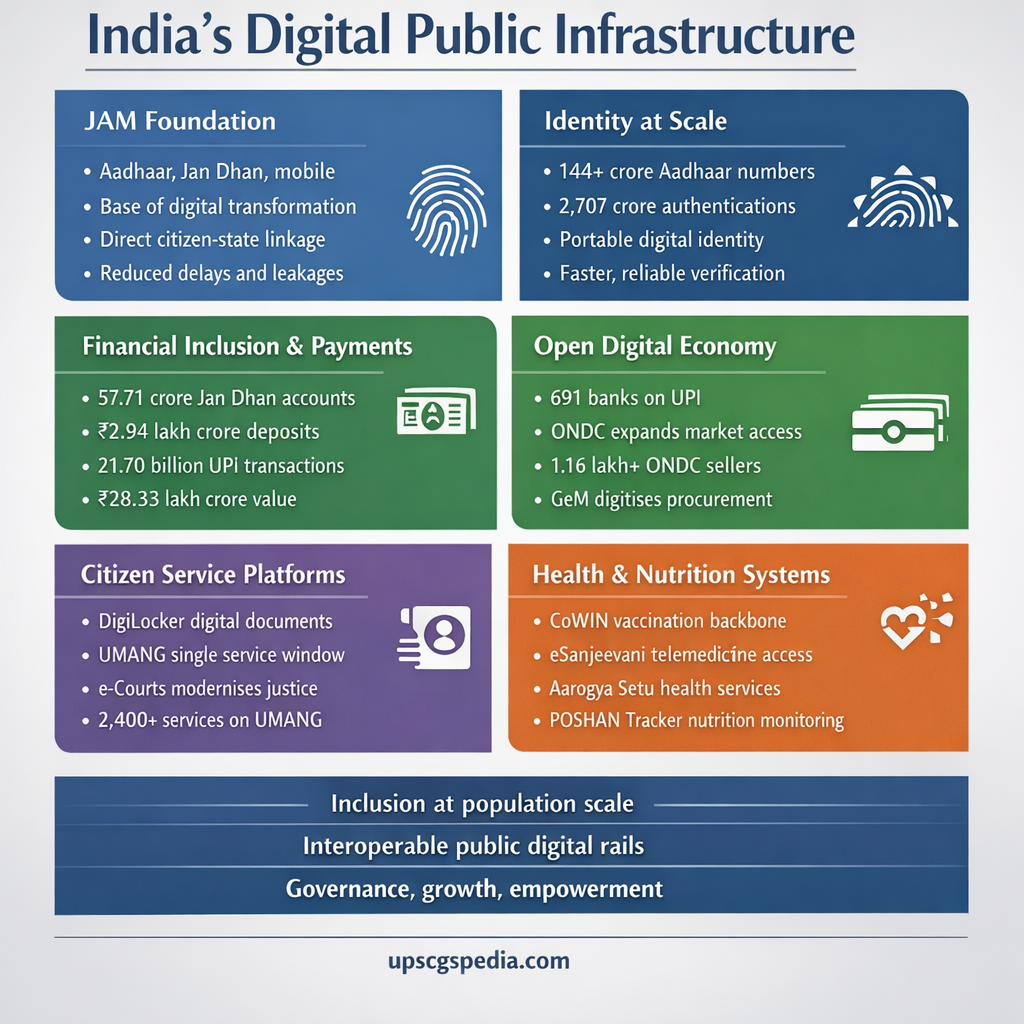
India’s Digital Public Infrastructure (DPI) has emerged as a major foundation of governance, service delivery and economic activity. It has enabled India to move from being a large user of digital technology to becoming a builder of population-scale digital systems.
What makes India’s approach distinctive is the combination of scale, openness and interoperability. Identity, payments and data exchange have been linked through public digital rails that support welfare delivery, market participation and state capacity.
India’s experience has also attracted global attention because it presents digital infrastructure as a public good rather than a closed private platform. It shows that inclusion, efficiency and trust can advance together when digital systems are designed in the public interest.
The Global Digital Moment
- Changing meaning of infrastructure: Infrastructure is no longer confined to roads, ports and power grids. It now includes digital systems that enable secure interaction among citizens, businesses and governments.
- Role of DPI in daily life: DPI supports identity verification, access to banking, instant digital payments and safe data exchange. In the modern economy, these systems shape access to services, markets and rights.
- Conditions for public value: For DPI to deliver broad social value, it must be inclusive, interoperable and governed in the public interest. When digital identity, payment systems and data-sharing frameworks are linked, they improve state capacity and expand opportunity.
- India as a working example: India offers a practical demonstration of how DPI can function at population scale. Its digital architecture shows that development and democratic inclusion can be strengthened together.
Foundations Of India’s DPI
- JAM trinity as the base: India’s DPI grew through the convergence of Jan Dhan accounts, Aadhaar and mobile connectivity. This JAM trinity created a direct and verifiable link between citizens and the state.
- Direct benefit architecture: Through JAM, welfare benefits began moving directly into bank accounts instead of passing through multiple intermediaries. This reduced delays, narrowed leakages and laid the foundation for a larger digital ecosystem.
Aadhaar:
- Population-scale identity system: Aadhaar introduced a biometric-based digital identity platform for residents across India. By March 2026, more than 144 crore Aadhaar numbers had been generated.
- Everyday operational use: In 2024–25 alone, over 2,707 crore authentication transactions were recorded on the platform. This made identity portable, verification faster and access to services more transparent.
Jan Dhan Yojana:
- Financial inclusion mission: The Pradhan Mantri Jan Dhan Yojana was launched in August 2014 to provide every unbanked adult with a bank account, financial identity and access to financial services. It evolved into one of the largest financial inclusion programmes in the world.
- Expansion in account ownership: The number of Jan Dhan accounts rose from 14.72 crore in 2015 to 57.71 crore by March 2026. This reflects the massive widening of access to formal banking.
- Growth in deposits and instruments: Deposits increased from ₹15,670 crore in March 2015 to ₹2.94 lakh crore by March 2026, while 39.98 crore RuPay debit cards were issued. This expanded financial participation and brought more savings into the formal system.
Mobile Phones and Connectivity
- Connectivity as the third pillar: Mobile connectivity completed the JAM framework by making digital identity and banking practically usable. With 85.5 percent of households owning at least one smartphone, the mobile phone became a key gateway to public services and transactions.
- Telecom reach across India: The number of wireless subscribers reached 125.87 crore by December 2025. This scale ensured that digital access extended well beyond urban centres.
- Expansion of 5G infrastructure: Fifth generation mobile services became available in 99.9 percent of districts, covering 85 percent of the population. By December 2025, 5.18 lakh 5G base transceiver stations had been installed nationwide.
Rise Of India’s DPI Stack
- From foundation to framework: India’s DPI Stack developed from a few basic systems into a connected national framework built on open APIs and public digital goods. Known as India Stack, it provides large-scale building blocks for identity, data and payments.
- Expansion across sectors: What began with digital identity and financial inclusion gradually extended into welfare delivery, health, education, skilling and governance. This created an integrated backbone rather than a set of isolated digital portals.
- Broader relevance of the model: Although built in the Indian context, the system is modular and adaptable. This gives it significance beyond India and makes it relevant to other countries exploring digital public goods.
Digital Economic Infrastructure
- UPI and retail payment transformation: Unified Payments Interface has made retail payments instant, interoperable and secure. In January 2026, it processed 21.70 billion transactions worth more than ₹28.33 lakh crore.
- Institutional scale of adoption: A total of 691 banks are live on the UPI platform. This shows how deeply UPI has been integrated into India’s banking and payment ecosystem.
- Global standing of UPI: The IMF, in June 2025, recognised UPI as the world’s largest retail fast payment system by transaction volume. The 2024 ACI Worldwide report also noted that UPI accounts for around 49 percent of global real-time payment transaction volume.
- Dominance in domestic retail payments: Within India, 81 percent by volume of total retail payment transactions are processed on UPI rails. It has become the preferred mode for both person-to-person and person-to-merchant transactions.
- PFMS and public expenditure monitoring: The Public Financial Management System is a web-based online transaction system that tracks government funds and enables electronic payments to agencies and beneficiaries. It was mandated in December 2014 for payment, accounting and reporting under Direct Benefit Transfer.
- Reduction of duplicate beneficiaries: PFMS helped remove duplicate and fake beneficiaries while reducing leakages in welfare delivery. This improved transparency and financial control in public expenditure.
- Savings and transfer scale: The government saved more than ₹4.31 lakh crore between 2015 and March 2024 through these reforms. By January 2026, cumulative Direct Benefit Transfer had crossed ₹49.09 lakh crore.
- ONDC and democratisation of e-commerce: Launched in 2022, the Open Network for Digital Commerce was designed to connect buyers and sellers through interoperable platforms rather than a single marketplace. It reduces entry barriers and widens participation, particularly for small businesses.
- Scale of ONDC expansion: By December 2025, more than 1.16 lakh retail sellers were live on ONDC. These sellers were spread across over 630 cities and towns across India.
- Government eMarketplace and procurement reform: The Government eMarketplace digitised public procurement and expanded participation in government contracting. By November 2025, it had processed nearly 3.27 crore orders with cumulative Gross Merchandise Value exceeding ₹16.41 lakh crore.
- Breadth of categories and buyers: The platform supports over 10,894 product categories and 348 service categories, with more than 1.67 lakh buyer organisations onboard. This gives it a broad institutional and operational footprint.
- Participation of small enterprises: More than 24 lakh sellers and service providers have completed profiles on the platform, including over 11 lakh Micro and Small Enterprises. These enterprises contribute 44.8 percent of cumulative order value and have received orders worth over ₹7.35 lakh crore.
Citizen Service Delivery Platforms
- DigiLocker as a trusted document wallet: DigiLocker, launched in 2015, allows citizens to store, access and share authenticated electronic documents through consent-based access. It reduces dependence on physical paperwork and helps prevent the use of fake documents.
- Scale of DigiLocker use: As of 5 March 2026, DigiLocker had 67.63 crore users. By March 2026, more than 950 crore documents had been issued through the platform.
- UMANG as a unified citizen interface: Launched in 2017, UMANG provides a single mobile and web platform for services offered by central, state and local governments. It brings together access to services such as EPFO, PAN, Aadhaar, DigiLocker, utility bill payments, pensions, scholarships, passports and driving licences.
- Transaction scale on UMANG: As of 5 March 2026, the platform had recorded 10.25 crore user registrations and 723.36 crore transactions. More than 2,400 government services are available on it.
- e-Courts and judicial digitisation: The e-Courts project is a nationwide Mission Mode initiative aimed at making the judiciary more efficient, transparent and accessible through ICT. Phase I from 2011 to 2015 focused on basic computerisation and internal connectivity.
- Achievements of Phase I: Under Phase I, 14,249 courts were computerised and Local Area Networks were installed in 13,683 courts. This created the technological base for further digital reform in the justice system.
- Shift in Phase II: Phase II from 2015 to 2023 moved towards ICT-enabled citizen service delivery. It introduced Wide Area Network connectivity, stakeholder training, eSewa Kendras and systems for digital filing and online payments.
- Phase III and advanced digital courts: In September 2023, the Union Cabinet approved Phase III for 2023 to 2027 with an outlay of ₹7,210 crore. This phase promotes paperless courts, digitisation of legacy records, wider video conferencing and the use of AI and OCR in judicial administration.
Health And Nutrition Ecosystem
- CoWIN as vaccination infrastructure: CoWIN was launched on 16 January 2021 as the digital backbone of India’s COVID-19 vaccination programme. It connected manufacturers, administrators, healthcare workers and beneficiaries across public and private sectors on a single platform.
- Scale and significance of CoWIN: By managing over 220 crore doses, CoWIN improved transparency, coordination and public trust in one of the world’s largest vaccination drives. Its design has attracted international interest as a model for digital public health systems.
- eSanjeevani and telemedicine access: Launched in November 2019, eSanjeevani expanded healthcare access through remote consultations between doctors and patients. It has been especially important for rural and underserved regions by reducing travel and waiting time.
- Scale of eSanjeevani usage: As of 5 March 2026, the platform had served 45.42 crore patients and onboarded 2.3 lakh healthcare providers. This indicates that teleconsultation has become a mainstream public health service.
- eHospital and ORS systems: Under Digital India, the National Informatics Centre developed eHospital, e-BloodBank and the Online Registration System. The ORS portal was launched on 1 July 2015 to provide online access to hospital services.
- Integrated hospital management: eHospital functions as a Hospital Management Information System that digitises appointments, diagnostics, billing and internal workflows. Together with e-BloodBank, it connects patients, hospitals and doctors through a unified digital platform.
- Aarogya Setu’s evolution: Aarogya Setu was launched on 2 April 2020 to support COVID-19 response through contact tracing, hotspot mapping and health advisories. It has since evolved into a National Health App under the Ayushman Bharat Digital Mission.
- Expanded health functions: The application now allows users to create an Ayushman Bharat Health Account and access digital lab reports, prescriptions and diagnoses. It also supports scheduling of online consultations through eSanjeevani OPD.
- National NCD Platform: The National Non-Communicable Diseases Platform supports screening, diagnosis and long-term management of major lifestyle diseases. It was developed in collaboration with the Ministry of Health and Family Welfare and Tata Trusts.
- Coverage and treatment tracking: By December 2025, 74.97 crore beneficiaries had been enrolled on the system. More than 8.64 crore patients were under treatment for hypertension and diabetes across 31 states and union territories.
- POSHAN Tracker and nutrition governance: Rolled out on 1 March 2021, the Poshan Tracker supports dynamic identification of stunting, wasting and underweight prevalence among children. It also strengthens last-mile monitoring of nutrition service delivery.
- Scale of the nutrition platform: By January 2026, 14.03 lakh Anganwadi Centres had been onboarded and 8.90 crore eligible beneficiaries had been registered. This strengthened data-driven nutritional interventions.
Education And Skilling
- DIKSHA as the national school platform: DIKSHA was launched in 2017 by NCERT under the Ministry of Education as the national platform for school education. It has been adopted by almost all States and Union Territories along with central bodies and boards including CBSE.
- Role in the learning ecosystem: The platform supports students, teachers and administrators by making learning more accessible, engaging and responsive to individual needs. It extends education beyond the classroom environment.
- Scale of DIKSHA use: As of 5 March 2026, DIKSHA had delivered 566 crore learning sessions, recorded 2.11 crore registered users, 18.52 crore course enrolments, 14.71 crore completions and 12.69 crore certificates issued.
- Skill India Digital Hub: Launched in 2023, the Skill India Digital Hub was created to support skilling, reskilling and upskilling through a comprehensive digital platform. It combines online training, trusted skill credentials, payment layers and job discovery functions.
- Integration with employment systems: The platform connects with Udyam, e-Shram, National Career Service and ASEEM portals. This helps link learners with employers and align training systems with industry demand.
Digital Systems for Governance Capacity and Coordination
- e-Office and paperless government: e-Office enables paperless functioning across government departments through electronic file management and digital decision-making. It aims to create a more transparent, responsive and simplified administrative system.
- Replicable digital governance model: Built on open architecture, e-Office is designed for adoption across central, state and district levels. It integrates different administrative functions into one digital framework and reduces procedural delays.
- API Setu and standardised data exchange: Initiated by MeitY in March 2020, API Setu enables secure and standardised sharing of government data and services through APIs. It manages the lifecycle of APIs from publishing to consumption and supports both public and private ecosystems.
- Scale of API Setu: As of March 2026, the platform hosted 8,036 APIs, with 6,592 consumers, 2,559 publishers and 10,530 organisations onboard. It strengthens interoperability and innovation across India’s digital governance landscape.
- PM GatiShakti and coordinated infrastructure planning: PM GatiShakti, launched on 13 October 2021, provides a GIS-based digital platform for integrated planning and coordinated implementation of infrastructure projects. It aims to improve multimodal connectivity and synchronisation among ministries and agencies.
- Scale of project evaluation: As of 10 February 2026, 352 infrastructure projects with a total estimated cost of ₹16.10 lakh crore had been evaluated through this mechanism. Of these, 201 had been sanctioned and 167 were under implementation.
India’s DPI has grown from the foundational JAM trinity into a broad digital ecosystem spanning payments, welfare, health, education, skilling and governance. Together, these interoperable platforms now form a comprehensive digital backbone for state capacity, economic growth and citizen empowerment.
UPSC Prelims Quiz
Practice exam-oriented current affairs questions daily and track your preparation effectively.
Attempt Quiz →