
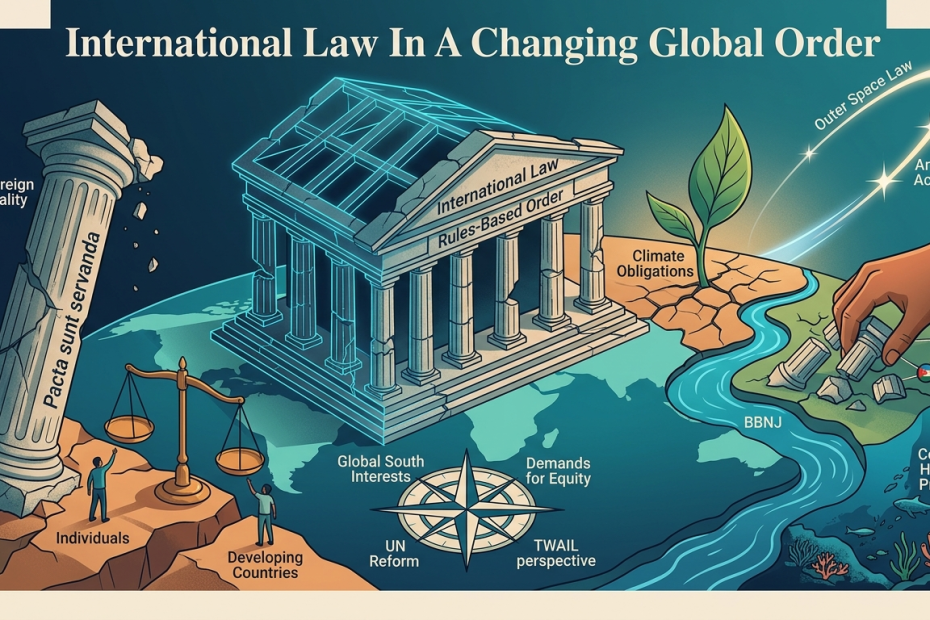
International law provides the legal framework through which states, international organisations and, increasingly, individuals and non-state actors interact across borders. Its importance has expanded beyond traditional questions of treaties and state sovereignty to climate change, oceans, armed conflict, cyberspace, outer space and global economic governance. At the same time, its effectiveness continues to depend on state consent, institutional enforcement and the distribution of power within the international system.
Foundations And Sources Of International Law
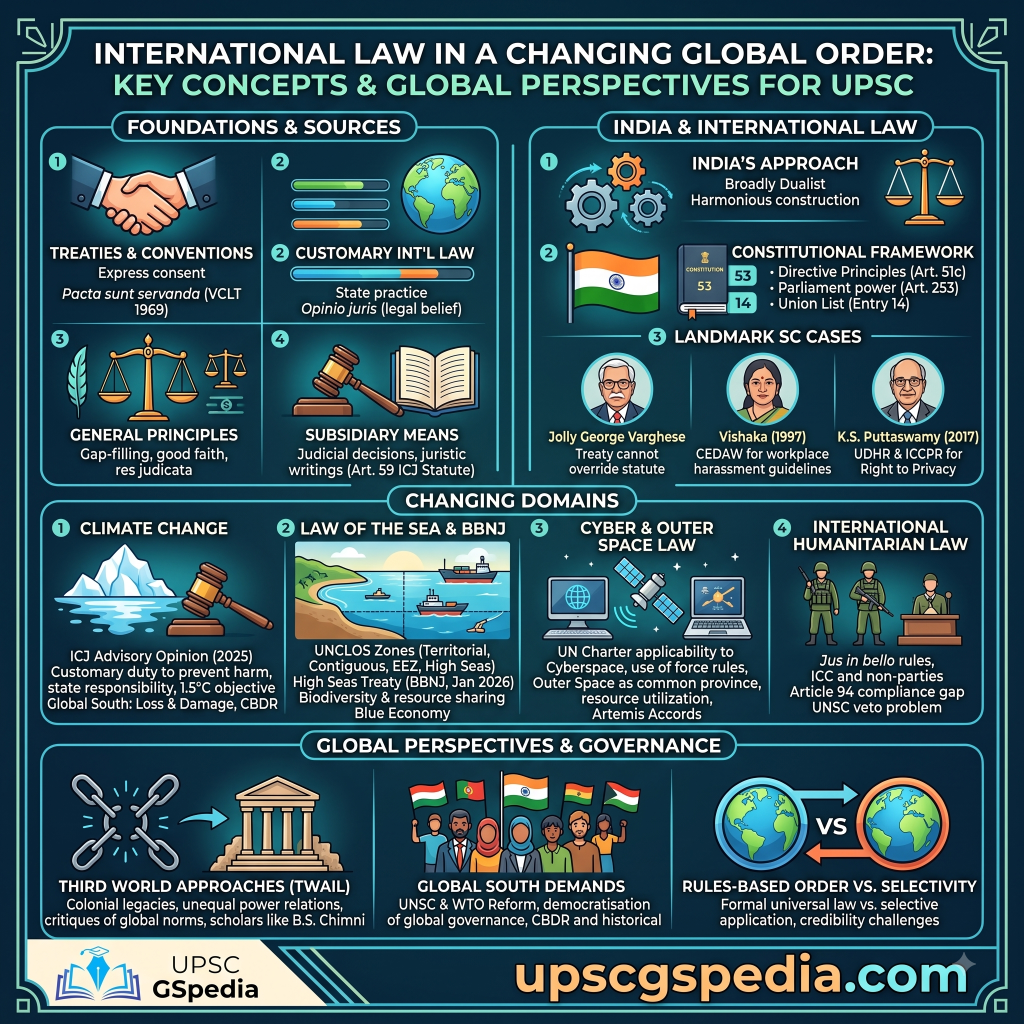
Public international law primarily governs relations among sovereign states and international organisations, while increasingly addressing the rights, duties and conduct of individuals and other non-state actors. Article 38(1) of the Statute of the International Court of Justice provides the principal framework for identifying the sources of international law.
Treaties And International Conventions
- Express consent: Treaties are written agreements through which states expressly consent to international legal obligations.
- Pacta sunt servanda: Treaties in force must be performed in good faith, a principle reflected in the Vienna Convention on the Law of Treaties, 1969.
Customary International Law
- State practice: Customary international law requires sufficiently widespread and consistent conduct by states.
- Opinio juris: State practice must be accompanied by the belief that such conduct is followed because international law requires it.
- Combined requirement: State practice alone does not create customary international law unless it is accompanied by opinio juris.
General Principles Of Law
- Gap-filling function: General principles recognised across legal systems can help international tribunals address issues where treaties and customary international law do not provide a complete rule.
- Important examples: These include good faith, estoppel, res judicata and principles of natural justice.
Judicial Decisions And Juristic Writings
- Subsidiary means: Judicial decisions and scholarly writings serve as subsidiary means for determining rules of international law.
- Effect of ICJ judgments: Under Article 59 of the ICJ Statute, an ICJ decision is binding only between the parties and in respect of the particular case, although its reasoning can possess substantial persuasive authority.
International Law In The Indian Legal System
The relationship between international and domestic law is generally understood through the approaches of monism and dualism.
Monism And Dualism
- Monist approach: Monism views international and domestic law as components of a unified legal system. Under a strongly monist framework, treaty obligations can acquire internal legal effect without separate domestic legislation.
- Dualist approach: Dualism treats international and municipal law as distinct legal orders. International obligations may bind the state externally while requiring domestic legislation before becoming enforceable within the national legal system.
- India’s approach: India broadly follows a dualist approach while also using harmonious construction to interpret domestic law consistently with international obligations where no conflict exists.
Constitutional Framework
- Article 51(c): As a Directive Principle of State Policy, Article 51(c) directs the State to foster respect for international law and treaty obligations in the dealings of organised peoples with one another.
- Article 253: Parliament can make laws for the whole or any part of India to implement treaties, agreements and conventions.
- Union List Entry 14: Entry 14 of the Union List covers entering into treaties and agreements with foreign countries and implementing treaties, agreements and conventions.
- Treaty implementation: Ratification of an international treaty does not automatically make every treaty provision directly enforceable in Indian courts where domestic legislation is necessary for implementation.
Supreme Court Jurisprudence
- Jolly George Varghese case: In Jolly George Varghese v. Bank of Cochin (1980), the Supreme Court held that an international treaty could not override a clear domestic statutory provision without appropriate legislative incorporation.
- Gramophone Company case: In Gramophone Co. of India Ltd. v. Birendra Bahadur Pandey (1984), the Court recognised that customary international law may operate within municipal law when it does not conflict with legislation enacted by Parliament.
- Vishaka case: In Vishaka v. State of Rajasthan (1997), the Supreme Court relied on CEDAW while framing guidelines against workplace sexual harassment in the absence of specific domestic legislation. International conventions consistent with Fundamental Rights could assist constitutional interpretation.
- Puttaswamy case: In K.S. Puttaswamy v. Union of India (2017), international human-rights instruments, including the UDHR and ICCPR, formed part of the wider legal reasoning supporting recognition of privacy as a fundamental right under Article 21.
International Law As A Foreign Policy Tool
- Underused legal capacity: Indian foreign-policy debates have often been dominated by diplomatic and strategic perspectives, with international legal expertise receiving comparatively limited institutional attention.
- Historical contribution: Post-independence India played an important role in debates concerning decolonisation and the development of the post-war international legal system.
- Defensive legal approach: Contemporary diplomacy can sometimes approach international law primarily as a constraint or defensive mechanism rather than using it strategically to protect and advance national interests.
- Strategic lawfare: Greater use of international legal mechanisms can strengthen India’s ability to contest competing claims, shape emerging norms and defend its strategic position, including in maritime disputes.
- Institutional strengthening: Expanding international-law expertise within the Ministry of External Affairs, particularly the Legal and Treaties Division, and strengthening institutions such as the Indian Society of International Law can deepen the integration of law with foreign-policy strategy.
Climate Change And International Legal Obligations
ICJ Advisory Opinion On Climate Change
- Advisory Opinion: The International Court of Justice delivered its Advisory Opinion on the Obligations of States in Respect of Climate Change on July 23, 2025, following a request made through UN General Assembly Resolution 77/276 led by Vanuatu.
- Customary duty to prevent harm: The prevention of significant environmental harm was recognised as a rule of customary international law applicable to the global climate system.
- Due-diligence obligations: Climate action is consequently framed not merely through political commitments but also through legally relevant duties requiring states to exercise appropriate diligence in preventing serious climate harm.
- 1.5°C objective: The 1.5°C temperature objective assumes central importance in assessing the adequacy of state climate action and the diligence expected in designing climate policies and Nationally Determined Contributions.
- Fossil-fuel decisions: Issuing new fossil-fuel exploration licences or maintaining fossil-fuel subsidies can become relevant when determining whether a state has complied with its international climate obligations.
- State responsibility: Breach of applicable climate obligations can engage the international law of state responsibility and raise questions concerning cessation of wrongful conduct and reparation for resulting harm.
Implications For The Global South
- Loss and Damage: The development strengthens the legal basis available to climate-vulnerable countries seeking compensation and other forms of redress for climate-related loss and damage.
- Climate justice: It reinforces arguments that international climate obligations must account for disparities in historical responsibility and developmental capacity.
- Carbon-border measures: The legal development also strengthens scrutiny of unilateral Carbon Border Adjustment Mechanisms where equity considerations affecting developing countries are inadequately addressed.
- Shift towards legal duty: Climate governance is increasingly moving beyond voluntary political pledges towards legal obligations derived from treaties, customary international law and state responsibility.
Law Of The Sea And Ocean Governance
Maritime Zones Under UNCLOS
- Territorial sea: UNCLOS permits coastal states to exercise sovereignty over a territorial sea extending up to 12 nautical miles from the relevant baselines.
- Contiguous zone: The contiguous zone extends up to 24 nautical miles and allows limited enforcement relating to areas such as customs and fiscal laws.
- Exclusive Economic Zone: The EEZ may extend up to 200 nautical miles. The coastal state possesses sovereign rights over natural resources rather than complete territorial sovereignty over the zone.
- High seas: Areas beyond national jurisdiction form part of the international maritime domain governed by rules that seek to reconcile freedom of use with collective interests.
BBNJ Agreement And High Seas Biodiversity
- High Seas Treaty: The Agreement on the Conservation and Sustainable Use of Marine Biological Diversity of Areas Beyond National Jurisdiction addresses gaps in the governance of biodiversity beyond national jurisdiction.
- Entry into force: The Agreement reached the required 60-ratification threshold in September 2025 and entered into force in January 2026.
- Marine genetic resources: It provides for fair and equitable sharing of monetary and non-monetary benefits derived from marine genetic resources obtained from areas beyond national jurisdiction.
- Area-based management: Marine Protected Areas and other area-based management tools can be established to support conservation in areas beyond national jurisdiction.
- Environmental impact assessment: Activities capable of significantly affecting marine environments beyond national jurisdiction are brought within an environmental-assessment framework.
- Capacity and technology: Capacity-building and transfer of marine technology seek to improve the ability of developing countries to participate in ocean science and benefit from marine resources.
Global South And Indian Interests
- North-South divide: Benefit-sharing seeks to address concerns that technologically advanced actors can commercially exploit marine genetic resources while developing countries lack comparable scientific and technological capacity.
- Common heritage principle: Ocean governance beyond national jurisdiction is connected with the broader principle that global commons should not become the exclusive preserve of technologically advanced countries.
- India’s interests: Participation aligns with India’s wider interests in ocean science, the Deep Ocean Mission and its Blue Economy objectives.
International Humanitarian Law And Enforcement
International Humanitarian Law
- Purpose of IHL: International humanitarian law regulates conduct during armed conflict and is built substantially around the four Geneva Conventions of 1949 and their Additional Protocols.
- Jus in bello: IHL governs how hostilities are conducted, separately from the question of whether resort to armed force was lawful.
- Genocide Convention litigation: Proceedings such as South Africa v. Israel have highlighted the role of international adjudication and obligations protecting interests extending beyond ordinary bilateral relations.
- Erga omnes dimension: Certain obligations in international law protect fundamental interests of the wider international community rather than merely reciprocal interests between individual states.
- International Criminal Court: The ICC operates under the Rome Statute of 1998. India, the United States, Russia, China and Israel are not parties to the Statute, creating recurring tensions involving criminal jurisdiction, arrest warrants and national sovereignty.
Compliance And Enforcement Gap
- Article 94 of the UN Charter: Where a party fails to comply with an ICJ judgment, the other party may seek recourse through the UN Security Council.
- Absence of independent enforcement: International courts generally lack coercive machinery comparable to that available to domestic courts.
- P5 veto problem: When enforcement requires Security Council action, veto powers held by permanent members can prevent an effective institutional response.
- Credibility challenge: A gap can therefore emerge between authoritative judicial decisions and actual compliance, particularly where major powers or their strategic allies are involved.
- Universal jurisdiction: Domestic courts employing principles of universal jurisdiction can provide an alternative avenue in cases involving serious international crimes when multilateral enforcement mechanisms prove ineffective.
Cyber And Outer Space Law
International Law In Cyberspace
- Application of existing law: The UN Group of Governmental Experts and Open-Ended Working Group have affirmed the applicability of existing international law to state conduct in cyberspace.
- Prohibition on force: Article 2(4) of the UN Charter is relevant in assessing when cyber operations might amount to an unlawful use of force.
- Self-defence: Article 51 raises the corresponding question of when a sufficiently serious cyber operation could engage the right of self-defence.
- Attribution challenge: Determining when cyber conduct can legally be attributed to a state remains central to questions of responsibility and permissible countermeasures.
- Tallinn Manual 2.0: Although non-binding, it provides an influential scholarly framework for examining how existing international legal rules apply to cyber operations.
Outer Space Law
- Outer Space Treaty: The 1967 Outer Space Treaty describes outer space as the province of all mankind and rejects national appropriation through claims of sovereignty.
- Military restrictions: It prohibits the placement of weapons of mass destruction in orbit while establishing broader principles governing state activities in outer space.
- Artemis Accords: The non-binding Artemis Accords introduce operational concepts involving issues such as safety zones and extraction of space resources.
- India’s participation: India joined the Artemis Accords in 2023.
- Emerging legal friction: New approaches towards resource utilisation and operational coordination create questions about their relationship with traditional interpretations of the Outer Space Treaty and approaches advanced by other space powers.
International Law And The Global South
International Law And The Rules-Based Order
- Formal international law: Public international law is grounded in recognised legal sources such as the UN Charter, treaties, customary international law and general legal principles.
- Sovereign equality: Its formal structure rests on the legal equality of states despite major differences in their political, military and economic power.
- Rules-based international order: The rules-based international order represents a broader political and normative concept associated with post-Second World War institutions, alliances and practices.
- Global South critique: Critics argue that references to a rules-based order can sometimes permit powerful states to invoke standards developed outside universal UN-based mechanisms.
- Selective application: Applying international norms selectively according to geopolitical interests can weaken the legitimacy of both international institutions and the wider legal order.
Third World Approaches To International Law
- TWAIL perspective: Third World Approaches to International Law examines international law through the experiences of colonialism, unequal power relations and developing societies.
- Colonial foundations: TWAIL scholars argue that important elements of classical international law developed alongside European imperial expansion and helped legitimise unequal political and economic relationships.
- Continuing inequalities: International regimes involving trade, intellectual property and global finance are criticised for reproducing structural advantages enjoyed by industrialised countries.
- Rules-based order debate: TWAIL questions whether supposedly universal international norms are always created and applied through genuinely inclusive processes.
- Prominent scholars: B.S. Chimni is an important Indian scholar associated with TWAIL, alongside wider Third World scholarship represented by figures such as Makau Mutua.
- South-South cooperation: Greater legal cooperation among developing countries can improve their collective ability to demand reform of international institutions.
- Climate justice: Principles such as Common But Differentiated Responsibilities seek to reconcile universal environmental obligations with differences in historical responsibility and developmental capacity.
- Economic governance: Demands involving WTO reform, dispute settlement and protection of food-security interests reflect wider Global South concerns about equity in international economic law.
- UN reform: Democratisation of global governance, including reform of the UN Security Council, forms part of efforts to reduce structural inequalities within multilateral institutions.
Conclusion
International law is evolving from a system primarily concerned with treaties, sovereignty and inter-state relations into a wider framework governing shared challenges such as climate change, biodiversity, cyber operations, armed conflict and outer-space activity. Yet legal development by itself cannot ensure effective global governance.
The credibility of international law ultimately depends on consistent application, equitable institutions and meaningful compliance. For India, international law is therefore both a legal framework and a strategic resource for protecting national interests, strengthening multilateralism and advancing a more representative global order.
UPSC Prelims Relevance
- Sources of international law: Article 38(1) of the ICJ Statute, treaties, customary international law, general principles, judicial decisions and juristic writings.
- Customary international law: State practice and opinio juris.
- Indian Constitution: Articles 51(c) and 253 and Entry 14 of the Union List.
- Important cases: Jolly George Varghese, Gramophone Company, Vishaka and K.S. Puttaswamy.
- Law of the Sea: Territorial sea, contiguous zone, EEZ and high seas under UNCLOS.
- BBNJ Agreement: Marine genetic resources, benefit-sharing, Marine Protected Areas, environmental impact assessments and technology transfer.
- Climate law: Paris Agreement, NDCs, customary obligations and the ICJ Advisory Opinion on climate change.
- International humanitarian law: Geneva Conventions, ICJ, ICC and Rome Statute.
- Cyber law: UN Charter principles, UN GGE, OEWG and Tallinn Manual 2.0.
- Outer-space law: Outer Space Treaty and Artemis Accords.
UPSC Mains Relevance
GS Paper II: International Relations; international institutions, agencies and fora; treaties and agreements affecting India’s interests; India’s foreign-policy strategy; reform of global governance institutions.
GS Paper III: Environmental conservation and climate change; ocean governance and Blue Economy; emerging technologies; cyber issues and outer-space governance.
- International law and national interest: Examine how India can use international legal expertise as an instrument of diplomacy and strategic policy.
- Law versus power: Analyse why international courts may produce authoritative decisions while enforcement remains constrained by geopolitics and the UNSC veto.
- Global South and legal reform: Use TWAIL to examine colonial legacies, institutional inequalities and demands for more representative multilateral governance.
- Global commons: Connect the BBNJ Agreement, climate obligations and outer-space governance with questions of equity, benefit-sharing and sustainable use.
- Evolution of legal obligations: Examine the movement from voluntary norms and soft-law commitments towards treaty obligations, customary duties and state responsibility.