Context
- The article questions whether increasing Lok Sabha seats automatically improves representation and argues that democratic responsiveness depends more on institutional capacity, local governance, and implementation choices than on population arithmetic alone.
- Source: “Beyond the population arithmetic: Do more MPs really mean better representation?”, The Indian Express, April 19, 2026.
Population Arithmetic and the Delimitation Debate
- Proposed Expansion: Proposals are being discussed to raise the Lok Sabha ceiling from 543 to 850 seats through a new Delimitation Commission using the 2011 Census.
- Core Critique: Public debate is trapped in the assumption that more people must automatically mean more MPs.
- Deeper Question: The article asks whether a large and potentially permanent institutional expansion is justified when India’s population is projected to peak in the early 2060s and then decline.
- Temporary Demography, Permanent Reform: The concern is that a time-bound demographic phase may produce an irreversible constitutional restructuring.
Representation Is Not Only About Headcount
- Arithmetic Temptation: “People per MP” is treated as the sole measure of representation.
- False Necessity: Recognition of unequal constituency size does not automatically make an across-the-board expansion to 850 the best solution.
- Access Dimension: Representation also depends on how citizens reach their representatives and how grievances are communicated and addressed.
- Changed Conditions: Compared with the post-Independence decades, mobility, connectivity, telephony, and digital communication have sharply increased access.
- Main Point: The service capacity benchmark of 1971 cannot simply be carried forward to 2026.
Representation Needs Institutional Capacity
- Large Constituency Size: Average constituency size in 2011 is noted as over 2.2 million persons.
- Multi-tier Democracy: India already has a vast representative structure below Parliament.
- Existing Architecture: The article cites over 250,000 Panchayats, about 3,700 urban local bodies, and more than 3 million local elected representatives.
- Core Problem: The issue is not an absolute shortage of elected offices, but weak distribution of authority, finances, and service-delivery capacity across levels of government.
- Policy Direction: Citizen responsiveness may depend as much on effective local institutions as on the size of Parliament.
Women’s Representation and the Wrong Justification for Expansion
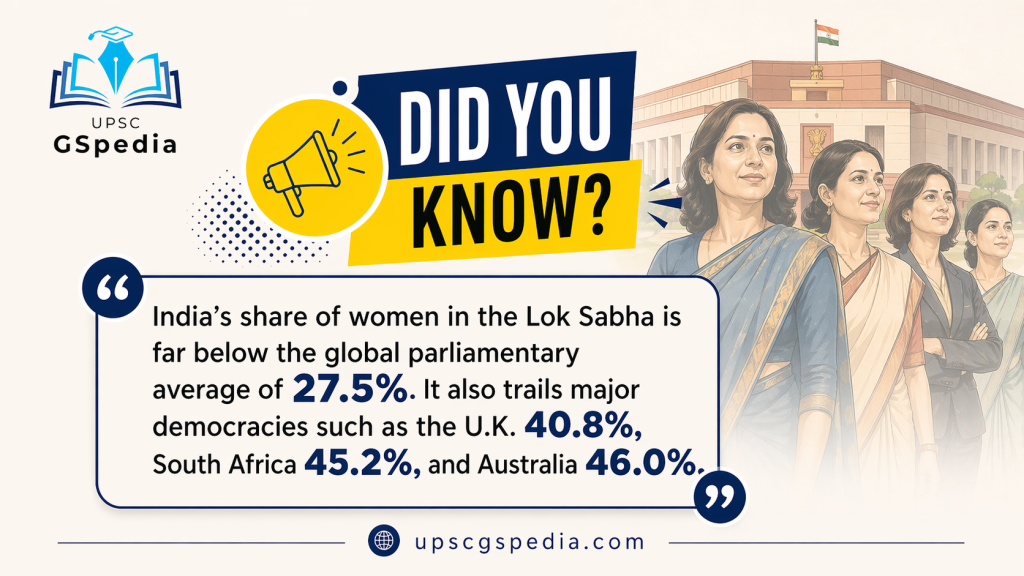
- Weak Second Argument: Lok Sabha expansion is sometimes defended as a way to improve women’s representation.
- Current Position: After the 2024 Lok Sabha elections, 74 women were elected, making up 13.6 per cent of MPs, lower than in the previous House.
- Comparative Gap: The article cites women’s representation as 46 per cent in South Africa, 35 per cent in the UK, and 29 per cent in the US.
- Real Bottleneck: The problem lies in party nominations, winnability, implementation, and political will, not in the number of seats.
- Reservation Logic: Since one-third reservation has already been passed but not implemented, the delay is institutional and political rather than arithmetic.
- Risk Identified: Expansion may become a distraction from the actual reforms needed for women’s representation.
Importance of Grassroots Democracy
- Existing Women’s Leadership: Reservation in Panchayats has already brought over 1 million women into formal political leadership roles.
- Pipeline Argument: The issue is not merely finding women leaders, but enabling transition of this leadership into higher tiers.
- Practical Alternative: Rather than focusing only on expanding Parliament, democratic effectiveness should be deepened where elected density is already highest.
- Scale Advantage: Parliament cannot replicate the accountability density already present in local bodies, even if expanded to 850 seats.
- Article’s Emphasis: Strengthening local institutions should be part of the response to representation concerns, not an afterthought.
Why a Larger Parliament May Not Be the Best Reform
- Alternative Reform Path: The article favours a calibrated package of targeted boundary rationalisation, stronger institutions, greater use of technology, and a deeper role for local government.
- Federal and Fiscal Stakes: Seat expansion would shape federal balance and the weight of votes for decades.
- One-Way Door Concern: Once seats are created, they are unlikely to be reduced even if demographic conditions later change.
- Burden of Proof: Because the institutional trade-offs are long-term, the justification for expansion must be stronger than temporary population pressure.
- Final Warning: A permanent fiscal and federal redesign should not be locked in on the basis of a temporary demographic moment.
Women’s Representation in Parliament: India in Comparative Perspective
India’s Position
- Lok Sabha: Women account for 13.6%–13.8% of the House, depending on whether one uses the figure of 74 women elected out of 543 seats or the IPU’s current sitting-strength snapshot of 75 women out of 542 members.
- Global rank: India stands at 147th in the IPU’s April 2026 ranking of women’s representation in lower or single chambers.
- Recent trend: The 18th Lok Sabha records a slight decline from the 17th Lok Sabha, which had 78 women members, the highest so far.
Comparison with Major Democracies: Lower House
| Country | Women’s Representation |
|---|---|
| India | 13.8% |
| Japan | 14.6% |
| Brazil | 17.2% |
| United States | 28.7%–28.8% |
| Canada | 30.0% |
| Germany | 32.5% |
| France | 36.2% |
| United Kingdom | 40.8% |
| South Africa | 45.2% |
| Australia | 46.0% |
Comparative Pattern
- Closer grouping: India is positioned closer to Japan and Brazil than to the leading democracies in this group.
- Large gap with major democracies: It remains well behind the U.K., France, Germany, Canada, Australia, and South Africa.
- Scale of difference: The U.K. is about 27 percentage points ahead of India, while Australia and South Africa are more than 30 percentage points ahead, based on current IPU lower-house figures.
Upper House Context
- Rajya Sabha: India’s Rajya Sabha has a lower share of women than several peer democracies’ upper chambers.
- Recent comparison: Recent reporting places women’s share in the Rajya Sabha at roughly 17%, compared with about 57% in Australia’s Senate, about 55% in Canada’s Senate, and 31.5% in the U.K. House of Lords.
Global Context
- World average: Women held 27.5% of parliamentary seats worldwide as of 1 January 2026.
- India’s position: India’s lower-house representation is therefore well below the global average.
Overall Picture
- Low representation: India’s women’s representation in Parliament remains low by both global and major-democracy standards.
- Central fact: India has around 13.6%–13.8% women in the Lok Sabha, ranks 147th globally, and trails most major democracies by a wide margin.
UPSC Prelims Quiz
Practice exam-oriented current affairs questions daily and track your preparation effectively.
Attempt Quiz →