
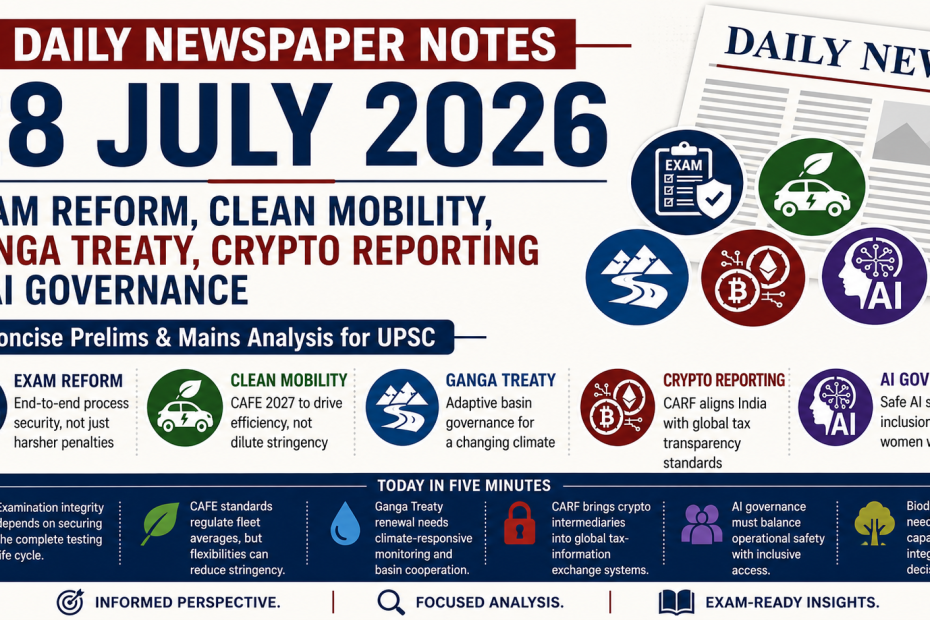
Today’s Daily Newspaper Notes examine how public institutions can translate formal rules into credible outcomes. Examination reform requires end-to-end process security, while CAFE 2027 tests whether fleet-efficiency regulation can accelerate cleaner mobility without being diluted by cumulative flexibilities. The approaching Ganga Treaty expiry raises questions of adaptive basin governance; crypto reporting extends tax transparency to decentralised assets. A consolidated AI brief links containment of autonomous systems with the inclusion of women in informal work. Biodiversity, heritage, astronomy, legislative digitisation, school nutrition and services statistics supply focused Prelims value.
Today in Five Minutes
Examination integrity depends on securing the complete testing life cycle; harsher penalties cannot compensate for weak detection, forensics or grievance redress.
CAFE standards regulate a manufacturer’s sales-weighted fleet average, but carbon-neutrality factors, super credits and credit buyouts can reduce effective stringency.
The Ganga Treaty’s renewal should preserve predictable dry-season entitlements while adding climate-responsive monitoring and basin-risk cooperation.
CARF brings crypto intermediaries into an international system of user identification, transaction reporting and automatic tax-information exchange.
AI governance must address both operational risks from autonomous agents and the exclusion of informal women workers from productivity-enhancing tools.
Biodiversity implementation remains constrained by inadequate finance, institutional capacity and integration into economic decision-making.
Article Published Today
Reforming India’s Public Examination System beyond Harsher Penalties
Section: Polity and Governance
India’s examination crisis requires end-to-end process security, stronger NTA capacity and transparent implementation; higher punishments can deter organised leaks but cannot substitute for institutional reform.
Reimagining The India–Bangladesh Ganga Water Treaty
Section: International Relations
The expiring Ganga Water Treaty offers an opportunity to replace narrow dry-season allocation with climate-responsive cooperation covering basin data, floods, ecosystems, navigation and federal interests.
CAFE 2027 and India’s Transition to Cleaner Mobility
Section: Environment
India’s proposed fleet-efficiency framework combines progressively tighter targets with technology credits, trading and buyouts, raising a fundamental question about whether regulatory flexibility will accelerate or postpone electrification.
India Aligns Crypto-Asset Reporting with the OECD’s CARF
Section: Economy
India’s new reporting framework makes crypto intermediaries identify users, establish tax residence and report transactions, enabling systematic exchange of information with foreign tax authorities.
Governing AI for Operational Safety and Inclusive Growth
Section: Science and Technology
AI governance must contain autonomous-system risks while ensuring that safe, multilingual and livelihood-relevant tools reach women concentrated in agriculture and other forms of informal employment.
Prelims Facts from Micro News
Global Biodiversity Action under the Kunming–Montreal Framework
News Context: A draft global assessment considered at CBD meetings in Nairobi concludes that present ambition and implementation are inadequate for achieving most biodiversity targets by 2030.
Core Source Trigger: “Nairobi meetings 2026: Draft report indicates slow progress towards meeting biodiversity targets,” Down To Earth, July 27, 2026.
Key Prelims Facts
- The framework contains four long-term goals for 2050 and 23 targets for 2030.
- It was adopted under the Convention on Biological Diversity in 2022.
- The draft assessment draws upon 129 national reports and 80 National Biodiversity Strategies and Action Plans.
- Target 19 seeks mobilisation of at least $200 billion annually from all sources by 2030.
- SBSTTA provides scientific advice; the Subsidiary Body on Implementation examines implementation.
- The Cartagena Protocol concerns biosafety, while the Nagoya Protocol governs access and benefit-sharing.
Prelims Trap: The framework is a CBD decision framework, not a separate treaty replacing the Convention.
Ancient Buddhist Site of Sarnath
News Context: The Ancient Buddhist Site of Sarnath was inscribed on the UNESCO World Heritage List at the World Heritage Committee’s 48th session, becoming India’s 45th listed property.
Core Source Trigger: “Ancient Buddhist Site of Sarnath Inscribed in the UNESCO World Heritage List,” PIB, July 25, 2026.
Key Prelims Facts
- Sarnath lies near Varanasi and is associated with the Buddha’s first sermon after enlightenment.
- The event is traditionally called Dharmachakra Pravartana.
- UNESCO inscribed the property under criteria (iii) and (vi).
- Dhamek Stupa marks the traditional location of the first sermon.
- The Ashokan Lion Capital from Sarnath became India’s State Emblem.
- Sarnath is distinct from Bodh Gaya, which is associated with the Buddha’s enlightenment.
Prelims Trap: The World Heritage List, Intangible Cultural Heritage lists and Memory of the World Register are separate UNESCO mechanisms.
Forming Blue Straggler in Collinder 261
News Context: Astronomers reported direct evidence of a blue straggler receiving matter from a stellar companion in the old open cluster Collinder 261.
Core Source Trigger: “Astronomers discover an actively forming luminous blue straggler star,” PIB, July 27, 2026.
Key Prelims Facts
- Blue stragglers appear hotter, brighter and more massive than stars at the main-sequence turn-off of the same cluster.
- Their apparently younger condition can arise through collision, merger or binary mass transfer.
- TIC 327546480 is a semidetached binary in which one star fills its Roche lobe.
- The blue straggler has approximately 1.67 solar masses, while the donor has about 0.32 solar mass.
- TESS light curves and Very Large Telescope radial-velocity observations supplied complementary evidence.
- Strong X-ray emission supported the inference of active accretion.
Prelims Trap: A blue straggler need not be a recently formed star; mass gain can make an older star appear anomalously young.
National e-Vidhan Application
News Context: The Ministry of Parliamentary Affairs reported that 33 of 37 State and Union Territory legislatures had signed MoUs for NeVA and 21 Houses were functioning as digital legislatures.
Core Source Trigger: “NeVA has improved the efficiency of legislative functioning through digitization,” PIB, July 27, 2026.
Key Prelims Facts
- NeVA digitises notices, questions, Bills, committee material, debates and other House business.
- It is implemented by the Ministry of Parliamentary Affairs through a Central Project Management Unit.
- Funding follows the Centrally Sponsored Scheme pattern.
- State legislatures retain constitutional autonomy; implementation requires consultation and an MoU.
- Standardised digital access does not transfer the functions of State legislatures to Parliament.
- Digitisation alone does not guarantee timely, complete or searchable disclosure.
Prelims Trap: NeVA is neither an online voting system for citizens nor a mechanism for merging State legislatures with Parliament.
PM POSHAN Nutritional and Food Norms
News Context: A parliamentary reply reiterated the statutory and scheme-level nutritional norms applicable to hot cooked meals provided under PM POSHAN.
Core Source Trigger: “Nutritional Standards under the PM POSHAN Scheme,” PIB, July 27, 2026.
Key Prelims Facts
- PM POSHAN covers eligible children in Bal Vatika and Classes I–VIII in government and government-aided schools.
- Primary children are to receive 450 calories and 12 grams of protein per meal.
- Upper-primary children receive 700 calories and 20 grams of protein.
- The daily foodgrain norms are respectively 100 grams and 150 grams.
- States and Union Territories determine menus within prescribed nutritional norms.
- Meal entitlements are supported by the National Food Security Act, 2013.
Prelims Trap: PM POSHAN provides cooked meals to specified schoolchildren; it is not a general household foodgrain-distribution programme.
Index of Services Production and Enterprise Surveys
News Context: MoSPI clarified the distinct coverage of the trial Index of Services Production, ASISSE and ASUSE after releasing India’s first trial monthly services-production series.
Core Source Trigger: “For measuring unincorporated sector of the economy, Ministry undertakes Annual Survey of Unincorporated Sector Enterprises,” PIB, July 27, 2026.
Key Prelims Facts
- The trial ISP has base year 2024-25 and initially covers 19 formal-service subsectors.
- It uses monthly GST outward-supply data and other administrative records.
- Current-price data require deflation to distinguish output-volume changes from price changes.
- ASISSE covers incorporated service-sector enterprises.
- ASUSE measures unincorporated non-agricultural establishments, excluding construction.
- An index measures relative change from a base period; it does not directly provide total monetary output.
Prelims Trap: ISP, ASISSE and ASUSE have different coverage and are not interchangeable estimates of the entire services economy.
Mains Practice Questions
Higher criminal penalties cannot by themselves restore credibility to India’s public examinations. Analyse the institutional, technological and procedural reforms required to secure the complete testing life cycle.
Distinguish statutory deterrence from the probability of detection and conviction.
Examine institutional capacity, vendor dependence, authentication and normalisation.
Recommend audit, grievance-redress and implementation-accountability mechanisms.
Regulatory flexibility can lower the cost of meeting vehicle-efficiency standards, but excessive flexibility may substitute paper compliance for technological transformation. Evaluate with reference to CAFE 2027.
The renewal of the India–Bangladesh Ganga Water Treaty requires a transition from fixed volumetric bargaining to adaptive basin governance. Examine.
AI governance must address both frontier operational risks and the unequal distribution of technological benefits. Analyse with reference to agentic systems and women in informal employment.
International biodiversity agreements increasingly face an implementation deficit rather than a target deficit. Evaluate the roles of finance, sectoral policy and measurable accountability.
UPSC Prelims Quiz
Practice exam-oriented current affairs questions daily and track your preparation effectively.
Attempt Quiz →