
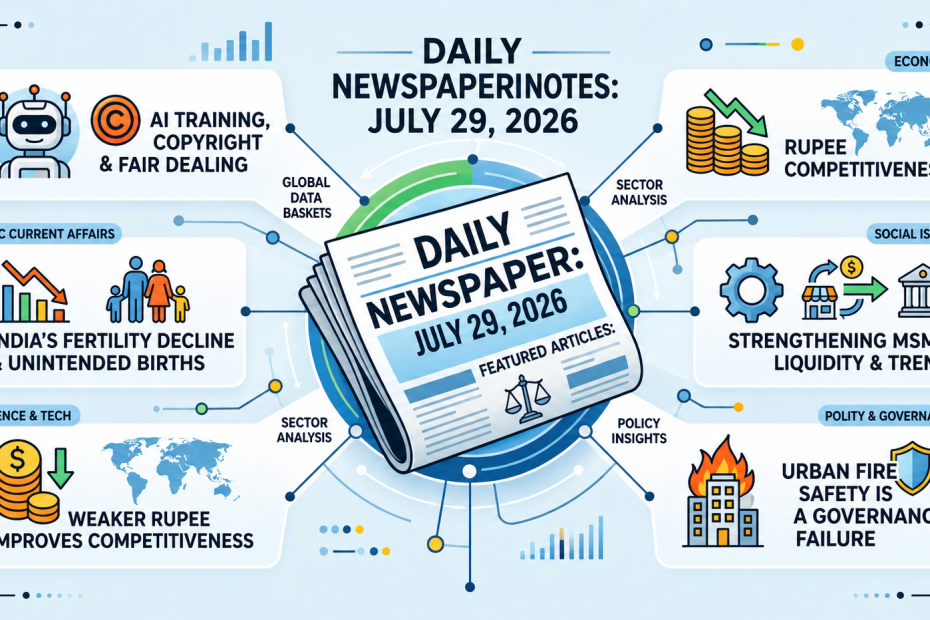
Today’s Daily Newspaper Notes examine the gap between policy outcomes and institutional quality. The Delhi High Court’s interim AI-copyright ruling tests fair dealing and creator compensation. India’s low fertility conceals unintended births, early childbearing and an excessive reliance on terminal contraception.
A weaker real effective exchange rate may improve competitiveness, while MSME reform targets delayed payments. Recurrent urban fires reveal failures of enforcement and municipal accountability. Environmental notes shift attention from sapling counts and reserve boundaries towards ecological restoration, wildlife corridors and coexistence in shared landscapes.
Today in Five Minutes
The Delhi High Court’s AI-training ruling is interim and fact-specific; it does not create an unconditional copyright exemption.
India’s TFR of 2.0 exceeds its wanted fertility rate of 1.6, indicating that aggregate fertility still includes unintended births.
A weaker REER may improve export prices but can simultaneously increase imported inflation and external-debt costs.
The MSME Amendment Bill combines TReDS-based invoice settlement with time-bound dispute resolution and stronger recovery.
Recurrent urban fires reflect fragmented regulation, tolerated illegality and weak municipal authority rather than an absence of safety rules.
Tiger dispersal and plantation failure show why conservation must extend beyond reserve boundaries and sapling-count targets.
Articles Published Today
AI Training, Copyright and the Limits of Fair Dealing
Section: Science and Technology
The Delhi High Court’s interim ruling protects OpenAI’s training use on the present evidence, but leaves unresolved the wider policy choice between unlicensed data mining and creator-remuneration models.
India’s Fertility Decline Masks Unintended Births
Section: Social Issues
India’s TFR of 2.0 conceals a lower wanted fertility rate, early childbearing, contraceptive-method imbalance and births influenced by unmet need and son preference.
When a Weaker Rupee Improves Competitiveness
Section: Economy
India’s REER has moved below its base-year level, potentially improving price competitiveness; the benefit remains conditional on export capacity, global demand and control of imported inflation.
Urban Fire Safety Is a Governance Failure, Not a Legal Vacuum
Section: Polity and Governance
Repeated urban fires expose a regulatory system in which fragmented authority, political protection and weak municipal capacity allow known building and fire-safety violations to persist.
Prelims Facts From Micro News
Plantation Survival and Joint Forest Management
News Context: West Bengal has announced a target of planting 7.2 crore saplings during 2026 with two years of aftercare. An editorial argues that survival, biodiversity and community stewardship are more meaningful measures than plantation numbers.
Core Source Trigger: “The way forward for West Bengal’s greening,” The Hindu, July 29, 2026.
Key Prelims Facts
- West Bengal contains Himalayan forests, lateritic sal tracts and the Sundarbans mangrove ecosystem; a uniform plantation model cannot serve every landscape.
- Forest restoration seeks to recover ecological structure, functions and native biodiversity, whereas plantation may create a stand of trees without restoring the original ecosystem.
- Arabari in Paschim Medinipur became an early model of participatory sal-forest regeneration and influenced Joint Forest Management.
- JFM involves forest departments and local committees sharing protection responsibilities and specified benefits.
- Forest cover and tree cover are separately assessed by the Forest Survey of India.
- The proposed “30/70” division between planting and maintenance is an editorial recommendation, not an existing statutory budget rule.
Prelims Trap: Saplings planted, saplings surviving, tree cover and ecologically functional forest cover are not interchangeable indicators.
Tigers Outside Tiger Reserves
News Context: The Tigers Outside Tiger Reserves initiative seeks to develop a landscape-based system for managing tiger dispersal and human–tiger interactions beyond formally notified reserves.
Core Source Trigger: “Co-existing with tigers outside reserves,” The Hindu, July 29, 2026.
Key Prelims Facts
- India had 58 tiger reserves covering approximately 85,000 sq km by 2025.
- The 2022 estimation placed the country’s average tiger population at 3,682.
- The National Tiger Conservation Authority is a statutory body under the Wild Life (Protection) Act, 1972.
- A tiger reserve contains core or critical tiger habitat and a buffer or peripheral area under Section 38V.
- The new initiative does not automatically convert participating territorial forest divisions into tiger reserves.
- Its principal components include monitoring, rapid-response capacity, rescue infrastructure, community engagement and timely compensation.
Prelims Trap: Tiger presence outside a Tiger Reserve does not mean that the land is legally part of a Tiger Reserve or that the animal has moved outside all forest habitat.
Modelling Human–Elephant Interactions in the Southern Western Ghats
News Context: A July 2026 study combined community interviews, satellite land-cover information and ecological models to examine how rainfall, water and land-use change may alter reported elephant occurrence by 2030.
Core Source Trigger: “There could be more elephant-human encounters in India during the next four years, predicts study,” Down To Earth, July 28, 2026.
Key Prelims Facts
- The Asian elephant’s scientific name is Elephas maximus.
- The study covered communities near Bandipur and Nagarahole and in Kerala’s Palakkad and Mannarkkad forest divisions.
- Reported occurrence identifies places where respondents encountered elephants; it does not independently establish herd size or migration routes.
- Rainfall was the strongest environmental correlate in both studied States.
- Proximity to protected areas and water bodies was associated with higher reported occurrence.
- Habitat fragmentation can create irregular interfaces between elephants, farms, settlements and infrastructure.
Prelims Trap: A statistical association between rainfall and reported encounters does not prove that rainfall alone causes conflict or predict the movement of individual elephants.
Houbara Bustard and the Aral Sea Landscape
News Context: Uzbekistan and its partners released 672 captive-bred Asian houbara bustards in Karakalpakstan in June 2026 as part of a wider restoration programme.
Core Source Trigger: “Vulnerable bustard species being captive-bred and released to restore Aral Sea,” Down To Earth, July 28, 2026.
Key Prelims Facts
- The Asian houbara is Chlamydotis macqueenii and is classified as Vulnerable on the IUCN Red List.
- It is a migratory species dependent on desert and semi-arid habitats across national boundaries.
- The Aral Sea is an endorheic basin without natural drainage into an ocean.
- It was principally supplied by the Amu Darya and Syr Darya.
- Irrigation diversions caused severe shrinkage and contributed to formation of the Aralkum Desert.
- Karakalpakstan is an autonomous republic in western Uzbekistan.
Prelims Trap: The Asian houbara and India’s Great Indian Bustard are different species, although both belong to the bustard family.
Bharat 6G Alliance and International Standard-Setting
News Context: The Communications Ministry reviewed the Bharat 6G Alliance on July 28, highlighting research, standardisation and India’s participation in the 3rd Generation Partnership Project.
Core Source Trigger: “Union Minister for Communications reviews progress of Bharat 6G Alliance,” PIB, July 28, 2026.
Key Prelims Facts
- The Bharat 6G Alliance is a multi-stakeholder platform; it is not a statutory regulator.
- Its working groups cover technology, spectrum, devices, applications, sustainability, outreach and commercial use cases.
- The ITU uses “IMT-2030” for the framework associated with the next generation of mobile communications.
- 3GPP develops specifications through collaboration among recognised standards organisations.
- TSDSI is India’s telecommunications standards-development organisation.
- Standard-essential patents cover technologies required to implement an adopted standard.
Prelims Trap: Neither the Bharat 6G Alliance nor 3GPP allocates spectrum in India.
Mains Practice Questions
AI training challenges the distinction between learning from protected works and substituting for their protected expression. Analyse the legal and policy safeguards required to balance innovation with creator rights.
Distinguish training inputs, model parameters, retrieval and generated outputs.
Examine fair dealing, market harm and public interest.
Evaluate text-and-data-mining exceptions, opt-outs and remuneration models.
India’s achievement of replacement-level fertility does not necessarily imply that women have achieved reproductive autonomy. Examine.
Fatal urban fires persist despite building codes, fire-clearance systems and inspection authorities. Analyse the institutional reasons for this implementation failure.
A depreciated real effective exchange rate can improve price competitiveness but cannot substitute for productivity and domestic value addition. Evaluate.
Digital invoice financing can ease MSME liquidity constraints, but it cannot by itself eliminate delayed payments. Discuss the complementary institutional reforms required.
UPSC Prelims Quiz
Practice exam-oriented current affairs questions daily and track your preparation effectively.
Attempt Quiz →