
Current affairs preparation should help an aspirant see connections. Too often, it does the opposite: newspapers accumulate, PDFs multiply, and revision becomes harder than the original reading. The Policy & Issues Brief was created to offer a more disciplined middle path – selective enough to save time, but detailed enough to build understanding.
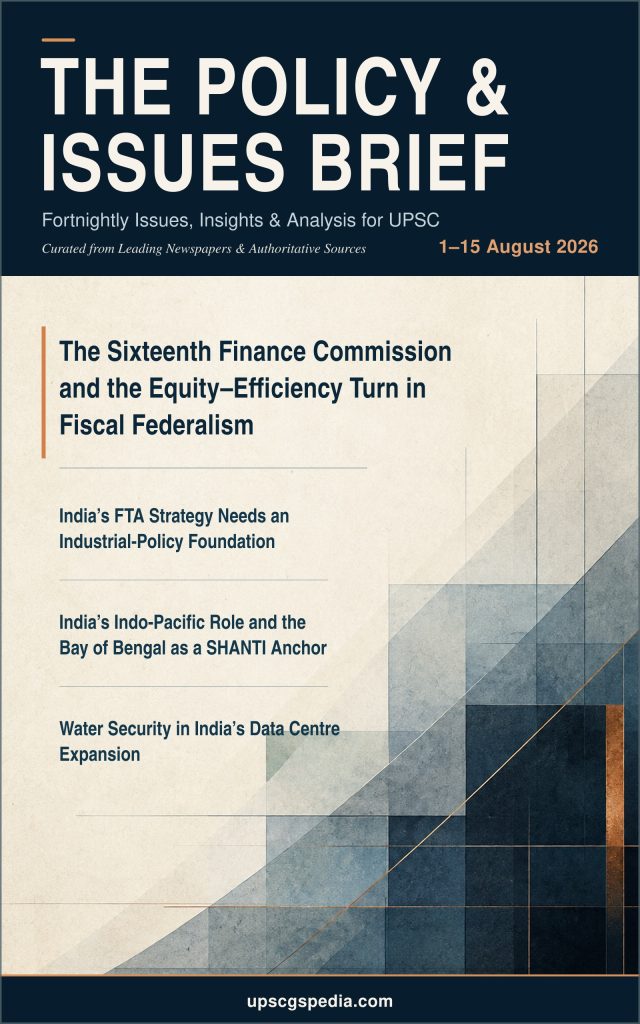
The 1–15 August 2026 edition of The Policy & Issues Brief: Fortnightly Issues, Insights & Analysis for UPSC is now available on Amazon Kindle. Curated from leading newspapers and authoritative sources, it brings the fortnight’s most consequential public-policy debates into one structured, exam-relevant volume.
What this edition contains
This edition covers 115 carefully selected topics across Polity and Governance, Economy, International Relations, Environment and Ecology, Science and Technology, Social Issues, and Internal Security. The coverage is organised into 36 Lead Notes, 40 Digest Notes and 39 Prelims Facts from Micro News.
That structure is deliberate. Lead Notes examine major debates in depth. Digest Notes consolidate important developments that need context but not excessive length. Micro-news entries isolate the facts, institutions, places, species, technologies and legal provisions that are easy to miss in daily reading but valuable for Prelims revision.
The notes move beyond a summary of what happened.
They connect current developments with constitutional provisions, laws, institutions, economic concepts, scientific mechanisms and policy trade-offs. Where directly relevant, the edition also includes Prelims focus points, Mains answer-enrichment material and related UPSC Previous Year Questions.
Major Themes Covered In The 1–15 August Edition
Constitution, governance and federalism
The Polity and Governance section examines whether fast-track courts can deliver speedy justice without wider judicial capacity; how the Sixteenth Finance Commission balances equity and efficiency in fiscal transfers; the constitutional controversy surrounding Money Bill certification; and the federal implications of delimitation after 2026. It also covers tribunal independence, parliamentary disruption, inter-State boundary settlement, legislative privilege, river-basin governance and the relationship between environmental jurisprudence and judicial review.
Economy, production and the future of work
The Economy section ranges from offshore exploration, energy security and critical minerals to agricultural support, industrial competitiveness and the changing labour market. It explains why Free Trade Agreements need an industrial-policy foundation, how industrial heat can be electrified, what the April–June 2026 PLFS signals, and why MSME clusters and delayed-payment reform matter. UPI at ten, the sustainability of zero-MDR payments, rupee internationalisation, the digital rupee for food subsidies, the Government e-Marketplace and the AI transition in youth employment receive focused treatment.
India’s external environment
The International Relations coverage follows India’s strategic choices across the Indo-Pacific, the Bay of Bengal and the Arctic. It explores the continuing relevance of international law, the need for ecological renewal of the Ganges Water Treaty, strategic hedging in West Asia, the instrumentalisation of migration around Ceuta, India–Israel defence cooperation, Europe’s evolving role within NATO and the wider challenge of building strategic resilience amid trade, energy and sanctions risks.
Climate, conservation and resource governance
Environment and Ecology receives especially wide coverage. The edition considers connected landscapes beyond protected areas, Himalayan forest-fire governance, the water footprint of data centres, organic-waste value chains, the slowing of Zanskar glaciers, solid-waste management and Assam’s flood vulnerability. Other notes examine land-efficient solar power, Asiatic lion recovery, forest diversion, eutrophication in urban lakes, E20 ethanol, compressed biogas, Mising flood resilience, migratory-bird flyways, water-wise cities, ocean warming, the Ganga floodplain and a rich set of species and conservation developments.
Science, technology and emerging capability
The Science and Technology section explains how vitrimers could turn mixed milk-packet waste into higher-value material, why AI capability depends on a national innovation system, and what full-flow staged combustion means for India’s private space sector. It also covers India–US lunar cooperation and the emerging lunar order, agentic AI and cybersecurity, lab-grown diamonds, planned re-entry rules for launch vehicles, Bharat Small Reactors and the scientific value of a total solar eclipse.
Social policy and inclusion
The Social Issues section keeps the human consequences of policy at the centre. It addresses extreme heat as an occupational-safety challenge, urban inclusion beyond physical infrastructure, food security beyond grain entitlements, consent and agency in interventions involving sex workers, and the gap between digital registration and effective social protection. Internal-security micro-notes add concise coverage of India–Bangladesh border fencing and CIBMS, along with the Shruti next-generation offshore patrol vessel.
A Proper Reflowable Kindle Edition – Not A PDF Dump
The format matters because serious reading is rarely confined to a desk. This book is not a fixed-layout PDF pushed into a Kindle wrapper, and it is not a raw Markdown export. It has been prepared as reflowable Kindle content, so the text adapts to the screen instead of forcing the reader to pinch, zoom and drag across a static page.
On compatible Kindle devices and apps, readers can adjust font size, typeface, line spacing, margins and background to suit their reading conditions. The same edition can therefore remain comfortable on a Kindle e-reader, phone or tablet. Kindle reading tools such as highlighting, bookmarks, dictionary lookup and search also make it easier to mark facts, revisit arguments and build a personal revision trail.
For a long current-affairs volume, this is not a cosmetic difference. Reflowable text reduces friction during sustained reading and makes short revision sessions practical – while commuting, between classes or whenever a few focused minutes become available.
Who Will Find It Useful
The book is designed for UPSC Civil Services aspirants who want to integrate Prelims facts with Mains analysis rather than maintain two disconnected current-affairs systems. It is especially useful for readers who follow newspapers but need structured consolidation, working aspirants with limited time, and candidates seeking contemporary examples and balanced arguments for answer writing.
How To Use The Book
Begin with the Lead Notes to understand the fortnight’s most important issues. Mark the constitutional provisions, institutions, reports, schemes and scientific concepts that recur across topics. Use the Prelims Focus sections for factual revision, then return to the Mains Answer Enrichment sections when practising issue-based answers. The shorter Digest Notes and micro-news facts work well for a second, faster revision cycle.
The aim is not to make you read more. It is to help you retain what matters, connect it with the syllabus and use it with greater confidence. Your time should go into understanding and revision – not into collecting another folder of files you may never reopen.
Now Available On Amazon Kindle
The Policy & Issues Brief, covering 1–15 August 2026, is available now on Amazon India. If you prefer current affairs in a structured, readable and genuinely Kindle-friendly format, you can explore the edition at the link below.