
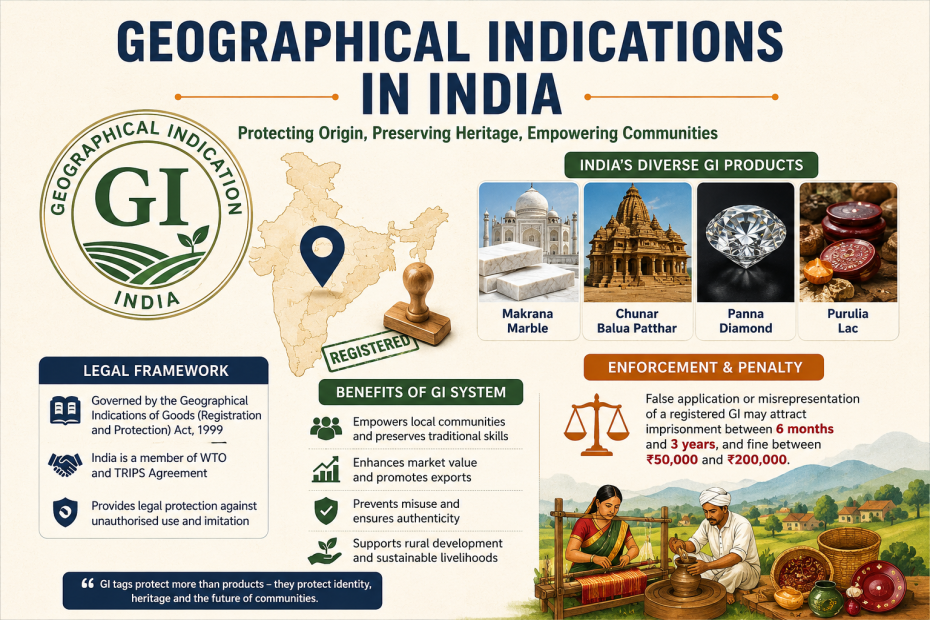
Geographical Indications (GIs) constitute a distinctive branch of Intellectual Property Rights that identifies goods whose quality, reputation or other defining characteristic is essentially attributable to their geographical origin. Unlike individually owned proprietary rights, GIs connect agricultural produce, handicrafts, natural products and manufactured goods with local terroir, biocultural heritage and community knowledge. In India, their significance extends beyond preventing commercial misuse to supporting rural development, export promotion and inclusive economic growth.
Concept and Statutory Foundation
- International Background: India’s specialised GI framework developed against the backdrop of international controversies involving foreign claims over traditional products and knowledge associated with neem, turmeric and basmati rice derivatives.
- TRIPS Obligation: As a founding member of the World Trade Organization, India enacted the Geographical Indications of Goods (Registration and Protection) Act, 1999 to fulfil its obligations under the Agreement on Trade-Related Aspects of Intellectual Property Rights.
- Operational Framework: The GI Act came into force on September 15, 2003 along with the Geographical Indications of Goods (Registration and Protection) Rules, 2002. The framework is administered by the Department for Promotion of Industry and Internal Trade under the Ministry of Commerce and Industry.
- Statutory Definition: Section 2(1)(e) covers indications identifying agricultural goods, natural goods, manufactured goods, handicrafts or foodstuffs as originating or manufactured in a country, region or locality where the relevant geographical connection exists.
- Manufactured Goods: For manufactured products, at least one of the activities of production, processing or preparation must take place within the specified geographical territory.
- Non-Geographical Names: GI protection is not confined to formal geographical place names. A non-geographical expression inherently associated with a particular region, such as Alphonso for particular mangoes, can also qualify for registration.
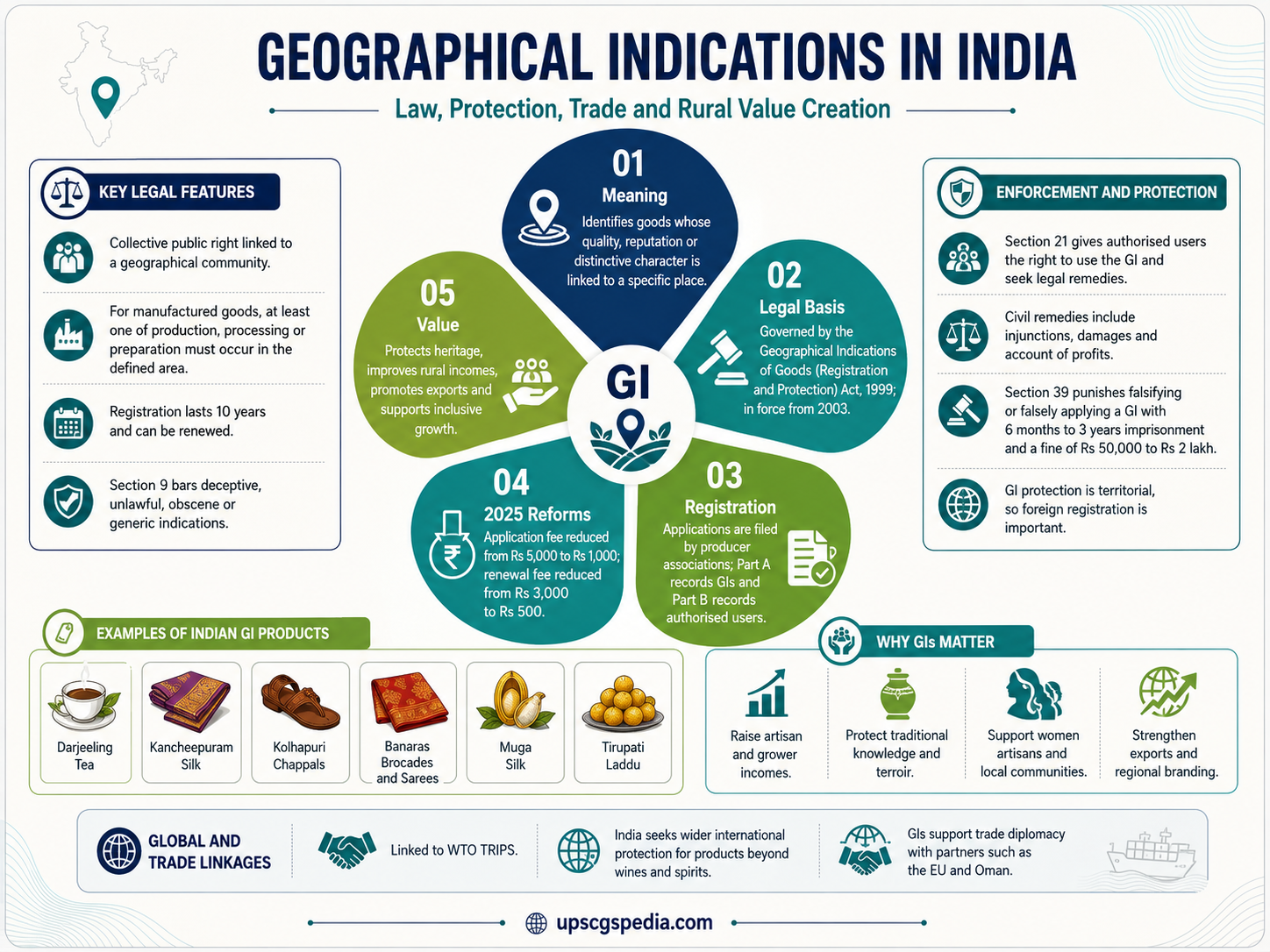
Distinctive Legal Character Of Geographical Indications
- Collective Public Right: A GI operates as a collective right associated with producers located within a defined geographical area rather than as an individually transferable proprietary asset.
- Restriction on Transfer: Section 24 prohibits the assignment, transmission, licensing, pledge or mortgage of a registered GI, preserving its collective and territorially rooted character.
- Protection from Private Appropriation: The statutory framework prevents a geographical indication from being privately monopolised in a manner inconsistent with the collective rights attached to the geographical origin.
- Bipartite Register: Section 6 requires the Register of Geographical Indications maintained at the GI Registry in Chennai to contain two parts. Part A records registered GIs, while Part B records registered authorised users entitled to use them commercially.
- Duration of Protection: GI registration remains valid for ten years from the filing date and can be renewed for successive ten-year periods on payment of the prescribed fee.
- Rights of Authorised Users: Section 21 gives registered authorised users the exclusive right to use the geographical indication in relation to the goods for which it is registered and provides legal remedies against infringement.
- Civil Remedies: Available remedies include injunctions, damages or account of profits, alongside legal action against passing-off.
- False GI Application: Under Section 39, falsifying a geographical indication or falsely applying one to goods is punishable with imprisonment ranging from six months to three years and a fine ranging from ₹50,000 to ₹2 lakh. A court may impose a lower sentence for adequate and special reasons recorded in the judgment.
- False Representation as Registered: Falsely representing a geographical indication as registered is dealt with separately under Section 42. Following the Jan Vishwas amendments effective from August 2024, this contravention was decriminalised and is subject to a monetary penalty linked to turnover or gross receipts, capped at ₹5 lakh.
Restrictions On GI Registration
- Deceptive Indications: Section 9 bars indications whose use is likely to deceive consumers or create confusion.
- Violation of Law: An indication cannot be registered when its use would be contrary to any law in force.
- Offensive Content: Protection is denied to indications containing scandalous or obscene matter or material likely to hurt the religious susceptibilities of any class or section of citizens.
- Generic Names: Expressions that have lost their original geographical significance and become generic descriptions of goods are excluded from GI protection. Cheddar and Sherry illustrate this phenomenon in certain foreign jurisdictions.
Registration Process And Institutional Scrutiny
- Eligible Applicants: An application may be made by an association of persons or producers, or by an organisation or authority established under law representing the interests of the producers concerned.
- Application Form: Registration is sought in triplicate through Form GI-1.
- Statement of Case: The application must explain the human or natural factors responsible for the distinctive characteristics associated with the product.
- Territorial Delimitation: An exact geographical map defining the production territory must accompany the application.
- Product and Producer Details: Applicants must provide the relevant classification of goods and particulars of the initial producers associated with the proposed GI.
- Preliminary Scrutiny: The Registrar examines the application for formal deficiencies, which must be corrected within one month.
- Expert Examination: A Consultative Group of Experts subsequently evaluates the technical particulars and statement of case.
- Publication: Once accepted, the application is published in the official Geographical Indications Journal.
- Opposition Window: Any person may submit an opposition through Form GI-2 within three months of publication, with a possible one-month extension.
- Final Registration: If no opposition is filed, or if opposition proceedings are resolved in favour of the applicant, the GI is entered in Part A of the Register and a registration certificate is issued by the Geographical Indications Registry.
The 2025 Regulatory Overhaul
- Amendment Rules: The DPIIT notified the Geographical Indications of Goods (Registration and Protection) (Amendment) Rules, 2025 through Gazette Notification G.S.R. 812(E).
- Fee Rationalisation: The amendments substituted the First Schedule of the 2002 Rules and introduced a revised fee regime intended to reduce administrative and financial barriers for producer organisations.
- Application Fee: The statutory fee for registering a GI was reduced by 80 per cent, from ₹5,000 to ₹1,000 for each class of goods.
- Renewal Fee: The fee for renewal after the ten-year registration period was reduced from ₹3,000 to ₹500, representing an 83.3 per cent reduction.
- Convention-Country Applications: Applications originating from convention countries were rationalised to ₹1,000 for each class of goods.
- Additional Protection: The fee for seeking additional protection for specified goods under Section 22(2) was reduced from ₹25,000 to ₹12,000.
- Restoration Fee: Restoration of a lapsed GI registration was simplified through a flat fee of ₹1,000.
Institutional And Financial Support For GI Producers
- MSME Innovative Scheme: Its Intellectual Property Rights component provides reimbursement of up to 100 per cent of actual statutory and legal expenditure incurred for GI registration, subject to a ceiling of ₹2 lakh for each registered GI.
- Handicrafts Enforcement Assistance: The Office of the Development Commissioner (Handicrafts) under the Ministry of Textiles provides assistance of up to ₹1.5 lakh for legal enforcement and anti-infringement proceedings.
- PM Ekta Malls: Supported by a capital allocation of ₹5,000 crore across the states, these commercial spaces provide physical retail outlets for One District One Product items and GI-registered crafts.
International Architecture Of GI Protection
- Paris Convention: The Paris Convention for the Protection of Industrial Property, 1883 recognised indications of source and appellations of origin as subjects of industrial property and established foundational principles such as national treatment and right of priority.
- TRIPS Agreement: The 1994 TRIPS Agreement standardised international GI protection through Articles 22 to 24.
- Article 22 Protection: Article 22 provides general protection against geographical designations that mislead consumers regarding origin or amount to unfair competition.
- Article 23 Protection: Wines and spirits receive enhanced protection without the requirement to establish consumer deception or unfair competition.
- India’s Position: India has advocated extending the enhanced protection available under Article 23 to non-wine products, including specialised teas, spices and distinctive handicrafts.
- Lisbon System: The Lisbon Agreement and its 2015 Geneva Act, administered by WIPO, enable international registration of GIs and Appellations of Origin through a single application across contracting parties.
- Territorial Nature of Rights: Protection obtained under India’s domestic GI law does not automatically extend to foreign jurisdictions, making separate international protection important for export-oriented products.
Territoriality And The Challenge Of Cultural Appropriation
- Kolhapuri Chappal Case: In 2025, luxury fashion house Prada displayed footwear inspired by traditional Kolhapuri Chappals at its Milan show.
- Domestic Protection: Kolhapuri Chappals possess joint GI protection across specified districts of Maharashtra and Karnataka.
- International Vulnerability: The absence of equivalent registration in the European Union illustrated the limitations of territorial GI rights and the difficulties involved in preventing cultural appropriation beyond the jurisdiction of domestic protection.
GI Protection in Trade Diplomacy
- EU-India GI Negotiations: India is pursuing a standalone bilateral GI Agreement with the European Union alongside broader Free Trade Agreement negotiations, with the objective of obtaining protected status for products such as Basmati Rice, Darjeeling Tea and regional textiles.
- India-Oman CEPA: Following the Comprehensive Economic Partnership Agreement, commercial shipments of GI-tagged Indi Lime from Karnataka were exported to Oman.
- New Zealand Commitments: New Zealand committed to enabling registration mechanisms for Indian GI products, extending formal recognition beyond arrangements earlier restricted to European entities.
- Export Promotion through APEDA: Targeted export initiatives involving the Agricultural and Processed Food Products Export Development Authority have enabled GI products to enter overseas markets and obtain higher price realisation.
- Karnataka GI Fruits: Exports to the Maldives produced returns reported to be 40–50 per cent higher.
- Salem Sago: The GI product entered the Canadian market.
- Joha Rice: Exports reached the United Kingdom and Italy.
- Tezpur Litchi: Shipments to Dubai obtained an approximately 10 per cent price premium.
Socioeconomic Importance of GI Protection
- Income Effects: Ministry of Textiles assessments indicate that certified GI status can raise the real incomes of artisans and growers by 20–30 per cent by authenticating direct supply chains and reducing dependence on intermediaries.
- Large Artisan Base: India’s handloom and handicraft sectors support an estimated 64.66 lakh artisans and weavers.
- Women’s Participation: Women constitute 71 per cent of handloom weavers and 64 per cent of craft artisans, making GI protection particularly significant for home-based and decentralised production systems.
- Counterfeit Protection: GI certification helps protect traditional producers against mass-manufactured imitations that appropriate the reputation associated with traditional products.
Terroir, Biodiversity And Community Knowledge
- Ecological Linkages: GIs can preserve locally evolved ecological adaptations, agricultural biodiversity and indigenous systems of knowledge.
- Similipal Kai Chutney: This GI-linked product from Odisha is prepared by Mayurbhanj tribal communities using indigenous red weaver ants, transforming ethno-biological knowledge into a protected socioeconomic asset.
- Arunachal Yak Churpi: The naturally fermented cheese produced from high-altitude Arunachali yaks connects GI protection with pastoral nomadic livelihoods and provides a safeguard against industrial dairy encroachment.
Authorised Users And Expansion Of The GI Ecosystem
- Formalisation of Producers: Registration of individual producers as Part B authorised users has helped transform fragmented artisan clusters into more formalised economic cooperatives.
- Growth in Authorised Users: Enrolment expanded from 365 authorised users to more than 29,000 over a ten-year period, strengthening the capacity of producers to participate directly in enforcement.
- Mid-2025 Registration Base: Registered GIs had crossed 658 by mid-2025, while the registration record was higher when separately registered product logos were also counted.
- Long-Term Target: The Government announced at the national GI Samagam a target of securing 10,000 GI registrations by 2030.
Product-Wise Structure Of India’s GI Registry
- Five Categories: Indian GIs span handicrafts, agricultural goods, foodstuffs, manufactured goods and natural goods.
- Handicrafts: This forms the largest category in the registration profile, with 445 registered products and 27 separately registered product logos in the figures presented.
- Agricultural Goods: Agricultural products form the second-largest category and have an important presence in export markets.
- Foodstuffs: This category includes traditional delicacies and regional confectionery.
- Manufactured Goods: It encompasses specialised industrial crafts and regional spirits, with Goa Feni identified as the first spirit in India to receive GI status.
- Natural Goods: The GI Registry classifies products including Makrana Marble, Ambaji White Marble, Chunar Balua Patthar, Panna Diamond and Lac of Purulia under the Natural Goods category. Lac of Purulia remains a Natural Good for GI classification despite being a biological product rather than a geological asset.
- Registration Timeline: Panna Diamond received its registration certificate on November 10, 2025, while Lac of Purulia received its certificate on March 27, 2026. They should therefore not be included in a numerical GI count explicitly described as representing the position in mid-2025.
Structural Challenges In India’s GI Regime
- Authorised-User Gap: A substantial difference persists between the number of GIs registered by associations and the number of individual producers registered as Part B authorised users.
- Enforcement Consequence: Producers who are not individually registered under Part B cannot directly exercise the statutory remedies available under Section 21 against counterfeiters, leaving enforcement concentrated in registered producer bodies.
- Quality-Control Deficit: India does not have dedicated statutory quality-control inspection institutions equivalent to European Protected Designation of Origin regulatory councils.
- Post-Registration Monitoring: Although registration requires detailed documentation of terroir and production processes, subsequent quality monitoring remains largely self-regulatory.
- Risk of Dilution: Weak monitoring can contribute to deterioration in product standards and erosion of the characteristics on which GI recognition was originally based.
- Genericisation Risk: Failure by registered associations to challenge imitation and unauthorised use can allow protected names to become generic over time.
- International Registration Costs: Because GI protection is territorial, grassroots cooperatives face financial and legal difficulties when attempting to obtain protection in multiple foreign jurisdictions.
Strategic Policy Priorities
- Regional Quality Boards: Regional quality-control monitoring institutions can conduct periodic audits of certified GI supply chains and align domestic monitoring more closely with international PDO standards.
- Geneva Act Accession: Accession to WIPO’s Geneva Act under the Lisbon System would allow Indian producer organisations to seek multi-country protection through a centralised international application.
- Digital Traceability: QR-code-based provenance systems can be integrated into product packaging to enable consumers to verify the authenticity of GI goods.
- Retail Integration: Expansion of PM Ekta Malls can strengthen physical market access for GI products and improve alignment with the One District One Product initiative.
- Trade Agreements: Export opportunities created by Comprehensive Economic Partnership Agreements and Free Trade Agreements can be used to expand overseas market access for registered products.
- Long-Term Expansion: These interventions can support the stated national objective of reaching 10,000 GI registrations by 2030.
Conclusion
India’s GI framework combines intellectual-property protection with the economic organisation of geographically rooted communities, traditional production systems and region-specific knowledge. Lower registration costs, support for producer organisations, expanding export initiatives and the long-term registration target have widened the scope of the GI ecosystem. Yet registration by itself cannot secure its full potential.
Wider enrolment of authorised users, stronger post-registration quality control, protection against genericisation, international recognition, digital traceability and improved market infrastructure remain central to translating geographical identity into durable economic value.