
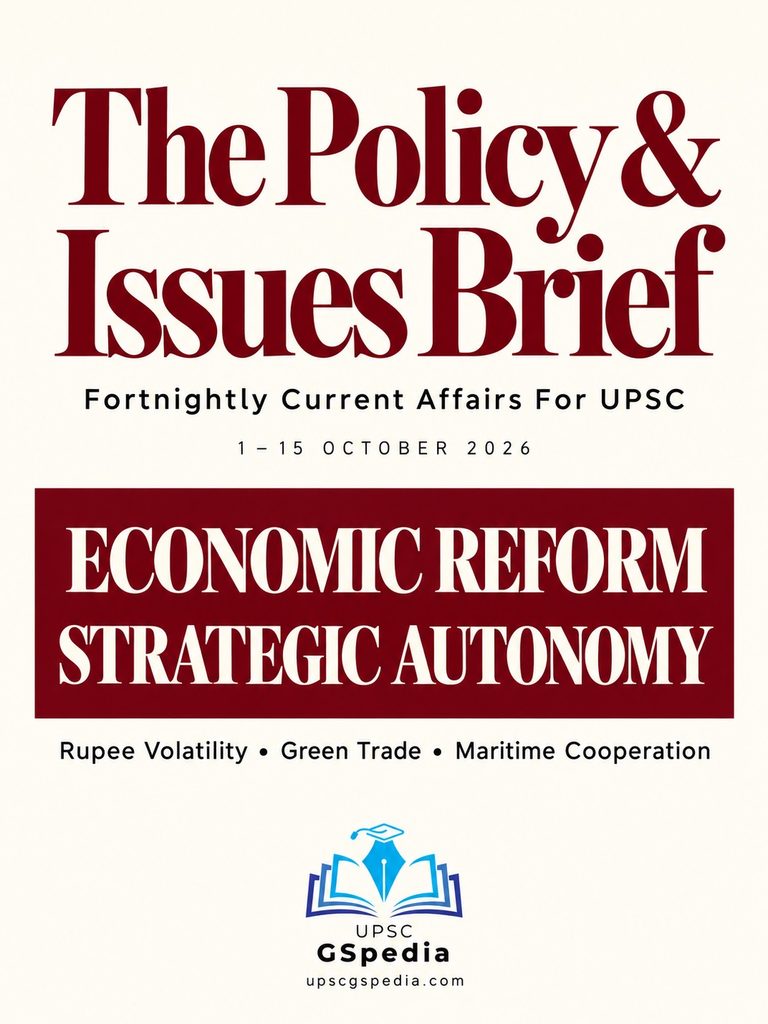
The 1–15 October 2026 issue of The Policy & Issues Brief examines developments across governance, the economy, international relations, the environment, science, social policy and security. A recurring question connects these subjects: what institutions, resources and safeguards are needed to translate policy decisions into durable public outcomes?
Rights and accountability
The discussion on the Uniform Civil Code places substantive gender equality, maintenance, inheritance, privacy and access to remedies at the centre of family-law reform. Legislative privileges raise a related question about the relationship between institutional independence and freedom of speech. Electoral integrity, proactive RTI disclosure and UAPA safeguards extend the examination to public trust, access to information and personal liberty. Together, these topics show why constitutional analysis must consider procedures and implementation alongside formal powers.
Economic policy and employment
GST reform is examined through compliance, input tax credit, refunds, disputes and taxpayer trust. Notes on inflation and rupee volatility distinguish the sources of economic pressure from the instruments available to policymakers. UPI pricing raises questions about payment-system costs, commercial sustainability and inclusion, while bank restructuring brings ownership and regulatory oversight into focus. Employment and AI adoption connect these discussions with a wider challenge: whether investment and productivity growth create accessible, adequately remunerated work.
Agriculture beyond production
Agricultural coverage follows the chain from cultivation to aggregation, storage, processing and markets. Value-chain finance concerns working capital and enterprises beyond the farm gate. Income diversification requires alignment among technology, irrigation, electricity, procurement and market incentives.
District convergence and the pulses mission examine coordination across programmes and institutions. Punjab’s foodgrain-storage constraints illustrate how procurement, milling, outward movement and destination capacity form one connected system. Building storage alone cannot resolve every bottleneck.
Infrastructure and resource readiness
Industrial parks, GatiShakti and integrated transport planning address the coordination needed for investment and logistics. Green Energy Corridors connect renewable generation with transmission, storage and reliable supply. Data-centre expansion adds concentrated electricity and water demands, making location, grid readiness and public incentives part of digital policy.
Green trade rules, cement decarbonisation, vehicle-efficiency standards and sustainable cooling show how industrial competitiveness increasingly depends on credible environmental performance.
Climate and ecological risk
Himalayan hazards require attention to interacting processes, including unstable slopes, glacier retreat, natural dams and downstream exposure. Coastal protection combines physical adaptation with questions of livelihoods, displacement and maritime entitlements. El Niño coverage distinguishes seasonal forecasts from realised outcomes and national rainfall totals from local agricultural stress.
Stubble burning, PFAS contamination and wastewater reuse connect environmental outcomes with monitoring, incentives, treatment capacity and sustained municipal or regulatory operations.
Conservation and evidence
Wildlife recovery depends on suitable habitats, connectivity, prey, community cooperation and continued monitoring. Great Indian Bustard conservation and tiger reintroduction at Buxa illustrate the difference between releasing animals and establishing viable populations. Kerala’s ecosystem assessment broadens the focus to ecological functions and collapse risk.
The interpretation of wildlife population indices adds another distinction: an average change in monitored populations cannot be treated as the percentage of species becoming extinct. These differences affect both conservation priorities and the reading of scientific reports.
External relationships and resilience
Geoeconomic chokepoints, Arctic resources and the Eastern Maritime Corridor connect foreign policy with energy, critical minerals, finance and transport. Investment treaties examine the balance between investor protection and regulatory space. Pandemic governance and aid contraction raise questions about access, financing and decision-making in international cooperation. BIMSTEC and maritime partnerships bring operational coordination into this wider account of regional security and development.
Technology and social institutions
Research capacity, supercomputing, quantum communication, space payloads and precision healthcare are considered through their applications and institutional requirements. Scientific demonstrations, proposed systems and established services have different implications for policy.
Women’s livelihood groups and disability assistance similarly require attention to continuity, accessible delivery and support beyond programme announcements. Archives and classical-language institutions underline the need to preserve both cultural materials and the expertise and access that make them usable.
Across these subjects, the issue links current developments with static concepts and relevant UPSC previous-year questions. Its analytical emphasis is on mechanisms, policy choices, implementation constraints and the evidence needed to assess outcomes.
Read more ebooks here.