
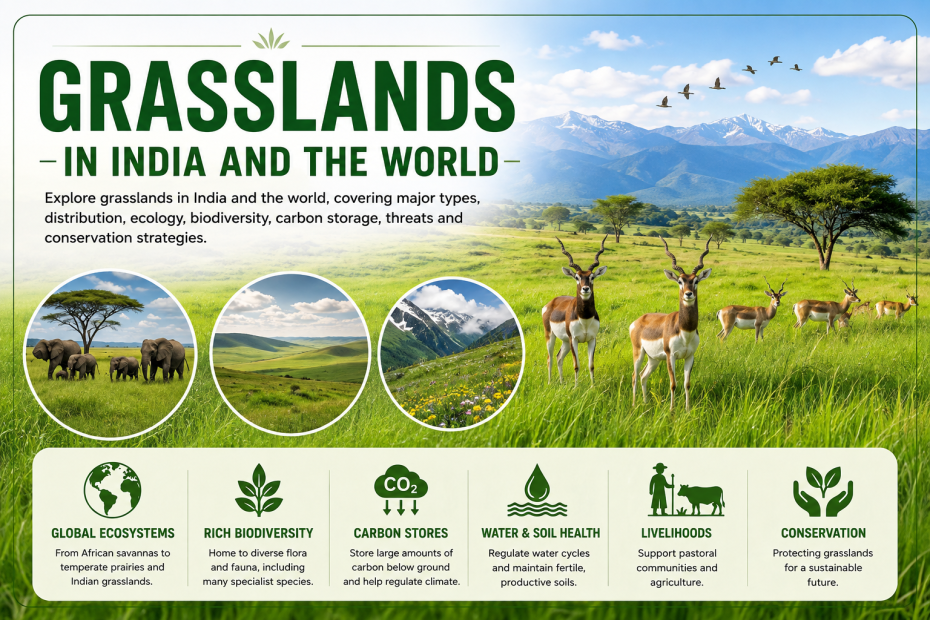
Grasslands are ecosystems in which grasses and other herbaceous plants dominate the vegetation and tree cover is absent, limited or spatially open. They occur under a wide range of climatic and soil conditions and are maintained by interactions among moisture availability, periodic drought, fire and grazing.
Although their vegetation may appear structurally simpler than forests, grasslands support major ecological processes, productive soils, diverse wildlife and extensive human livelihoods. Their global distribution and ecological diversity make them important to physical geography, biodiversity conservation, climate policy and sustainable land management.
Understanding Grassland Ecosystems
- Dominant vegetation: Grasslands are primarily characterised by grasses of the family Poaceae, together with sedges, rushes and a wide variety of herbaceous flowering plants.
- Moisture regime: They commonly develop where precipitation is sufficient to sustain continuous herbaceous vegetation but inadequate for the formation of a closed forest canopy.
- Indicative rainfall range: The supplied ecological framework places many grasslands within an intermediate annual rainfall range of roughly 250–1,000 mm.
- Global extent: Grasslands account for roughly 40% of the Earth’s ice-free land surface.
- Dynamic ecosystems: Their continued openness is often maintained by the combined influence of seasonal drought, periodic fire and grazing by wild or domestic herbivores.
Grasslands therefore cannot be understood simply as landscapes where trees have failed to grow. In many regions, open vegetation is maintained by stable ecological processes and represents the natural ecosystem.
Global Types And Distribution
Grasslands can be broadly understood through two major climatic groups: tropical grasslands or savannas and temperate grasslands.
Tropical Grasslands And Savannas
- Latitudinal setting: Tropical savannas occur mainly within tropical latitudes and are strongly influenced by seasonal shifts in rainfall.
- Seasonal climate: Temperatures remain high for much of the year, while rainfall is concentrated in a distinct wet season followed by a pronounced dry season.
- Vegetation structure: Drought-resistant deciduous trees may occur in an open canopy above a continuous or near-continuous grass layer.
- Grass adaptations: Tall C4 grasses such as Themeda, Hyparrhenia and Andropogon are adapted to warm temperatures, seasonal water stress and recurring disturbance.
East And Southern African Savannas
- Large-mammal landscapes: The Serengeti-Mara and associated East African savannas support enormous populations of grazing ungulates such as wildebeest, zebra and gazelle together with large carnivores.
- Ecological processes: Seasonal rainfall, grazing and fire interact to maintain the open character of these ecosystems.
Llanos
- Geographical location: The Llanos extend across Venezuela and Colombia in the Orinoco basin.
- Seasonal flooding: Extensive flooding during the wet season alternates with drought, producing a dynamic wetland-savanna environment.
- Human use: Cattle pastoralism forms an important part of the regional economy.
Cerrado And Campos
- Brazilian grasslands and savannas: The Cerrado and Campos represent major South American open ecosystems.
- High biodiversity: The Cerrado is notable for high biological diversity and plant endemism.
- Soil adaptation: Deep-rooted grasses and woody plants are adapted to acidic and nutrient-poor soils.
Gran Chaco
- Regional extent: The Gran Chaco spans parts of Bolivia, Paraguay and Argentina.
- Mosaic landscape: It combines savanna, thorn scrub and dry forest rather than forming a uniform grassland.
Australian Tropical Savannas
- Northern distribution: Extensive savanna and open woodland occur across northern Australia.
- Fire adaptation: Vegetation including Triodia and Sorghum species is adapted to nutrient-poor soils and recurrent fires.
Temperate Grasslands
Temperate grasslands generally occur in continental interiors in the middle latitudes, where seasonal temperature contrasts are strong.
- Continental climate: Summers can be warm or hot while winters are cold, and rainfall is generally moderate rather than excessive.
- Vegetation: Perennial bunchgrasses and sod-forming grasses dominate, while trees tend to be concentrated along rivers and other locally favourable sites.
- Fertile soils: Chernozems, Mollisols and Kastanozems are associated with many temperate grasslands. Long-term root turnover contributes to high levels of organic matter and humus.
Eurasian Steppes
- Geographical belt: The Steppes extend from Ukraine and southern Russia through Kazakhstan towards Mongolia and northern China.
- Vegetation: Feather grasses such as Stipa and species of Festuca are characteristic.
- Continental character: Low-to-moderate rainfall and strong seasonal temperature variations favour extensive treeless or sparsely wooded landscapes.
North American Prairies
- Regional extent: Prairies stretch across the central portions of North America.
- Rainfall gradient: Tallgrass prairie occurs towards the wetter east, mixed-grass prairie in intermediate areas and shortgrass prairie towards the drier west.
- Rain-shadow influence: The Rocky Mountains influence the westward decline in precipitation.
South American Pampas
- Location: The Pampas extend across Argentina, Uruguay and parts of southern Brazil.
- Fertile plains: Their productive soils and relatively favourable climate support extensive agriculture.
- Economic role: Grain farming and cattle ranching have transformed large areas of the natural grassland.
Southern African Veld
- Plateau grasslands: Veld ecosystems occur across high plateaus of southern Africa.
- Regional variation: Differences in grass quality and climatic conditions give rise to distinct types, including sweet and sour veld.
Australian Downs And Canterbury Plains
- Southern grasslands: Fertile grassland environments occur in southeastern Australia, while the Canterbury Plains form an important grassy landscape in New Zealand.
- Pastoral transformation: Large areas have been modified for wool, livestock and dairy production.
Why Grasslands Matter
Carbon Storage
- Below-ground reserves: Grasslands may hold a very large proportion of their ecosystem carbon in roots and soil organic matter, with the supplied material placing the below-ground share as high as 90% in some systems.
- Fire resilience: Because much of this carbon lies beneath the surface, it can remain comparatively secure during surface fires.
- Climate relevance: Degradation of grassland soils can therefore affect a major terrestrial carbon store even when above-ground vegetation appears sparse.
Water And Soil Regulation
- Soil infiltration: Dense fibrous roots help water enter the soil instead of rapidly flowing across the surface.
- Groundwater recharge: Improved infiltration can contribute to aquifer recharge.
- Erosion control: Root networks stabilise the soil, reduce runoff velocity and limit topsoil loss.
- Watershed role: Mountain grasslands and other open ecosystems can play an important role in regulating river-basin hydrology.
Biodiversity
- Specialist fauna: Grasslands support species adapted to running, burrowing, grazing and living in open terrain.
- Bird diversity: Bustards, floricans, larks and pipits are among the bird groups strongly associated with open habitats.
- Predators and herbivores: Wolves, cheetahs, caracals, antelopes and other large herbivores or cursorial predators are closely linked to grassland and savanna systems.
Food And Livelihoods
- Agricultural production: Many fertile temperate grasslands have become major centres of wheat, maize and barley cultivation.
- Pastoral production: Tropical and semi-arid grasslands provide grazing for livestock and support dairy, meat, leather and wool economies.
- Human adaptation: Mobile pastoral systems have evolved around seasonal variations in forage and water availability.
Grassland Classification In India
A classical classification associated with Dabadghao and Shankarnarayan divides Indian grasslands into five broad ecological associations.
Sehima–Dichanthium Type
- Distribution: This type occurs across the Deccan Plateau, central Indian highlands, Chota Nagpur Plateau and Aravalli region.
- Environmental setting: It develops on red gravelly and black cotton soils under moderate rainfall.
- Characteristic grasses: Sehima nervosum, Dichanthium annulatum, Heteropogon contortus and Chrysopogon fulvus are important species.
Dichanthium–Cenchrus–Lasiurus Type
- Distribution: This association characterises the arid and semi-arid areas of western Rajasthan, northern Gujarat and adjoining parts of Punjab and Haryana.
- Soils and climate: It is adapted to low rainfall and sandy, saline or calcareous soils.
- Characteristic grasses: Lasiurus sindicus, Cenchrus ciliaris, Cenchrus biflorus and Dichanthium annulatum are prominent.
Phragmites–Saccharum–Imperata Type
- Distribution: These grasslands occur in moist, flood-prone lowlands of the Ganga, Brahmaputra and Indus plains and the Terai-Duar belt.
- Hydrological influence: Flooding, alluvial deposition and high soil moisture shape the ecosystem.
- Characteristic grasses: Saccharum spontaneum, Phragmites karka, Imperata cylindrica and Sclerostachya fusca are common.
Themeda–Arundinella Type
- Distribution: This type occurs in subtropical and temperate Himalayan foothills and parts of the northeastern hill region.
- Elevation: It is associated broadly with elevations of about 1,000–2,000 metres.
- Characteristic species: Arundinella nepalensis, Themeda anathera and Chrysopogon gryllus are among its representative grasses.
Temperate–Alpine Type
- High-altitude setting: These grasslands occur in the higher Himalayas, including sub-alpine pastures, alpine meadows and trans-Himalayan cold landscapes.
- Characteristic genera: Festuca, Poa, Agrostis, Stipa, Bromus and Danthonia form part of the vegetation.
Major Grassland Landscapes In India
Banni Grasslands
- Location: Banni lies along the southern edge of the Great Rann of Kachchh in Gujarat.
- Extent: It covers approximately 2,500 sq km and represents a large contiguous arid-to-semi-arid grassland landscape.
- Edaphic character: The ecosystem is strongly influenced by saline soils formed through marine and alluvial processes.
- Pastoralism: Maldhari communities depend on its grazing resources and maintain livestock adapted to local conditions, including the Banni buffalo.
- Wetland connection: Chhari-Dhand provides freshwater habitat and functions as an important migratory-bird stopover.
Terai-Duar Savannas And Floodplain Grasslands
- Location: These grasslands occur along the Himalayan foothills across northern Uttar Pradesh, Bihar, West Bengal and Assam.
- Tall grasslands: They contain some of the world’s tallest alluvial grassland vegetation.
- Disturbance regime: Monsoon floods, sediment deposition and periodic low-intensity fire maintain their ecological structure.
- Wildlife: The landscape supports the Greater One-horned Rhinoceros, Asian Elephant, Bengal Tiger, Swamp Deer,nPygmy Hog and Bengal Florican.
- Protected landscapes: Important examples occur in and around Kaziranga, Manas, Dudhwa and Valmiki Tiger Reserves.
Shola-Grassland Mosaics
- Location: Shola-grassland systems occur in high-elevation areas of the Nilgiris, Anamalais and Palani Hills in the Western Ghats.
- Mosaic structure: Stunted evergreen Shola forests occupy sheltered valleys while montane grasslands dominate surrounding slopes and plateaus.
- Hydrological function: The grasslands intercept mist and rainfall and help sustain streams feeding peninsular river systems.
- Biodiversity: Nilgiri Tahr, Nilgiri Pipit and Neelakurinji are associated with these high-elevation landscapes.
Himalayan Bugyals
- Altitudinal position: Bugyals occur above the timberline and below permanent snow zones across parts of the western and central Himalayas.
- Seasonality: Long periods of snow cover are followed by rapid summer growth and flowering.
- Flora and fauna: Herbs such as Primula, Gentiana and Potentilla occur alongside high-altitude fauna including Bharal, Himalayan Ibex and Musk Deer.
- Pastoral value: These seasonal pastures are important to transhumant communities including Gujjars, Bakarwals, Gaddis and Bhotiyas.
Semi-Arid And Deccan Grasslands
- Distribution: These open landscapes occur across the rain-shadow areas of peninsular India and the semi-arid plains of western India.
- Soils: Shallow black and red soils are common.
- Characteristic wildlife: Great Indian Bustard, Lesser Florican, Blackbuck, Chinkara and Indian Grey Wolf depend on these open habitats.
Threats To India’s Grasslands
The Wasteland Paradigm
- Historical classification: Treeless landscapes were frequently classified as wastelands, degraded scrub or unproductive land.
- Land conversion: Such classification has facilitated diversion for industry, urbanisation and infrastructure.
- Restoration error: Ecologically intact grassland can be mistaken for degraded land because it lacks dense tree cover.
Inappropriate Afforestation
- Tree planting in open biomes: Afforestation programmes may introduce dense tree stands into ecosystems naturally dominated by grasses.
- Ecological alteration: Such plantations change light conditions, water movement and soil processes.
- Habitat loss: Wildlife requiring open sightlines and grass-dominated vegetation may decline even though nominal tree cover increases.
Invasive Alien Species
- Banni: Prosopis juliflora has spread widely through native pasture landscapes.
- Western Ghats: Acacia mearnsii and other exotic trees have invaded montane grasslands.
- Central grasslands: Lantana camara and Parthenium hysterophorus affect native vegetation in some open ecosystems.
- Livelihood impact: Invasion reduces the availability of palatable native grasses needed by livestock.
Infrastructure And Fragmentation
- Linear barriers: Roads, irrigation canals and transmission corridors fragment large open landscapes.
- Renewable-energy infrastructure: Solar and wind developments can create additional pressure where projects overlap sensitive grassland habitats.
- Great Indian Bustard: Overhead transmission lines pose a serious collision risk to this heavy-bodied bird.
Unsustainable Grazing And Fire
- Excessive livestock pressure: Grazing beyond ecological carrying capacity can compact soils and reduce perennial root biomass.
- Vegetation change: Degraded sites may become increasingly dominated by unpalatable weeds.
- Fire imbalance: Both complete suppression of ecologically important fire and excessively frequent anthropogenic burning can disrupt grassland dynamics.
Conservation And Policy Framework
Planning Commission Task Force
- Grasslands and deserts: The 2006 Task Force on Grasslands and Deserts recommended recognising grasslands as ecologically valuable ecosystems rather than wastelands.
- Policy recommendation: It called for a National Rangeland and Grassland Policy, improved surveys of grazing lands and an end to inappropriate afforestation of naturally open ecosystems.
Forest Rights Act
- Community Forest Rights: Community Forest Rights under the Forest Rights Act can strengthen the role of traditional communities in managing and protecting customary grazing landscapes.
- Pastoral participation: Such rights can support locally adapted grazing management, invasive-species control and restoration.
Species Recovery
- Bustards and floricans: Species recovery programmes have focused conservation attention on threatened grassland birds.
- Habitat-centred approach: Protecting flagship species can also protect the wider ecological communities that depend upon the same open landscapes.
International Frameworks
- UNCCD: Grassland conservation is closely linked with efforts to combat desertification and achieve Land Degradation Neutrality.
- UN Decade on Ecosystem Restoration: The 2021–2030 decade provides a broader international framework for restoring degraded ecosystems.
- International Year of Rangelands and Pastoralists: The United Nations designated 2026 as the International Year of Rangelands and Pastoralists, increasing global attention to rangeland health and pastoral livelihoods.
Recent Grassland Developments
- Global rangeland degradation: The supplied UNCCD material reports that nearly half of global rangelands are degraded, linking the decline to land-use change, overgrazing, industrial agriculture and inappropriate afforestation.
- India’s ONEs framework: India’s first guide to grasslands and other Open Natural Ecosystems formally strengthens the argument that savannas, grasslands, rocky plateaus and scrublands should not automatically be regarded as degraded forests.
- Protection deficit: Mapping of India’s open ecosystems has highlighted how little of their total extent falls within the conventional Protected Area network.
- Afforestation rethink: The emerging policy approach emphasises ecosystem-specific restoration and the restoration of native grass vegetation rather than indiscriminate tree planting in naturally open habitats.
- Great Indian Bustard litigation: The conservation of the Great Indian Bustard has brought the interaction between biodiversity protection, transmission infrastructure and renewable-energy development into constitutional and environmental jurisprudence.
- Climate rights dimension: In M.K. Ranjitsinh & Ors. v. Union of India, the Supreme Court recognised a right to be free from the adverse effects of climate change in relation to Articles 14 and 21.
- Species-led restoration: Grassland species conservation, including programmes involving the Great Indian Bustard, floricans and cheetahs, has increasingly been linked with restoration of open habitats and prey populations.
- Invasive-species removal: Restoration initiatives in landscapes such as the Nilgiris and Banni emphasise removal of invasive trees and recovery of indigenous grassland vegetation.
- Community stewardship: Pastoral and other local communities are increasingly being treated as important participants in monitoring, grazing management, invasive-species control and species conservation.
The Way Forward
- Correct land classification: Grasslands, savannas and scrublands need to be separated from degraded or genuinely barren land in official records.
- Restore ecological processes: Restoration should rebuild native grass communities, soil function and appropriate disturbance regimes rather than merely increasing tree density.
- Control invasive species: Removal programmes should be followed by recovery of locally adapted native grasses to reduce reinvasion.
- Integrate pastoral knowledge: Rotational grazing, seasonal movement and community management can contribute to restoration when adapted to local ecological carrying capacity.
- Expand conservation beyond forests: Community Reserves and Conservation Reserves can help protect large open landscapes that fall outside conventional forest-dominated Protected Areas.
- Plan infrastructure ecologically: Renewable-energy and transmission projects should incorporate sensitivity mapping, wildlife corridors and bird-safe infrastructure.
- Protect landscape connectivity: Grassland conservation requires large connected spaces because many specialist species range over extensive open terrain.
Key Concepts For Revision
Savanna
- Structure: A grass-dominated ecosystem with scattered trees or an open woody layer.
- Climate: Tropical savannas are generally associated with alternating wet and dry seasons.
- Maintenance: Fire, seasonal moisture stress and herbivory can restrict the development of closed forest.
Temperate Grassland Names
- Prairies: North America.
- Pampas: South America.
- Steppes: Eurasia.
- Veld: Southern Africa.
- Downs: Australia.
Indian Open Ecosystems
- Banni: Arid and saline grassland of Kachchh.
- Bugyals: Alpine and sub-alpine Himalayan meadows.
- Terai-Duar: Floodplain and tall-grass savannas along the Himalayan foothills.
- Shola-grassland mosaic: High-elevation Western Ghats ecosystem combining montane grasslands and Shola forest patches.
- Deccan savannas: Semi-arid open landscapes of peninsular India.
Conclusion
Grasslands are neither empty spaces nor incomplete forests. They are diverse ecosystems created and maintained by particular combinations of climate, soils, fire, herbivory and hydrology. Globally, they sustain major food-producing regions, pastoral societies, wildlife populations and large soil-carbon stocks.
India’s grasslands are equally varied, ranging from Himalayan meadows and Terai floodplains to Banni and Deccan savannas. Their future depends on recognising this ecological diversity, correcting inappropriate land classifications, managing invasive species, protecting landscape connectivity and replacing uniform tree-planting approaches with restoration strategies suited to naturally open ecosystems.