Energy efficiency, defined as achieving the same level of output with lower energy input, has emerged as a central pillar of India’s energy strategy, balancing economic growth, energy security, and climate commitments.
Understanding Energy Efficiency And Its Strategic Importance
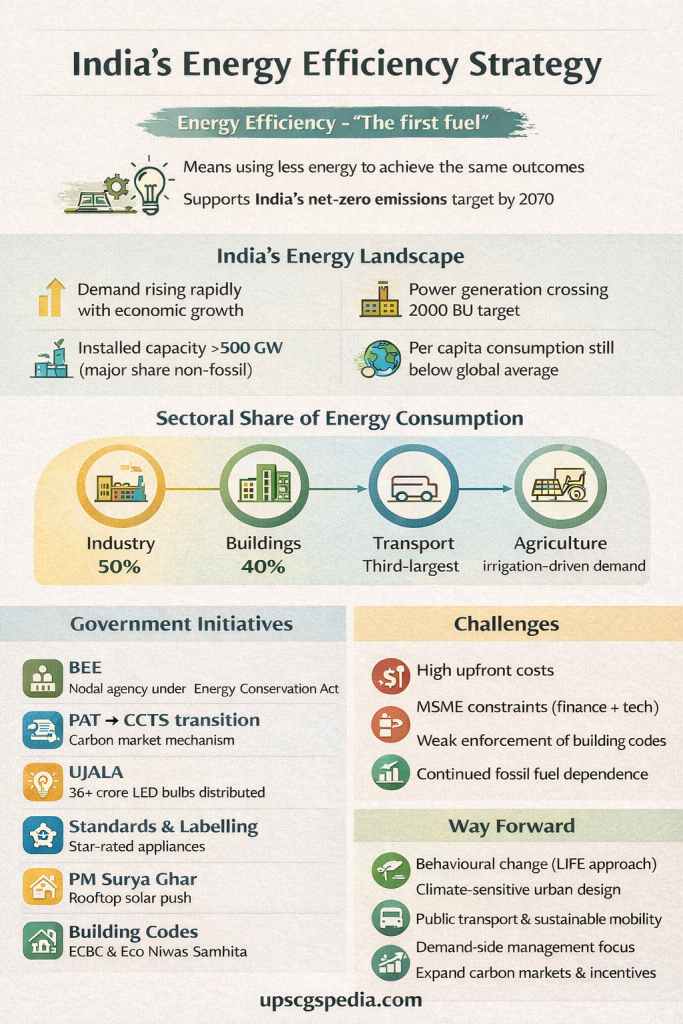
Concept of energy efficiency
Energy efficiency refers to minimising energy consumption while maintaining the same level of service or productivity. It focuses on eliminating waste through improved technology, smarter design, and better management practices. For instance, LED lighting provides equivalent illumination while consuming significantly less electricity than conventional bulbs.
Energy efficiency as India’s “first fuel”
With India’s energy demand projected to grow substantially in the coming decades, efficiency is increasingly recognised as the most cost-effective and sustainable source of energy. Policymakers view it as the “first fuel” because saving energy is often cheaper and faster than generating additional supply.
Relevance for energy security and economic resilience
India is expected to remain dependent on energy imports, exposing it to global price volatility and geopolitical risks. Efficiency improvements reduce this vulnerability by lowering overall demand and improving competitiveness across industries.
India’s Energy Landscape And Growing Demand
- Rising electricity demand and expanding supply: India is among the world’s largest energy consumers, with electricity generation rising steadily—from over 1,700 billion units in 2023–24 to nearly 1,830 billion units in 2024–25. Targets for 2025–26 indicate further expansion beyond 2,000 billion units.
- Improved system reliability and reduced shortages: The power system has become more resilient, with energy shortages reduced to negligible levels and peak demand being met effectively, reflecting improved demand-supply management.
- Transition towards non-fossil energy sources: India’s installed electricity capacity has crossed 500 GW, with more than half coming from non-fossil sources such as solar, wind, hydro, and nuclear energy. However, their actual contribution to generation remains lower due to intermittency challenges.
- Rising per capita energy consumption: Although India’s per capita energy use remains below the global average, it is expected to increase significantly with economic growth. Efficiency measures can moderate this rise and optimise resource utilisation.
Sectoral Distribution of Energy Consumption
- Industry as the largest consumer: Industrial activities account for nearly half of total energy consumption, making this sector central to efficiency improvements and emissions reduction.
- Buildings as a major energy user: Buildings contribute over 40% of total consumption, highlighting the importance of efficient construction, design, and operation.
- Transport and agriculture sectors: Transport is the third-largest consumer, while agriculture relies heavily on energy for irrigation, making efficiency improvements critical across these sectors.
Key Benefits of Energy Efficiency
- Economic gains and cost savings: Reduced energy consumption lowers household electricity bills and enhances industrial profitability, contributing to overall economic efficiency.
- Environmental sustainability: Efficiency directly reduces greenhouse gas emissions and air pollution, supporting India’s climate commitments.
- Energy security enhancement: Lower demand reduces dependence on imports and strengthens resilience against supply disruptions.
- Employment generation: Investments in energy efficiency generate more jobs compared to conventional fossil fuel investments.
Major Government Initiatives and Policy Framework
Institutional role of Bureau of Energy Efficiency (BEE)
The BEE plays a central role in designing and implementing efficiency programmes under the Energy Conservation Act, 2001.
Industrial efficiency: transition from PAT to CCTS
- The Perform, Achieve and Trade (PAT) scheme laid the foundation by setting energy reduction targets.
- The Carbon Credit Trading Scheme (CCTS) builds on this by linking industrial performance directly to emissions reduction.
- Industries exceeding targets earn tradable carbon credits, creating market incentives.
Household efficiency: standards and labelling
- The Standards and Labelling Programme provides star ratings for appliances, guiding consumer choices.
- From 2026, star labelling has expanded to more appliances, supported by digital verification tools.
UJALA scheme
- Distribution of over 36 crore LED bulbs has resulted in large-scale energy savings.
- The programme has reduced electricity consumption, peak demand, and emissions significantly.
PM Surya Ghar Yojana
- Promotes rooftop solar installation with financial incentives.
- Aims to reduce grid dependence and provide affordable electricity to households.
Power sector reforms
- Focuses on improving financial and operational efficiency of distribution companies.
- Deployment of smart meters enhances monitoring and reduces losses.
Building efficiency
- The Energy Conservation Building Code sets standards for commercial buildings.
- Eco Niwas Samhita promotes energy-efficient residential construction through better design and insulation.
Digital and behavioural initiatives
- Tools like UDIT provide data-driven insights into energy usage.
- The LiFE initiative promotes sustainable consumption patterns among citizens.
India’s Global Engagement And Leadership
- Commitments under climate agreements: India has committed to reducing emissions intensity, increasing non-fossil capacity, and achieving net-zero emissions by 2070.
- International collaborations: Membership in global platforms such as the International Energy Efficiency Hub. Leadership in initiatives like the International Solar Alliance and Global Biofuels Alliance.
- Global positioning in renewable energy: India ranks among the top countries globally in solar, wind, and overall renewable capacity, reflecting its growing leadership in clean energy.
Challenges in Scaling Energy Efficiency
- Mindset and investment barriers: Decision-making often prioritises upfront costs over long-term savings, slowing adoption of efficient technologies.
- Constraints in MSME sector: Small enterprises face limited access to finance and technical expertise, restricting their ability to adopt efficiency measures.
- Implementation gaps in building codes: Despite strong regulations, enforcement remains weak due to institutional and capacity constraints.
- Technological and infrastructure limitations: Energy storage remains expensive, and dependence on imported materials hampers large-scale deployment of clean technologies.
Structural Challenges in Energy Transition
- Intermittency of renewable energy: Solar and wind energy depend on weather conditions, leading to variability in supply.
- Gap between installed capacity and generation: Although non-fossil sources dominate installed capacity, their actual contribution to electricity generation remains lower.
- Continued reliance on fossil fuels: Given affordability concerns and energy demand growth, fossil fuels will continue to play a role in the near term.
- Global energy system constraints: The transition to clean energy is influenced by geopolitical tensions, supply chain disruptions, and cost pressures.
Reframing Energy Efficiency: Beyond Technology
- Need for behavioural and cultural transformation: Energy efficiency is not merely about efficient devices but also about changing consumption patterns and lifestyles.
- Urban planning and building design: Poorly designed buildings can lock in high energy demand. Climate-sensitive architecture can significantly reduce long-term consumption.
- Transport system redesign: Sustainable mobility requires a shift from private vehicles to public transport, cycling, and walking.
- Demand-side management as a strategic tool: Managing how energy is used is as important as how it is produced, especially in a rapidly growing economy.
The Road Ahead: Role in India’s Development Vision
- Integration with climate and development goals: Energy efficiency is central to achieving India’s NDC targets and long-term sustainability objectives.
- Expanding markets for efficiency: Scaling carbon markets and financial incentives can accelerate adoption across sectors.
- Strengthening public participation: Awareness campaigns, awards, and educational initiatives foster a culture of conservation.
- Towards Viksit Bharat: Energy conservation is both a technical necessity and a civic responsibility, requiring coordinated efforts from government, industry, and citizens.
UPSC Prelims Quiz
Practice exam-oriented current affairs questions daily and track your preparation effectively.
Attempt Quiz →