
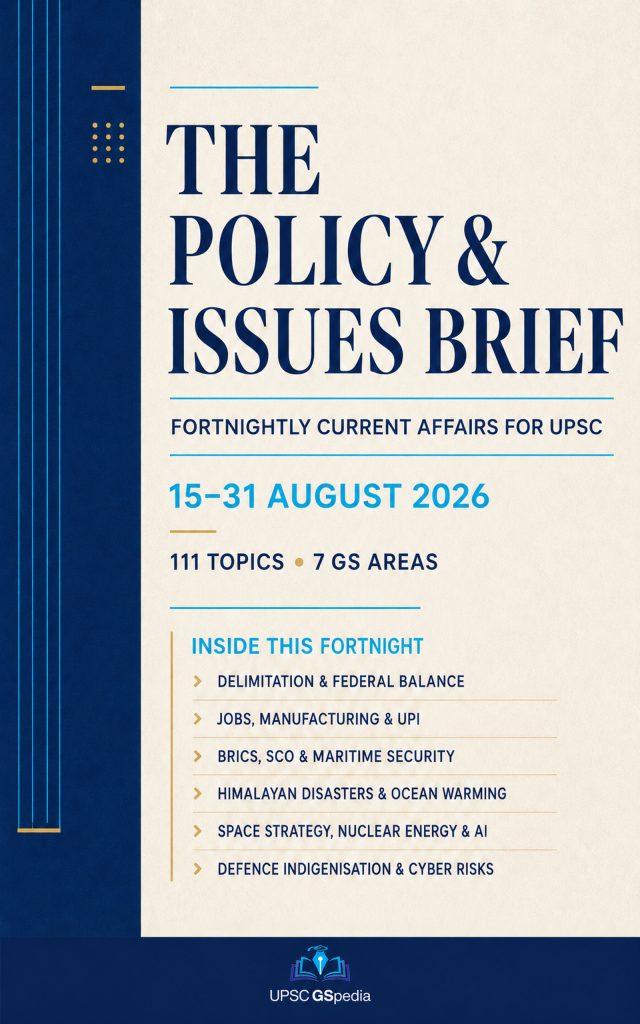
The 15-31 August 2026 issue of UPSCGSpedia.com’s fortnightly Newspaper Digest brings together selected developments from newspapers, official releases and other authoritative sources for UPSC Civil Services Examination preparation. The purpose is to organise current affairs by issue and syllabus area, rather than reproduce news in the order in which it appeared.
This edition contains 111 topic entries across seven General Studies areas. It is intended for aspirants who want a single review point for the fortnight and need material that can support Prelims revision, Mains answer writing and the updating of personal notes.
What The August Fortnightly Issue Covers
Polity and Governance includes delimitation and the size of the Lok Sabha, simultaneous elections, the SYL Canal dispute, secularism and sacrilege laws, urban heat and flood governance, legal aid, electoral black money, Jal Jeevan Mission and digital capacity in Gram Panchayats.
The Economy section examines youth unemployment and job mismatch, manufacturing statistics, UPI financing, the meaning of industry under labour law, mineral taxation, agricultural power supply, renewable-energy transmission, flexible coal generation, FDI screening, trade agreements, changes in global finance, food security, ethanol, crop insurance, irrigation and the blue economy.
International Relations covers India’s Central Asian and SCO strategy, maritime security and food-system resilience, India-Japan and India-Nepal relations, universal jurisdiction, the Makkah Pact, BRICS climate and energy cooperation, climate finance, India’s UN Security Council campaign and maritime domain awareness.
Environment receives substantial attention through notes on cascading Himalayan disasters, record ocean heat, Arctic feedbacks, heatwave finance, Assam’s flood risk, the Green India Mission, open natural ecosystems, land restoration, UNCCD COP17, elephant corridors, Ken-Betwa, biodiversity clearance, regenerative agriculture, rangelands, wastewater reuse, coastal adaptation and species conservation.
Science and Technology includes space sovereignty, India’s nuclear strategy, monsoon forecasting, planned space re-entry, lunar exploration, reusable launch systems, AI-ready public datasets, distributed acoustic sensing, microbiome research, personalised mRNA tumour vaccines, Gaganyaan’s thermal protection system and non-GMO hybrid breeding.
Social Issues and Internal Security cover disability enumeration in Census 2027, demographic ageing, climate and the health workforce, heritage governance, surrogate advertising, UDISE+, mechanised sanitation, e-Shram, defence indigenisation, AI-related cyber risk, border command centres, missile production and anti-submarine warfare.
How The Notes Are Organised
The book uses three levels of treatment. Lead Notes are reserved for questions that require fuller explanation or combine several related articles. Digest Notes cover developments that remain important but can be studied more compactly. Prelims Facts from Micro News identify shorter developments with useful factual, institutional, geographical or scientific content.
Every topic is connected to the relevant part of the UPSC syllabus and retains the source details. A short context explains why the issue is being discussed. The main note then presents the necessary background and current development. Where the topic allows it, the entry also includes static linkages, legal or institutional provisions, data, conceptual distinctions, an editorial view, Prelims-focused points, Mains answer enrichment and relevant previous year questions.
This arrangement lets a reader distinguish between material that needs close study and material that only needs quick revision. It also reduces the need to revisit several separate articles on the same subject.
Why These Topics Matter For UPSC Preparation
Many themes in this issue sit at the point where static subjects and current developments meet. Delimitation requires knowledge of constitutional provisions and federalism. UPI raises questions about digital public infrastructure, regulation and financing. Heatwaves, floods and Himalayan disasters connect physical processes with disaster governance. Space activity involves science as well as authorisation and liability. Disability data, school education and sanitation link welfare policy with rights, institutions and implementation.
Such connections are useful in both stages of the examination. Prelims questions often test institutions, definitions, mechanisms, locations and distinctions that have appeared in the news. Mains questions require candidates to explain an issue, identify its wider implications and support an argument with suitable laws, policies, data or examples. The notes are structured to make these uses visible without turning every news item into an equally long chapter.
How To Use The Book
For a first reading, select one subject section and read the Lead Notes before the shorter entries. This creates a clear hierarchy and prevents minor facts from displacing major issues.
For Prelims, revise the sections on facts, institutions, schemes, locations, scientific mechanisms and conceptual distinctions. Pair them with the corresponding chapter in a standard book and check the related previous year questions.
For Mains, reduce each major note to a one-page framework containing context, causes, implications, challenges and a practical way forward. Transfer only new data, examples and arguments to your personal notes. This keeps the note-making system manageable.
For revision, return to the digest at the end of the fortnight and again during monthly consolidation. Reading by subject can also help when a test series or answer-writing schedule is organised paper-wise.
Why Publish Every Fortnight?
Daily current affairs are useful for continuity, but daily notes can become difficult to review when related developments appear across several days. A monthly compilation provides more distance, but the volume may become heavy. The fortnightly format offers a middle interval: related reports can be combined, low-value repetition can be removed, and readers receive a defined set of material for regular revision.
Each issue can therefore function as a checkpoint. Aspirants can complete the fortnight’s major topics, update their subject notes and identify gaps before the next issue is published.
Kindle Availability
The 15-31 August 2026 edition is available in Kindle format. It can be read sequentially as a fortnightly review or consulted by subject when preparing for a test, revising General Studies or developing an answer-writing file.
Read the Kindle edition if this subject-wise, issue-based format fits your current affairs routine, and use the contents list to begin with the areas most relevant to your preparation.
You may also be interested in The Policy & Issues Brief, 1–15 August 2026.