
Jammu and Kashmir has held a distinctive place in India’s constitutional framework since its accession in 1947. The changes introduced in August 2019 fundamentally altered this arrangement by ending its special constitutional status and reorganising the former State into two Union Territories. After the Supreme Court upheld the constitutional changes in December 2023, the debate increasingly centred on democratic restoration, the timing of statehood, security considerations and the future political framework of Jammu and Kashmir.
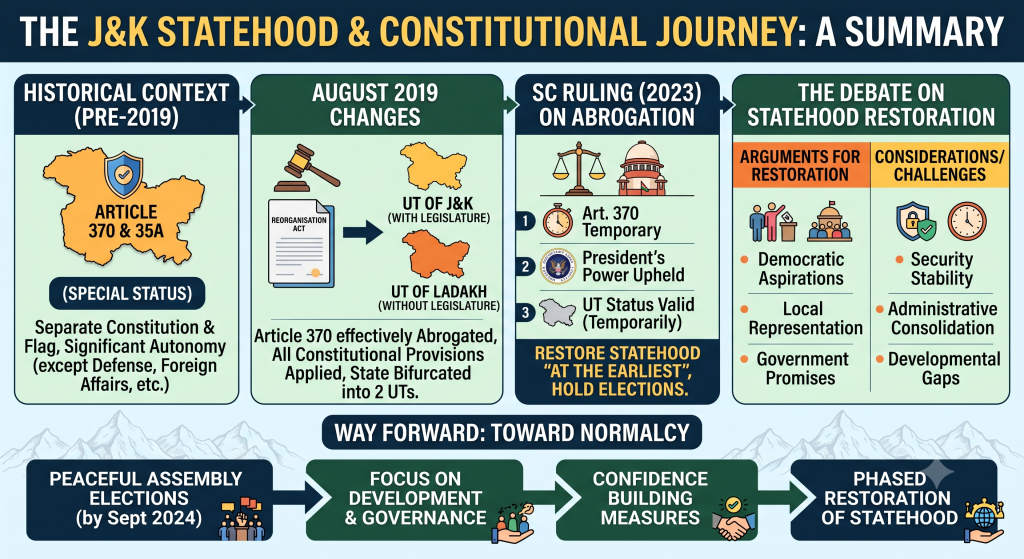
How Article 370 Shaped Jammu And Kashmir’s Special Constitutional Position
- Special constitutional status: Article 370 granted Jammu and Kashmir a distinct constitutional position within the Indian Union following its accession to India in 1947.
- Separate constitutional arrangements: Jammu and Kashmir had its own Constitution and a separate flag, along with considerable autonomy over its internal administration.
- Limited Union jurisdiction: The arrangement preserved a substantial sphere of autonomy for the State, while defence, foreign affairs, finance and communications remained outside this sphere.
- Asymmetric federalism: This special arrangement represented a form of asymmetric federalism designed to accommodate the particular historical circumstances surrounding Jammu and Kashmir’s integration with India.
How The August 2019 Changes Transformed The Constitutional Arrangement
- Effective abrogation of Article 370: On August 5, 2019, the Union government used a Presidential Order to effectively remove the special status enjoyed by Jammu and Kashmir under Article 370.
- Full application of the Constitution: Following the change, the provisions of the Constitution of India became fully applicable to the region.
- Reorganisation of the former State: Parliament enacted the Jammu and Kashmir Reorganisation Act, 2019, which divided the former State into two separate Union Territories.
- Jammu and Kashmir as a Union Territory: The Union Territory of Jammu and Kashmir was constituted with a Legislative Assembly, broadly resembling the institutional model followed in Delhi and Puducherry.
- Ladakh as a separate Union Territory: Ladakh was constituted as a Union Territory without a Legislative Assembly.
- Greater constitutional integration: Together, these measures represented a major shift from the earlier special-status framework towards closer constitutional and administrative integration with the Indian Union.
What The Supreme Court Decided On The 2019 Constitutional Changes
- Temporary character of Article 370: In December 2023, a five-judge Constitution Bench unanimously held that Article 370 was a temporary provision associated with the transitional circumstances of Jammu and Kashmir’s accession.
- Presidential power recognised: The Court upheld the President’s authority to issue the notification that effectively ended the operation of Article 370 and held that this power was not dependent upon a recommendation from the Jammu and Kashmir Constituent Assembly.
- Reorganisation framework sustained: The judgment upheld the constitutional changes associated with the reorganisation while taking note of the Union government’s submission that the Union Territory status of Jammu and Kashmir would be temporary and that its statehood would be restored.
- Different position for Ladakh: The commitment regarding restoration of statehood applied to Jammu and Kashmir and did not extend to Ladakh.
- Assembly elections directed: The Supreme Court directed the Election Commission of India to conduct elections to the Jammu and Kashmir Legislative Assembly by September 30, 2024.
- Statehood restoration emphasised: The Court also stressed that restoration of statehood to Jammu and Kashmir should take place at the earliest.
Why Restoration Of Statehood Became The Next Major Political Question
- Democratic aspirations: Supporters of early restoration argue that Union Territory status limits the degree of local political representation and that statehood would better reflect the democratic aspirations of the people.
- Commitment to restore statehood: The Union government has repeatedly stated that statehood would be restored after the security situation stabilises, while regional political parties have sought an earlier transition.
- Demand linked with elections: Several political actors have argued that restoration should either precede Assembly elections or take place alongside the revival of representative government.
- Greater authority for an elected government: Advocates of statehood contend that a fully empowered elected State government would be better placed to address local governance, development and law-and-order concerns than a system operating under greater central control.
Why The Timing Of Statehood Restoration Remains A Complex Issue
- Security considerations: The Union government has treated durable peace and security as a central consideration in determining the timing of the transition.
- Continuing security concerns: Although the overall level of violence has declined, targeted killings and cross-border terrorism continue to pose challenges.
- Administrative consolidation: Another consideration is the need to stabilise the administrative and developmental framework created following the establishment of the two Union Territories.
- Political normalisation: Peaceful elections and the effective functioning of a representative Legislative Assembly have been viewed as important stages in the broader process of political normalisation.
What A Broader Roadmap For Political Normalisation Requires
- Peaceful democratic elections: Free and fair elections were identified as an essential step for restoring meaningful representative politics and strengthening democratic participation.
- Restoration of statehood: Following political normalisation and improvements in the security environment, restoration of Jammu and Kashmir’s statehood forms a central element of the proposed political transition.
- Economic development: Continued efforts to promote economic activity, generate employment and strengthen infrastructure are considered important for long-term stability.
- Effective grassroots governance: Stronger Panchayati Raj Institutions can help deepen democratic participation and improve governance at the local level.
- Confidence-building measures: Engagement with local stakeholders and mechanisms for addressing grievances are necessary for strengthening trust between citizens and the administration.
- Balancing security and democracy: The larger challenge is to reconcile legitimate security concerns with the need for representative government and democratic empowerment.
Conclusion
The constitutional changes of August 2019 fundamentally altered Jammu and Kashmir’s relationship with the Indian Union. The Supreme Court verdict settled the principal constitutional challenge to the removal of Article 370 while simultaneously placing democratic restoration and statehood at the centre of the subsequent political process. A durable transition requires an appropriate balance between security, democratic representation, effective governance, development and public confidence.
Prelims Relevance
Article 370: Its special constitutional position, temporary character and implications for Jammu and Kashmir.
Jammu and Kashmir Reorganisation Act, 2019: Reorganisation of the former State into the Union Territories of Jammu and Kashmir and Ladakh.
Union Territories with legislatures: Constitutional distinction between Union Territories with and without Legislative Assemblies.
Presidential powers: Constitutional role of Presidential Orders in the changes relating to Article 370.
Supreme Court and constitutional interpretation: Role of a Constitution Bench in adjudicating major questions concerning federal arrangements and constitutional provisions.
Federalism: Asymmetric federalism and special constitutional arrangements within the Indian Union.
State reorganisation: Constitutional questions concerning changes in the status and territorial organisation of States and Union Territories.
Mains Relevance
GS Paper II: Indian Constitution, federalism, Centre-State relations, constitutional provisions, democratic governance and the functioning of Union Territories.
GS Paper III: Internal security, cross-border terrorism and the relationship between security conditions and political normalisation.
Useful analytical dimensions:
- Constitutional transformation following the removal of Article 370.
- Asymmetric federalism and national integration.
- Statehood versus Union Territory administration.
- Relationship between security concerns and democratic representation.
- Role of elections, development and confidence-building in political normalisation.
Relevant Prelims PYQs:
UPSC Prelims 2020:
Siachen Glacier is situated to the
(a) East of Aksai Chin
(b) East of Leh
(c) North of Gilgit
(d) North of Nubra Valley
Answer: (d) North of Nubra Valley.
UPSC Prelims 2008:
Which one of the following is the largest (areawise) Lok Sabha constituency?
(a) Kangra
(b) Ladakh
(c) Kachchh
(d) Bhilwara
Answer: (b) Ladakh.
These are closely related regional PYQs; no directly relevant Prelims PYQ on the Article 370 abrogation or restoration of Jammu and Kashmir’s statehood was identified with sufficient confidence.
Relevant Mains PYQs:
UPSC Mains 2016, GS Paper II: UPSC asked candidates to examine the temporary character of Article 370 and discuss its future prospects in the context of Indian polity. This is the most directly relevant previous-year question for the topic.
UPSC Mains 2019, GS Paper III: UPSC asked candidates to examine the role of over-ground workers in assisting terrorist organisations in insurgency-affected areas, with the question specifically arising from developments in Jammu and Kashmir.
UPSC Mains 2020, GS Paper III: UPSC asked candidates to analyse internal-security threats and transborder crimes along India’s Myanmar, Bangladesh and Pakistan borders, including the Line of Control, and discuss the role of security forces.