
The 16–30 September 2026 issue of The Policy & Issues Brief brings together debates on technological capability, constitutional rights, employment, environmental risk and public welfare. Several of these subjects overlap. Semiconductor manufacturing connects industrial policy with international competition. Solar expansion raises questions about farmer incomes and land use.
Electoral roll administration affects the exercise of citizenship rights.
The issue’s 100 notes are arranged across seven subject sections. The principal themes concern how institutions exercise authority, who receives the benefits of economic change, and what capabilities India needs to manage technological and environmental risks.
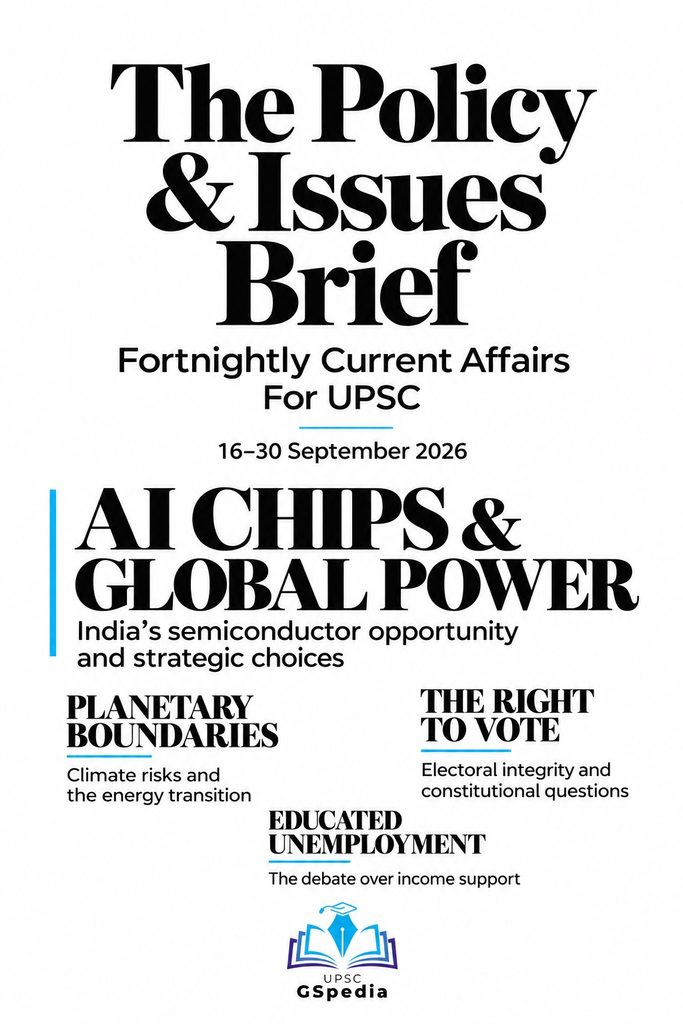
AI competition And The Semiconductor Value Chain
The AI coverage examines technological rivalry alongside India’s access to computing infrastructure and its capacity to develop domestic capabilities. It connects international competition with the semiconductor value chain, including processors, memory, packaging and specialised manufacturing.
The chip notes distinguish manufacturing from assembly and packaging, and memory capacity from bandwidth and latency. They also address commercial viability: a project’s prospects depend on utilisation, customers, technological change and the costs of production. These distinctions matter when assessing announcements about domestic chip capacity.
Notes on rare earth magnets and subsea cables extend the discussion to other concentrated supply chains and infrastructure dependencies.
Voting Rights And Institutional Accountability
The polity section examines the legal status of voting and the safeguards required during electoral roll revision. It addresses registration, wrongful exclusion, administrative procedure and the Election Commission’s role. Related notes consider appointments to the Commission, removal of the Chief Election Commissioner, party finance and disputes over election symbols.
The coverage of the Uniform Civil Code examines equality in civil rights alongside religious, cultural and tribal pluralism. Jammu and Kashmir provides another constitutional discussion, involving the territory’s legal status and the relationship between constitutional provisions, political decisions and judicial interpretation.
Employment And The Design Of Income Support
The discussion of educated unemployment considers state allowances for unemployed youth, employment transitions and the creation of suitable jobs. It examines how unemployment is measured and how qualifications can differ from the requirements of available work.
The social policy notes place cash transfers within a wider discussion of poverty reduction. Income protection, productive assets, access to services and the design of delivery systems receive separate attention. Coverage of women farmers examines recognition beyond land ownership, while the occupational safety discussion considers workers’ ability to report danger and obtain protection. The healthcare notes distinguish hospital insurance from primary care, digital access and public health preparedness.
Ecological Limits And The Distribution Of Transition Benefits
Planetary boundaries provide the scientific framework for discussing interconnected environmental pressures. The issue also covers glacier retreat, glacial lake warnings, drought governance and coastal swell risks, linking environmental change with preparedness and public administration.
The energy transition receives attention through farmer ownership of solar generation, agrivoltaics and the constraints affecting clean energy expansion. Finance, land, water, storage and power contracts determine how projects operate and how returns are distributed. Notes on deep sea mining, nuclear waste, soil carbon payments and biodiversity conservation examine further choices about resource use, environmental protection and responsibility for long term impacts.
Strategic Infrastructure And Security Policy
The international relations and security sections examine the Arctic, space weapons, trade arrangements, nuclear doctrine and AFSPA. The subsea cable discussion considers physical damage, ownership, repair capacity and international law. Nuclear doctrine is examined through deterrence, command arrangements and the pressures created by emerging technologies. The AFSPA coverage addresses operational powers alongside procedural safeguards and judicial accountability.
Across these subjects, the issue links current developments with the provisions and concepts needed to assess them. Electoral inclusion depends on administrative safeguards; technological capability depends on production and infrastructure; and welfare outcomes depend on programme design and delivery. These relationships form the substance of the fortnight’s coverage.
Click to download the book.
Download September 15 Issue here.