
A History question can be answered correctly and still remain only partly understood. Recognising a monument does not necessarily establish its patron. Remembering a movement’s name does not explain its programme. Identifying a text does not always mean knowing its author, period or tradition. These relationships determine how well knowledge holds up when familiar material appears in a different form.
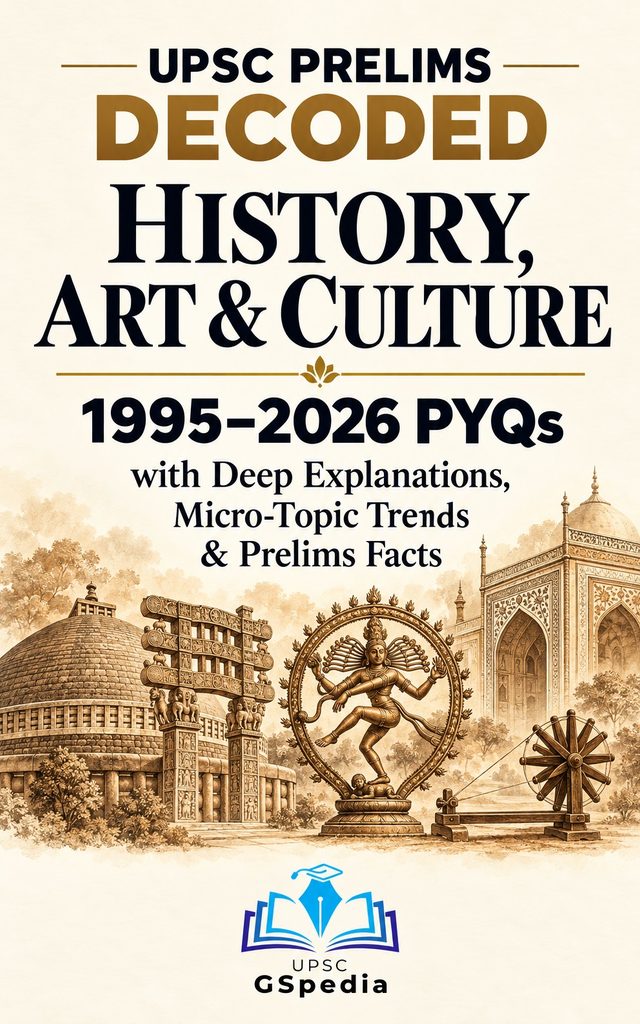
UPSC Prelims Decoded: History, Art & Culture: 1995–2026 PYQs with Deep Explanations, Micro-Topic Trends & Prelims Facts approaches previous year questions as material for subject learning, comparison and revision. The volume combines micro-topic organisation, detailed explanations, related Prelims facts and an opening chapter on examination trends.
A Clear Subject Structure
The questions are organised under Ancient History, Medieval India, Modern History, the Indian National Movement, and Art & Culture. Within these sections, smaller thematic groups allow readers to study related questions together.
This arrangement supports a different kind of reading from moving through successive annual papers. A reader working on land revenue can compare how different questions test rights, obligations and institutional relationships. A reader revising religious traditions can examine distinctions in doctrines, texts and terminology across years.
The purpose is to make the recurring concept visible without losing the particular wording and demands of each question.
Learning From the Alternatives
The explanations are organised around the structure of the question. They include option-wise, statement-wise, pair-wise and inference-wise discussion where relevant. This makes it possible to examine both the answer and the reasoning that separates it from the alternatives.
For example, the Harappan material discusses archaeological findings, craft materials, urban features and the interpretation of evidence. The question about the Dancing Girl is followed by discussion of the alternatives and related material on casting, ornamentation and other artefacts. The learning extends from identification into a more connected understanding of the topic.
The same principle applies to modern political history. A question about an organisation or movement can be used to clarify its participants, programme and circumstances. The explanation helps identify whether a mistake resulted from a missing fact or a misunderstanding of the relationship being tested.
Additional Facts Around the Tested Topic
The Additional Prelims Facts provide a second layer of study. They develop material related to the question, including institutions, historical sources, cultural features and associated personalities or places.
These sections are useful for preparing beyond the exact wording of an earlier question. Once a candidate understands a particular association, the related facts help place it among nearby concepts and potential confusions. They can also provide the basis for concise revision notes.
The original question remains the starting point. Supplementary information is most useful when the reader can explain how it relates to that topic.
What the Trend Chapter Adds
The opening chapter examines the changing balance between historical periods and the character of Art & Culture questions. It considers the continuing importance of the freedom struggle alongside the greater recent share of Ancient History and culture in the analysed collection.
It also studies how questions are constructed. Chronology, text–author relationships, monument–patron associations, regional consistency and institutional distinctions receive attention because they recur in different formats. The discussion separates specialised factual demands from difficulties created by dense associations or statement wording.
A vertical topic heatmap, grouped micro-concepts and a sequential solving framework connect these findings with preparation. The framework begins with the likely period, tests chronology and associations, and uses elimination where historical consistency provides a firm basis.
Trend analysis is treated as evidence for prioritisation. A recent cluster is identified as an emerging signal when the evidence is limited; a gap in appearances is not presented as proof that a topic has disappeared.
The Distinctive Editorial Approach
Topic-wise PYQs and explanatory answers are already available in the market. The contribution of this book lies in how its elements work together at the level of smaller topics and individual questions.
Readers can attempt a thematic group, examine the reasoning behind each answer, study related facts, and then use the trend chapter to understand the group’s place within the wider subject. This creates a connected cycle of practice, explanation and revision. The emphasis is on a consistent method of studying each topic, with explanations, supplementary facts and wider analysis serving connected purposes.
Using the Book in Preparation
Begin with a topic you have studied from a foundational source. Attempt its questions before consulting the answers. Record the reason for each error, then use the explanations and additional facts to revise the specific distinction that caused difficulty.
During later revision, return to these groups and test whether the same errors recur. Read the trend chapter as guidance on emphasis while maintaining a balanced foundation across the subject.
The volume belongs to the UPSC Prelims Decoded series, whose six subject books will cover Environment & Geography; Polity & Governance; History, Art & Culture; Indian Economy; Science & Technology; and Current Affairs & Miscellaneous. All books in the series will be published in coming months. The shared purpose is to make previous year questions useful throughout the preparation process, from understanding a topic to testing the precision of revision.
Download the kindle book from here.
Also read our current affairs magazine. Visit our ebook page.