
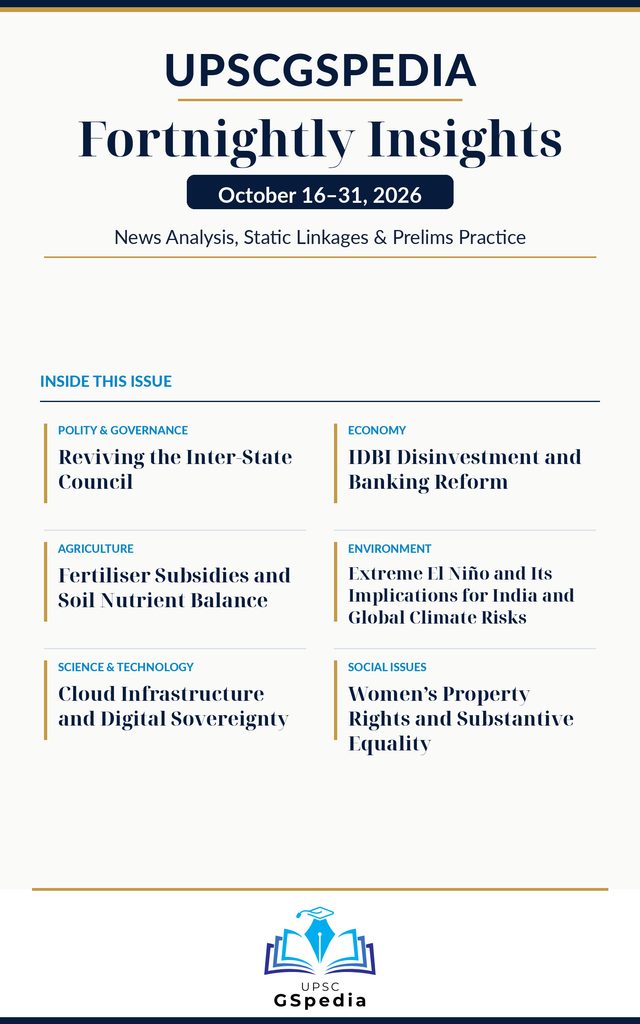
The October 16–31, 2026 issue of UPSCGSPEDIA Fortnightly Insights brings together current affairs across seven subject areas. Based on newspaper articles, official releases and accompanying factual material, the magazine examines developments alongside the institutions, concepts and policy debates needed to understand them.
Polity and governance
This section examines the Inter-State Council, Centre–State consultation, judicial appointments, separation of powers and electoral accountability. Coverage also includes Panchayat capacity, ration portability, social assistance and medical education regulation. These discussions connect current debates with questions of constitutional authority, institutional independence, public participation and administrative responsibility.
Economy and livelihoods
Economic coverage considers global debt pressures, taxation, investment, banking reform and employment. Articles on women’s economic participation and education-to-work transitions examine the relationship between human capital and access to productive work.
Agriculture receives attention through fertiliser incentives, soil nutrient balance, water productivity, crop flexibility and agrivoltaics. Farmer IDs, weather observation systems and crop insurance bring digital infrastructure and implementation challenges into the discussion. Energy and infrastructure topics include pumped storage, inland navigation and regional connectivity.
International relations
The international relations section covers UN reform, India–US strategic cooperation, India–ASEAN defence engagement and Baltic security. Satellite connectivity is examined through questions of provider diversity, strategic autonomy and access to orbital resources. These topics connect diplomatic developments with the institutions and technologies shaping international cooperation.
Environment and climate
Environmental coverage addresses energy justice, emissions, carbon markets, carbon capture and grid readiness. Discussions of El Niño, cyclone resilience and changing climate zones connect climate processes with agriculture, infrastructure and financial protection.
Conservation topics include wetlands, forests, big cats, agricultural biodiversity and indigenous seeds. Water security, wastewater treatment and estuarine contamination extend the discussion to resource management and ecological monitoring.
Science and technology
This section examines foreign technology dependence, cloud infrastructure, space commercialisation and emerging space capabilities. Green hydrogen, flex-fuel vehicles, genome editing, precision healthcare and lithium extraction illustrate the links between scientific developments and public policy. Coverage also considers open-weight AI models and cybersecurity vulnerabilities.
Social issues and internal security
Social coverage focuses on women’s property rights, educational continuity for migrant children, dignified ageing, global health threats and tribal-language preservation. The internal security section examines critical infrastructure supply chains, integrated military logistics and indigenous naval capabilities.
Static linkages and examination practice
The magazine pairs news context and analysis with relevant background material. Static linkages and additional facts explain the constitutional, institutional, economic and scientific foundations of the topics covered.
Related previous years’ questions provide a connection with UPSC examination requirements. Prelims questions support factual and conceptual revision, while Mains questions encourage examination of causes, consequences and policy alternatives. Readers can use the subject-wise structure to study a development, revisit its underlying concepts and then assess their understanding through the accompanying questions.