The United Nations Convention on the Law of the Sea provides the core legal framework for governing the world’s oceans. It defines maritime zones, allocates rights and responsibilities among states, protects navigation freedoms, regulates resource use, and provides mechanisms for peaceful dispute resolution. Its importance lies in balancing coastal-state jurisdiction with the global need for open, stable and predictable movement across the seas.
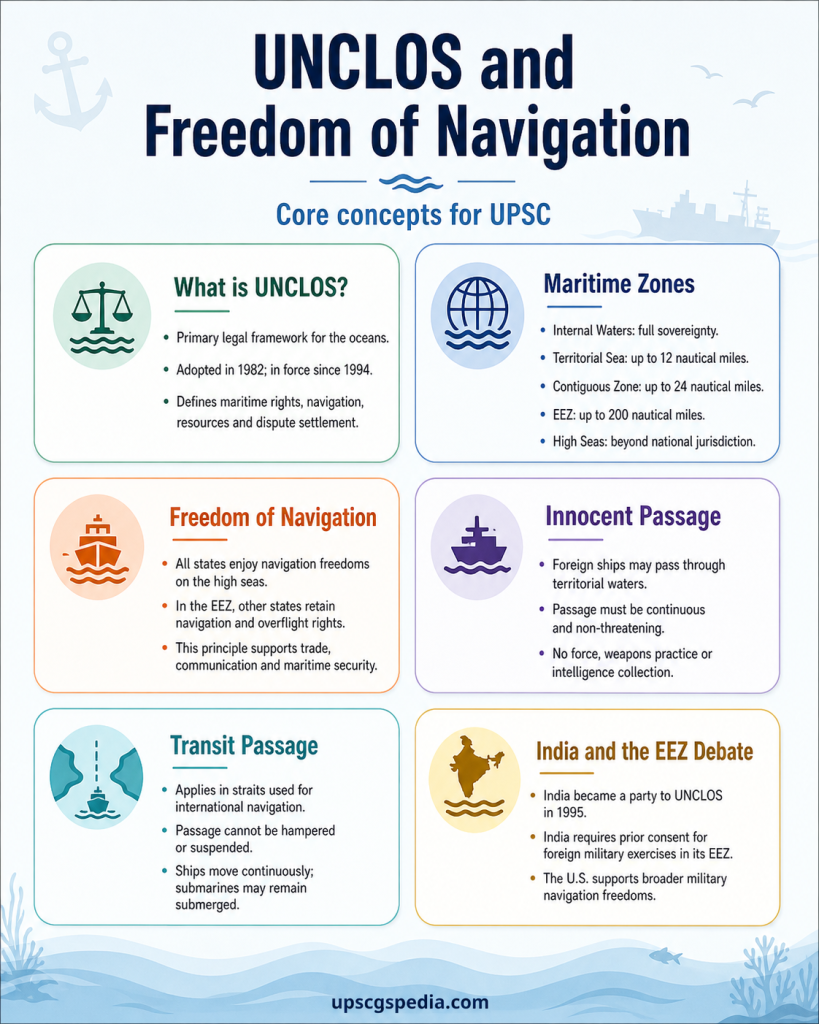
UNCLOS As The Framework For Ocean Governance
- Comprehensive Maritime Order: UNCLOS defines the rights and responsibilities of nations in their use of the world’s oceans. It sets rules for navigation, resource management, maritime jurisdiction and environmental protection.
- Constitution for the Oceans: The Convention functions as the primary international legal framework for activities at sea. It seeks to facilitate international communication, peaceful ocean use and equitable utilisation of marine resources.
- Package Deal Approach: UNCLOS was adopted as a complete legal package, requiring acceptance as a whole. This reflects the idea that ocean-related issues are interconnected and cannot be treated in isolation.
- Global Commons Principle: Seas and oceans are treated as shared spaces requiring collective management. Areas beyond national jurisdiction remain outside the sovereignty of any single state.
- Legal Stability: UNCLOS has provided a foundational legal order for the oceans for more than three decades. It has supported predictability in global trade and peaceful maritime activity.
Evolution Of UNCLOS
- Earlier Freedom of the Seas Doctrine: The older freedom of the seas doctrine limited national rights to a narrow belt of water close to the coastline. Waters beyond this belt were largely treated as international waters.
- Expansion of Maritime Claims: By the mid-20th century, countries began extending maritime claims because of mineral exploration, fishing interests and pollution concerns. These expanding claims created legal uncertainty and overlapping assertions of authority.
- Truman Declaration: In 1945, U.S. President Harry S. Truman extended American jurisdiction over natural resources on the continental shelf. Other countries later advanced similar claims over adjacent maritime areas.
- Latin American Claims: Chile, Peru and Ecuador asserted sovereign rights over larger maritime zones to protect fishing grounds and restrict foreign fishing fleets. Argentina also claimed rights over its continental shelf.
- Arvid Pardo’s Intervention: Malta’s Ambassador Arvid Pardo warned that competitive expansion of jurisdiction over the ocean floor could intensify global tensions. His intervention helped shape the movement toward a comprehensive law of the sea.
- Long Negotiation Process: UNCLOS emerged after a prolonged diplomatic process and was adopted in 1982. It entered into force in 1994, creating a comprehensive framework for maritime rights and responsibilities.
- Customary Law Question: Some UNCLOS rules are considered by several states to be firmly entrenched in customary international law. On that basis, they may apply even to states that have not ratified the Convention.
- Transit Passage Debate: The right of transit through international straits is presented as an inherent right of ships and aircraft to move without prior authorisation. States bordering such straits are not expected to hamper or suspend transit passage.
- Iran’s Position: Iran has argued that the transit passage regime is not customary international law. It therefore contests being bound by that regime in the same manner as parties to UNCLOS.
- Pre-UNCLOS Customary Law: Even before UNCLOS, customary international law did not allow strait states to prohibit, hamper or suspend innocent passage through straits used for international navigation. This reinforces the legal protection of movement through such straits.
- Conflict and Neutral Shipping: War between some states does not remove the right of other countries to move commercial ships through international straits. Restrictions may apply only to enemy vessels or ships actively assisting the enemy.
Major Law of the Sea Conferences
- UNCLOS I: The first United Nations Conference on the Law of the Sea was held in Geneva in 1958. It adopted four conventions dealing with the territorial sea and contiguous zone, the continental shelf, the high seas, and fishing and conservation of living resources.
- UNCLOS II: The second conference in 1960 failed to settle the exact breadth of territorial seas. This left important maritime boundary disputes unresolved.
- UNCLOS III: The third conference, held from 1973 to 1982, produced the comprehensive framework associated with the present Convention. It introduced provisions on maritime zones, navigation rights, archipelagic status, transit regimes, EEZs, continental shelf jurisdiction, deep seabed mining, marine environment protection, scientific research and dispute resolution.
Institutions Established under UNCLOS
- International Tribunal for the Law of the Sea: ITLOS is an independent judicial body created to resolve disputes arising from the interpretation and application of UNCLOS. It is part of the Convention’s dispute settlement architecture.
- International Seabed Authority: ISA regulates mineral-related activities in international seabed areas beyond national jurisdiction. It oversees exploration and exploitation of resources such as polymetallic nodules and other deep-sea minerals.
- Commission on the Limits of the Continental Shelf: CLCS examines and makes recommendations on claims by coastal states regarding the outer limits of continental shelves beyond 200 nautical miles. It helps implement rules on extended continental shelf claims.
- International Maritime Organization: IMO supports maritime safety, navigation and shipping regulation within the wider maritime legal framework. It also plays a role during maritime crises involving safe vessel movement and freedom of navigation.
Maritime Zones Under UNCLOS
- Baseline: The baseline is the reference line from which maritime zones are measured, usually the low-water line along the coast. Straight baselines may be used where coastlines are deeply indented or island-fringed.
- Internal Waters: Internal waters lie on the landward side of the baseline, including ports, harbours, rivers and bays. The coastal state exercises full sovereignty, and foreign ships generally have no automatic right of passage.
- Territorial Sea: The territorial sea extends up to 12 nautical miles from the baseline. The coastal state has sovereignty over the waters, airspace, seabed and subsoil, while foreign vessels enjoy the right of innocent passage.
- Contiguous Zone: The contiguous zone extends up to 24 nautical miles from the baseline. The coastal state may exercise limited control to prevent or punish violations of customs, fiscal, immigration and sanitary laws.
- Exclusive Economic Zone: The EEZ extends up to 200 nautical miles from the baseline. The coastal state has sovereign rights over natural resources, while other states retain freedom of navigation and overflight.
- Continental Shelf: The continental shelf refers to the natural prolongation of land territory and may extend up to 200 nautical miles or beyond where geographically justified. Coastal states have rights over seabed resources such as oil, gas and minerals.
- High Seas: The high seas lie beyond national jurisdiction. No state can claim sovereignty over them, and all states enjoy freedoms such as navigation, overflight, fishing and scientific research.
- Official Name: The UN High Seas Treaty is formally called the Agreement under UNCLOS on the Conservation and Sustainable Use of Marine Biological Diversity of Areas beyond National Jurisdiction. It is also known as the BBNJ Agreement.
- Purpose: The treaty creates specific laws and processes to expand UNCLOS’s broad commitment to ocean protection. It focuses on areas beyond national jurisdiction.
- Marine Protected Areas: The treaty establishes a framework for creating marine protected areas in the high seas. These areas aim to protect, preserve, restore and maintain biodiversity and ecosystems.
- Environmental Impact Assessments: Countries must conduct Environmental Impact Assessments before authorising planned marine activities such as deep-sea mining. This is meant to improve understanding of human impacts and prevent significant harm to the marine environment.
- Marine Genetic Resources: The treaty covers fair access to and use of marine genetic resources. These include genetic material derived from marine plants, animals and microbes.
- Technology Access: Access to marine technology is also addressed under the treaty. This widens the governance agenda beyond navigation and resource extraction.
Freedom of Navigation
- Core Principle: Freedom of Navigation is a central principle of UNCLOS. It enables states to use global waterways for trade, security and communication.
- High Seas Freedom: On the high seas, ships enjoy broad freedom of navigation. This freedom is subject mainly to flag-state jurisdiction and limited exceptions recognised under international law.
- Permitted Interceptions: Interception of merchant ships may be justified only in specific cases such as hot pursuit, UN Security Council authorisation, stateless vessels or flag-state consent. Unilateral interference with commercial shipping raises legal concerns.
- EEZ Navigation: In the EEZ, coastal states possess resource-related rights, but other states retain navigation and overflight freedoms. This distinction makes the EEZ a major site of legal disagreement.
- Military Navigation Debate: Some states interpret peaceful use of the EEZ as excluding foreign military activities. Others argue that military navigation and operations remain protected freedoms.
Innocent Passage in Territorial Waters
- Meaning of Innocent Passage: Foreign vessels may pass through territorial waters if their passage does not threaten the peace, good order or security of the coastal state. Passage must be continuous, expeditious and non-threatening.
- Warships and Weapons: Merchant ships and warships may enjoy innocent passage if they comply with required conditions. The presence of weapons does not automatically make passage non-innocent.
- Restrictions on Conduct: Passage ceases to be innocent if the vessel threatens or uses force, practises weapons, collects intelligence, loads or unloads goods unlawfully, or allows boarding or deboarding in violation of rules. Such conduct permits the coastal state to take measures.
- Submarine Requirement: In territorial waters, submarines must surface and show their flag. This condition distinguishes innocent passage from transit passage in international straits.
- Regulatory Space: UNCLOS leaves certain details open, allowing states to pass laws and regulations to address gaps. Questions such as prior permission for passage may therefore become contentious.
Transit Passage Through International Straits
- Special Rule for Chokepoints: International straits used for global navigation are governed by transit passage. This regime keeps strategic chokepoints open for global trade and communication.
- Continuous and Expeditious Movement: Ships and aircraft must be allowed to pass continuously and without undue delay. Coastal states bordering straits cannot hamper or suspend transit passage.
- No Tolls for Transit: States located next to international straits cannot charge tolls for the right of transit. They may regulate passage only for specific reasons such as safety of navigation and prevention of pollution.
- Submerged Transit: Submarines may transit submerged through international straits. This differs from the territorial sea regime, where submarines must surface and show their flag.
- Strait of Hormuz Example: The Strait of Hormuz is treated as an international passage where transit passage applies. At its narrowest point, Iranian and Omani territorial waters intersect, leaving no high seas or EEZ route.
Exclusive Economic Zone and the Central Legal Conflict
- Nature of the EEZ: The EEZ is an area beyond and adjacent to the territorial sea, extending up to 200 nautical miles from the baseline. It gives the coastal state economic and resource-related rights without converting the zone into territorial waters.
- Coastal-State Rights: A coastal state may explore, exploit, conserve and manage natural resources in its EEZ. It also has jurisdiction over marine research and environmental protection.
- Foreign-State Rights: Other states retain freedom of navigation and overflight in the EEZ. They also enjoy other internationally lawful uses of the sea related to these freedoms.
- Article 58 Linkage: Article 58 refers to freedoms associated with Article 87 on the high seas, including navigation. This connection is central to disputes over foreign military activities in the EEZ.
- Contested Military Activities: The main legal friction concerns whether a coastal state can regulate foreign military exercises or manoeuvres within its EEZ. Different national interpretations have produced recurring disputes.
Freedom of Navigation Operations
- Purpose of FONOPs: Freedom of Navigation Operations are conducted to challenge maritime claims regarded as excessive. They are used to assert navigational rights and resist restrictions viewed as inconsistent with UNCLOS.
- Common Targets: Such operations may challenge prior notification requirements for warships in EEZs. They may also oppose attempts to close or restrict international straits.
- Legal Signal: FONOPs are not merely naval movements but legal demonstrations. They express a state’s position on the scope of maritime freedoms under international law.
- Diplomatic Sensitivity: FONOPs may be conducted even in the waters of allies and partners. This can create tension between legal principle, sovereignty concerns and strategic partnership.
India and UNCLOS
- Role in Negotiations: India actively contributed to the negotiations that led to the 1982 Convention. It became a party to UNCLOS in 1995.
- Maritime Boundaries: India shares maritime boundaries with Bangladesh, Myanmar, Thailand, Indonesia, Sri Lanka, Maldives and Pakistan. These boundaries make UNCLOS important for India’s maritime governance.
- Continental Shelf Resources: India has exclusive rights to exploit resources on its continental shelf, including hydrocarbons, metallic minerals and non-metallic minerals. Deep-sea resource exploration carries both economic and strategic value.
- Deep-Sea Resource Interest: India has invested in exploration of polymetallic nodules, cobalt crusts and hydrothermal sulphides. Hydrocarbon discoveries in deeper continental shelf areas strengthen the strategic and economic relevance of maritime zones.
- Coastal-State Emphasis: India gives weight to the rights of coastal states in its maritime neighbourhood. This shapes its approach to foreign military activities in nearby maritime zones.
India–United States Differences on EEZ Navigation
- Treaty Status: India ratified UNCLOS in 1995, while the United States is not a party to the treaty. The United States nevertheless treats many UNCLOS provisions as customary international law.
- India’s Position: India requires prior consent for foreign military exercises or manoeuvres in its EEZ. It argues that UNCLOS does not authorise military activities in an EEZ without coastal-state consent.
- U.S. Position: The United States maintains that foreign military vessels may transit and operate without notice as part of high-seas freedoms. It rejects restrictions it views as excessive maritime claims.
- Baseline Disagreement: India uses straight baselines in certain areas, including around Lakshadweep. The United States views such baselines as excessive where they restrict the global commons.
- 2021 Lakshadweep Incident: The USS John Paul Jones conducted a FONOP about 130 nautical miles off the Lakshadweep Islands. The United States described the operation as upholding lawful uses of the sea, while India conveyed serious concern through diplomatic channels.
India’s Dual Maritime Approach
- South China Sea Position: India has become more vocal about upholding UNCLOS and freedom of navigation in the South China Sea. This position is linked to concerns over expansive maritime claims and the need for lawful passage.
- Support for Tribunal Ruling: India has moved from a more neutral tone toward explicit support for the 2016 Hague Tribunal ruling in favour of the Philippines against China. This marks a clearer legal position on South China Sea disputes.
- Economic Relevance: More than 55% of India’s trade passes through the South China Sea. Free passage through this region is therefore economically significant.
- Indian Ocean Position: In the Indian Ocean Region, India stresses its maritime neighbourhood and the rights of coastal states. This leads to a more restrictive view of foreign naval freedoms in nearby waters.
- Strategic Paradox: India supports freedom of navigation in the South China Sea while favouring stronger coastal-state control in the Indian Ocean. This creates a dual-track approach shaped by regional context.
- Domestic Sanctions: U.S. sanctions are based on domestic law and are not equivalent to international authorisation. Domestic legal measures cannot by themselves replace international legal authority.
- UN Security Council Role: Coercive action against ships on the high seas has stronger legal basis when supported by UN Security Council authorisation. This distinction is important for assessing legality.
- Unilateral Interception: Interception of merchant ships without recognised legal authority raises concerns under freedom of navigation principles. Such actions may conflict with the open character of the high seas.
- IMO’s Crisis Role: The International Maritime Organization can facilitate safe evacuation of ships and support freedom of navigation during maritime crises. It has also opposed tolls and permits for transit and condemned attacks on commercial vessels.
Collaboration Despite Legal Differences
- Quad Framework: India and the United States continue to cooperate with Japan and Australia through the Quad. Legal disagreement over EEZ interpretation has not prevented broader maritime collaboration.
- Malabar Exercises: Large-scale naval exercises such as Malabar improve interoperability among participating navies. These drills support coordination despite differences on some legal interpretations.
- Information Fusion Centre: The IFC-IOR supports real-time data sharing to monitor merchant ships and address threats such as piracy and illegal fishing. It reflects cooperation in maritime domain awareness.
Modern Maritime Disputes and Challenges
- South China Sea Disputes: Disputes over island features and straight baselines have generated concerns over claims that convert wide maritime areas into internal waters. Such claims are criticised for limiting lawful navigation.
- Red Sea and Strait of Hormuz Risks: Attacks on commercial shipping and attempts to impose tolls or fees create concerns for global supply chains. These developments test the practical strength of freedom of navigation.
- Interpretation Gaps: UNCLOS leaves room for varied national interpretations, especially on military activities in EEZs. These gaps allow states to defend different legal positions based on self-perception and strategic interest.
- Geopolitical Constraints: UNCLOS works strongly as a framework for norms, but enforcement may be affected by wider geopolitical considerations. Compliance depends heavily on state behaviour.
Dispute Settlement and Effectiveness
- Compulsory Mechanism: UNCLOS contains a compulsory dispute settlement mechanism. States may initiate proceedings against one another under the Convention.
- Available Forums: Disputing states may choose the International Court of Justice, the International Tribunal for the Law of the Sea or arbitration. These options provide multiple paths for legal resolution.
- Successful Resolution: Disputes such as the land reclamation dispute between Singapore and Malaysia have been resolved through UNCLOS-linked mechanisms. This reflects the practical utility of the Convention.
- Limits of Enforcement: UNCLOS is stronger in setting norms than in ensuring full compliance. Its effectiveness depends on states accepting and implementing legal obligations.
- Enduring Relevance: Despite limitations, UNCLOS remains central to stability and predictability in global maritime activity. It continues to serve as a foundation rather than a perfect enforcement system.
Conclusion
UNCLOS remains the core legal architecture for balancing sovereign rights, resource control, navigational freedoms and ocean conservation. Its strength lies in creating a common vocabulary for maritime zones, rights and responsibilities; its weakness lies in the interpretive space left to states pursuing divergent interests.
For UPSC preparation, its importance extends beyond international law to maritime security, global trade, India’s strategic choices, environmental governance and the evolving politics of the global commons.
UPSC Prelims Quiz
Practice exam-oriented current affairs questions daily and track your preparation effectively.
Attempt Quiz →