
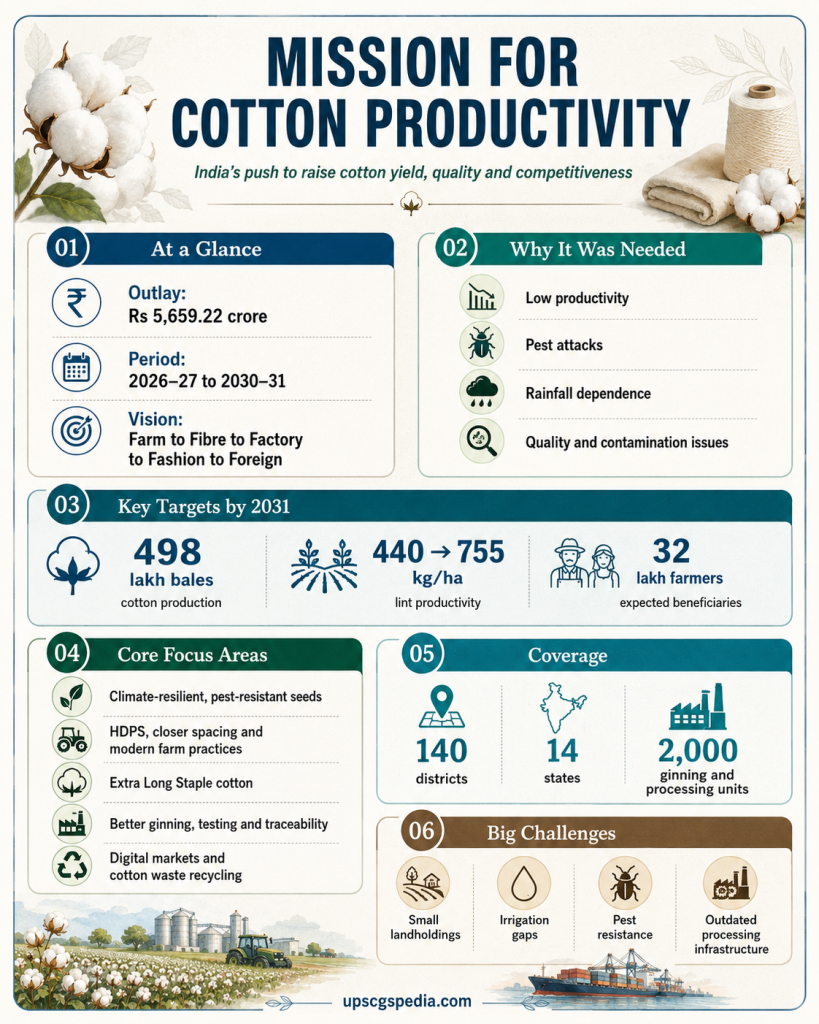
India’s cotton economy stands at a critical point where large acreage and global production strength have not translated into comparable productivity, fibre quality or export competitiveness. The Mission for Cotton Productivity, approved with an outlay of Rs 5,659.22 crore for 2026–27 to 2030–31, seeks to correct these structural weaknesses by linking farm-level productivity, seed innovation, quality control, processing modernisation, branding, traceability and market access into a single reform framework.
India’s Cotton Paradox
- Large Footprint, Modest Yield: India has the world’s largest area under cotton cultivation and contributes nearly one-fifth to one-fourth of global cotton output. Yet its lint productivity remains around 440–447 kg per hectare, far below the global average of about 770 kg per hectare.
- Global Comparison: India’s cotton productivity is significantly lower than Brazil’s 1,830 kg per hectare and the United States’ 1,065 kg per hectare. This weakens farmer income, processing efficiency and export competitiveness.
- Commercial Centrality: Cotton, often described as White Gold, is India’s most important commercial crop. It supports around 6 million farmers and millions more in processing, trade, textile manufacturing and allied activities.
- Textile Linkage: Cotton is not only an agricultural commodity but also a strategic input for India’s textile sector. Its quality and availability directly influence employment, exports, foreign exchange earnings and industrial competitiveness.
Why Cotton Productivity Reform Became Necessary
- Stagnant Growth: India’s cotton sector has faced declining growth trends and persistent bottlenecks in yield improvement. Low productivity has remained a core structural constraint despite the country’s large cultivated area.
- Rainfed Vulnerability: About 67% of Indian cotton cultivation depends on rainfall, leaving the crop exposed to weather fluctuations. Even where irrigation exists, water supply often depends on canal release rather than crop-specific demand.
- Climate Stress: Cotton cultivation in rainfed and semi-arid regions such as Vidarbha, Marathwada and parts of Telangana is highly vulnerable to erratic monsoon patterns and climate change. This makes productivity gains difficult without assured moisture support.
- Pest Pressure: Recurring attacks by Pink Bollworm and Whitefly have damaged yields and raised input costs. The earlier gains from Bt Cotton have weakened as pests developed resistance.
- Quality Erosion: Indian cotton has historically suffered from contamination and high trash content because of manual picking and outdated ginning practices. This lowers its value in premium international markets.
- Import Dependence: India’s textile industry depends heavily on imported Extra Long Staple cotton, mainly from Egypt and the United States, for high-end garments. Domestic production of this premium cotton variety remains inadequate.
Extra Long Staple Cotton
Premium Quality
Extra Long Staple cotton, mainly derived from Gossypium barbadense, is associated with Egyptian and Pima cotton. It is considered a high-quality textile fibre because of its superior fibre quality and staple length of 30 mm or more.
Domestic Shortfall
India’s domestic production of Extra Long Staple cotton does not meet domestic demand. This forces dependence on imports for high-end garments.
Mission Relevance
Expanding this variety can reduce import dependence and support premium textile manufacturing. Drought-tolerant, pest-resistant and disease-resistant seeds are important for its development.
The Mission’s Reform Logic
- Integrated Value Chain Approach: The mission is built around the 5F vision of Farm to Fibre to Factory to Fashion to Foreign. Its design links agricultural productivity with textile manufacturing, branding, exports and global market positioning.
- Productivity and Quality Together: The mission does not treat yield improvement and fibre quality as separate objectives. It combines better seeds, improved farming methods, contamination reduction, modern testing and processing reforms.
- Farmer-Centred Outcome: Around 32 lakh farmers are expected to benefit from the mission. Higher yields, better-quality cotton, transparent markets and improved price realisation form the core farmer-facing gains.
- Self-Reliance Objective: The mission seeks to make India more self-reliant in cotton by strengthening domestic production, reducing quality gaps and supporting premium cotton development. This also supports the wider goal of Atmanirbhar Bharat.
Institutional Framework
- Joint Implementation: The mission will be implemented by the Ministry of Agriculture and Farmers Welfare and the Ministry of Textiles. This joint structure reflects the connection between farm production, fibre quality, processing and textile exports.
- Scientific Support: Ten institutes of the Indian Council of Agricultural Research, one institute of the Council of Scientific and Industrial Research and 10 centres of the All India Coordinated Research Project on Cotton will be involved. Their role is central to seed development, technology validation and field-level scaling.
- Field-Level Network: State Agriculture Departments, Krishi Vigyan Kendras and State Agricultural Universities will support farmer training and technology adoption. This institutional network is essential for transferring improved practices from research systems to farms.
- Initial Coverage: The first phase will focus on 140 districts in 14 major cotton-growing states. It will also cover 2,000 ginning and processing factories to connect farm output with better post-harvest quality.
Production and Productivity Targets
- Production Goal: The mission aims to achieve cotton production of 498 lakh bales by 2031, with each bale weighing 170 kg of lint. This target reflects the mission’s ambition to expand output through productivity improvement.
- Yield Goal: Lint productivity is targeted to rise from 440 kg per hectare to 755 kg per hectare by 2031. This is the most important measurable outcome of the mission.
- Quality Goal: The mission aims to reduce trash content in cotton to below 2%. This is linked to the promotion of Kasturi Cotton Bharat, traceability and certification.
- Export Orientation: High-quality cotton exports are a major focus of the mission. Better quality testing, processing, branding and traceability are meant to strengthen India’s credibility in global markets.
Cotton Cultivation in India
- Agro-Climatic Needs: Cotton is a subtropical crop that requires warm, sunny and frost-free conditions with adequate humidity. It grows well in deep alluvial soils, black clayey soils and red-black mixed soils.
- Water Sensitivity: Cotton can tolerate some salinity but is highly vulnerable to waterlogging. Proper drainage is therefore critical for healthy cultivation.
- Cropping Season: Cotton is primarily a Kharif crop. Sowing starts in early April-May in northern India and during the monsoon season in the southern zone.
- Major Producing States: Maharashtra, Gujarat, Telangana and Karnataka were the largest cotton-producing states according to 2024–25 estimates. These states form the core of India’s current cotton production geography.
- Regional Zones: Most cotton is produced in nine major cotton-growing states grouped into northern, central and southern zones. Punjab, Haryana and Rajasthan form the northern zone; Gujarat, Maharashtra and Madhya Pradesh form the central zone; Telangana, Andhra Pradesh and Karnataka form the southern zone.
- Additional States: Cotton is also grown in Odisha and Tamil Nadu. This wider spread reflects the crop’s diverse agro-ecological presence in India.
Seed Technology and Fibre Quality
- Hybrid Cotton: Hybrid cotton is produced by crossing two parent varieties with different traits. Such crossing may also occur naturally through cross-pollination.
- Bt Cotton: Bt Cotton is a genetically modified variety that resists common pests, especially bollworms. However, resistance in pests such as Pink Bollworm and Whitefly has reduced the durability of earlier gains.
- Regulatory Position: Genetically modified herbicide-tolerant cotton is not approved for commercial cultivation in India. This remains relevant in discussions on seed technology and future productivity pathways.
- Need for New Varieties: Existing seed technology has been identified as outdated, creating an urgent need for early maturing, hybrid, climate-resilient and pest-resistant seeds suited to Indian conditions.
- Early Maturing Options: The Central Institute for Cotton Research, Nagpur has suggested that early maturing Bt and non-Bt varieties can be used in 20% of the cotton area where long-duration Bt hybrids are grown. Such varieties may help improve productivity in suitable regions.
- Protection of Innovation: New seed varieties need protection under the Protection of Plant Varieties and Farmers’ Rights Authority. This can encourage private participation in cotton-seed development.
Technology-Led Farm Reform
- Modern Cultivation: High Density Planting System, Closer Spacing and Integrated Cotton Management will be promoted to improve yield. These techniques seek to make cultivation more intensive and efficient.
- Climate-Smart Seeds: The mission promotes high-yielding, climate-resilient and pest-resistant cotton seeds. This is essential for reducing crop losses and improving productivity under uncertain weather conditions.
- Production and Protection Tools: The mission supports both production technologies and crop-protection technologies. This broader approach recognises that productivity depends on seed quality, agronomy and pest management together.
- Farmer Capacity Building: Large-scale farmer training will be carried out through Krishi Vigyan Kendras, State Agricultural Universities and state agriculture departments. Such training is necessary because modern methods require careful field-level adoption.
Processing, Testing and Branding Reform
- Ginning Modernisation: Ginning and processing units will be upgraded through capacity-building, modern technologies and best processing practices. This is critical to reducing contamination and improving fibre value.
- Quality Testing: Modern, standardised and accredited cotton-testing facilities will be strengthened across the country. Reliable testing is necessary for credible quality assessment and global benchmarking.
- Traceability and Certification: Kasturi Cotton Bharat will support branding, certification and traceability. It aims to position Indian cotton as a premium, sustainable and globally trusted product.
- Contamination-Free Supply: The mission seeks to ensure a low-contaminant cotton supply for industry. Improved harvesting, storage, ginning and processing practices are essential for this goal.
- Market Credibility: Better processing and testing can improve India’s reputation in premium international markets. This directly supports the mission’s export-oriented objective.
Market Access and Digital Integration
- Digital Mandis: Market yards will be digitally integrated to improve transparent price discovery. This can help farmers access markets more directly and improve realisation through e-platforms.
- Direct Market Linkage: Better market integration can reduce dependence on intermediaries and strengthen farmer bargaining power. The Cott-Ally app may also support direct access to market information.
- Price Realisation: Productivity gains alone may not improve farmer welfare unless they are matched by better prices. Transparent markets and assured procurement are therefore important for income stability.
- MSP and Procurement: Assured procurement at remunerative prices has been recommended to protect farmers from cheap cotton inflows. Cotton MSP is currently recommended at 1.5 times the A2+FL production cost, which includes input cost and family labour.
Sustainability and Fibre Diversification
- Circular Economy: Cotton waste recycling and reuse will be encouraged to improve resource efficiency and reduce environmental impact. This can also create additional value streams for industry.
- Sustainable Textile Production: The mission promotes environmentally sustainable textile production and innovation. This places cotton reform within a wider sustainability agenda.
- Natural Fibre Base: Natural fibres such as flax, ramie, sisal, milkweed, bamboo and banana will be promoted. Their strategic integration is intended to complement cotton and respond to evolving global demand patterns.
- Resource Efficiency: Recycling, waste reduction and natural-fibre diversification can reduce the environmental footprint of the textile value chain. This makes sustainability a core element of cotton-sector reform.
Significance for Farmers and Industry
- Farmer Income: Higher productivity and better-quality cotton can improve farm profitability. Transparent market access and improved realisation can further strengthen farmer income.
- Textile Strengthening: A reliable supply of high-quality cotton will support India’s textile industry. This is important because the sector is closely linked to employment and exports.
- Import Substitution: Expanding Extra Long Staple cotton can reduce India’s dependence on imported premium cotton. This is especially relevant for high-end textile manufacturing.
- Export Competitiveness: Improved quality standards, branding and traceability can help India compete better in global cotton and textile markets. Kasturi Cotton Bharat is central to this export-facing strategy.
- Employment Creation: The mission can generate opportunities in agriculture, textile manufacturing, processing, logistics and research and development. Its economic significance therefore extends across the value chain.
Implementation Challenges
- Moisture Constraint: High Density Planting System and Closer Spacing depend heavily on assured moisture. Without micro-irrigation, these methods may underperform during dry spells or erratic monsoons.
- Soil Stress: Continuous cotton cultivation without crop rotation or residue management has weakened soil health. Monocropping and excessive fertiliser use have depleted soil organic carbon in traditional cotton belts.
- Biological Threats: Pest resistance remains a major challenge for new seed technologies. Truly resilient varieties must withstand evolving threats from Pink Bollworm, Whitefly and other pests.
- Small Farms: Many cotton farmers are small and marginal, often owning less than 2 hectares. Fragmented landholdings make mechanised harvesting and high-density farming less economically viable.
- Mechanisation Gap: Manual picking is becoming less viable as rural labour becomes scarce and expensive. Mechanised cotton harvesters are costly, making custom hiring centres and cooperative models necessary.
- Processing Behaviour: The decentralised processing sector has long relied on practices that contribute to contamination. Achieving global standards will require capital investment and behavioural change.
- Adoption Risk: Farmers may hesitate to shift from traditional spacing and familiar seed varieties to new systems. Adoption will require awareness, financial support, risk mitigation and sustained hand-holding.
- Cost Pressure: Proprietary seeds, fertilisers and pest management can raise cultivation costs. If higher yields do not translate into higher MSP realisation or better market prices, debt risks may deepen.
- Global Competition: India faces strong export competition from Brazil, the United States and Australia. Productivity and quality improvements are therefore essential for international competitiveness.
Reform Measures Needed
- Extension Depth: The success of new seeds and modern cultivation methods depends on strong Lab-to-Land transfer. Krishi Vigyan Kendras and State Agricultural Universities must actively train farmers in practical field conditions.
- Irrigation Linkage: The mission should be coupled with Pradhan Mantri Krishi Sinchayee Yojana and Per Drop More Crop. Micro-irrigation support is crucial in rainfed cotton belts.
- Demand-Based Watering: Irrigation must gradually shift from canal-release dependence to crop-need-based supply. This can improve the reliability of productivity-enhancing methods.
- Mechanisation Support: Subsidies and institutional support for mechanised harvesters are needed alongside HDPS promotion. Custom hiring centres and cooperative models can make machinery accessible to small farmers.
- Integrated Pest Management: Sole dependence on genetically modified seeds can accelerate pest adaptation. Pheromone traps, biopesticides and mandatory refuge crops should be integrated into cotton pest management.
- Farmer Health Protection: Excessive pesticide use in cotton belts has created serious health risks, including eye diseases, cataracts and blindness from prolonged chemical exposure without proper safety equipment. Safer farming practices, subsidised protective gear and occupational safeguards are essential.
- Digital Advisories: AI and satellite data can provide farmers with real-time, hyper-local information on weather anomalies, soil moisture and early pest attacks. Smartphone-based advisories can improve timely decision-making.
- Seed Affordability: Bt cotton hybrid seeds are largely produced by the private sector, and annual purchase adds to farmer debt. Financial support, price caps and stronger seed development can reduce this burden.
- Private Participation: Private-sector partnership is considered viable across cotton development. It can support seed innovation, processing modernisation, branding and digital extension.
Conclusion
The Mission for Cotton Productivity is most significant because it treats cotton not merely as a crop but as a full economic chain connecting farmers, fibre quality, processing, branding, exports and sustainable textiles. Its success will depend on whether scientific seed development, irrigation support, farmer training, pest management, mechanisation, quality control and market reform are implemented together with strong state ownership and credible institutional coordination.
UPSC Prelims Quiz
Practice exam-oriented current affairs questions daily and track your preparation effectively.
Attempt Quiz →