
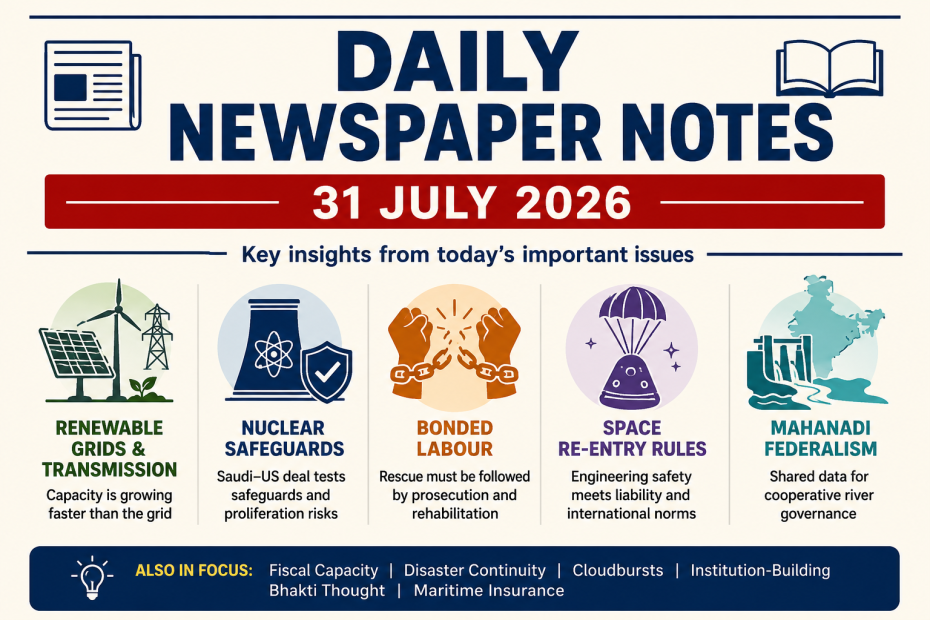
Today’s Daily Newspaper Notes examine how resilience depends on institutions that connect capacity with accountability. India’s renewable expansion is outrunning transmission, while the Saudi–US civil nuclear agreement tests the safeguards separating peaceful use from proliferation risk. Bonded labour persists because rescue is not consistently followed by prosecution and rehabilitation.
New rules for planned spacecraft re-entry combine engineering safety with international liability, and renewed Odisha–Chhattisgarh talks show how shared data can support cooperative river governance. Micro notes cover fiscal capacity, disaster continuity, scientific institution-building, Bhakti thought and maritime insurance.
Today in Five Minutes
About 21 GW of renewable capacity reportedly depends on temporary network access while awaiting associated transmission infrastructure.
Saudi Arabia has comprehensive IAEA safeguards but no Additional Protocol in force; the terms governing possible enrichment remain unpublished.
Article 23 and the Bonded Labour System (Abolition) Act prohibit bondage, but durable freedom requires release certificates, rehabilitation and livelihood security.
IN-SPACe requires planned re-entries to satisfy casualty-risk, debris-footprint, warning and liability conditions.
Odisha and Chhattisgarh have reopened negotiations over the Mahanadi while tribunal proceedings continue.
A cloudburst requires rainfall of at least 100 mm in an hour over approximately 20–30 sq. km; destructive rain is not automatically a cloudburst.
Articles Published Today
When Renewable Capacity Grows Faster than the Grid
Section: Economy
India’s renewable build-out is outrunning transmission capacity, forcing temporary network access and curtailment while exposing developers, lenders and the 2030 clean-energy transition to avoidable risk.
Saudi–US Civil Nuclear Cooperation: Reactor, Enrichment and Safeguards
Section: International Relations
The Saudi–US agreement can widen peaceful nuclear cooperation, but enrichment ambiguity and incomplete safeguards require published terms, stronger IAEA access, technology controls and credible consequences for breach.
Why Bonded Labour Endures after Legal Abolition
Section: Social Issues
India’s anti-bondage framework abolishes debt-based labour, yet weak identification, prosecution and rehabilitation leave many survivors formally rescued but not securely free, without restored wages, entitlements, safety or economic independence.
Governing The Planned Re-entry Of Space Objects
Section: Science and Technology
IN-SPACe’s planned re-entry framework turns spacecraft return into an authorisation problem involving debris survivability, casualty-risk modelling, advance air-and-sea warnings, insurance and operator liability before a controlled return is approved.
Resolving the Mahanadi Dispute through Data and Cooperative Federalism
Section: Polity and Governance
Odisha and Chhattisgarh have reopened political negotiations over the Mahanadi, but a durable settlement requires shared hydrological data, lean-season rules, ecological safeguards and enforceable basin institutions.
Cloudburst: Scientific Threshold and Governance Use
Section: Environment
Cloudbursts are often blamed for destructive rainfall, but the term has a precise scientific threshold. The article examines how extreme rain forms, why forecasting is difficult, and how misuse of the label can obscure failures in drainage, land use and disaster preparedness.
Prelims Facts from Micro News
Tamil Nadu’s Revenue Augmentation Committee
News Context: Tamil Nadu has constituted a committee chaired by former Planning Commission Deputy Chairman Montek Singh Ahluwalia to examine declining own-revenue mobilisation despite rapid economic growth.
Core Source Trigger: “Tamil Nadu is growing rapidly. Why are its revenues not keeping pace?”, The Indian Express, July 30, 2026.
Key Prelims Facts
- State own-tax revenue reportedly declined from 5.93% to 5.45% of GSDP between 2021–22 and 2025–26 pre-actuals.
- State GST, excise, stamp duty and registration charges, and motor-vehicle tax are own-tax sources.
- A State’s share in central taxes is a transfer from the divisible pool, not own-tax revenue.
- Tax buoyancy measures how revenue changes relative to the tax base or economy.
- Pre-actual figures remain provisional and may change in final accounts.
Prelims Trap: Economic growth does not automatically create equivalent fiscal capacity when tax effort or administration weakens.
Japan’s Secondary-Capital Framework
News Context: On July 24, 2026, Japan’s House of Councillors approved the secondary-capital bill, completing its passage through the National Diet. The framework seeks to preserve essential political, administrative and economic functions if a large-scale disaster makes it difficult for Tokyo to continue operating as the national centre. It also aims to reduce the excessive concentration of population and economic activity in the Tokyo region.
Source: “Why earthquake-prone Japan wants to set up a second capital,” The Indian Express, July 30, 2026.
Key Facts
- Two-Level Backup Structure: The bill distinguishes between a secondary capital, capable of temporarily replacing all or most of Tokyo’s core functions, and capital core-function alternative regions, which may substitute only selected functions.
- Pacific Seismic Belt: Japan lies within the circum-Pacific zone of intense seismic and volcanic activity commonly called the Pacific Ring of Fire.
- Plate Interaction: Around Japan, the oceanic Pacific Plate and Philippine Sea Plate move beneath continental plates generally identified as the North American and Eurasian plates. Their interaction produces both plate-boundary and intraplate earthquakes.
- Nankai Trough: The Nankai Trough is an approximately 700-km-long elongated submarine depression extending from waters south of Shikoku towards Suruga Bay. It marks the subduction of the Philippine Sea Plate beneath the continental plate and can generate major megathrust earthquakes and tsunamis.
- Tokyo Earthquake Risk: Japan’s official assessment places the probability of an earthquake of around magnitude 7 occurring beneath southern Kanto within the next 30 years at approximately 70%. This does not mean that a specific earthquake in Tokyo has been predicted.
- Magnitude and Intensity: Magnitude measures the overall size or energy of an earthquake, whereas seismic intensity measures the strength of shaking at a particular location. A single earthquake therefore has one principal magnitude but different intensities across different places.
- Sendai Framework Link: The Sendai Framework for Disaster Risk Reduction 2015–2030 was adopted at Sendai in Japan. Global Target D seeks to reduce damage to critical infrastructure and disruption of basic services, while Priority 4 focuses on disaster preparedness and “Build Back Better” in recovery, rehabilitation and reconstruction.
- National Diet: Japan’s bicameral legislature consists of the House of Representatives, the lower house, and the House of Councillors, the upper house.
Prelims Trap: Capital relocation, functional division and disaster-backup arrangements are distinct concepts. A secondary capital reduces geographical concentration but cannot by itself eliminate correlated seismic, cyber, energy, communications or supply-chain failures.
150 Years of the Indian Association for the Cultivation of Science
News Context: The Indian Association for the Cultivation of Science completed 150 years on July 29, renewing attention to its role in establishing research conducted by Indians under colonial rule.
Core Source Trigger: “150 years of the Indian Association for the Cultivation of Science,” The Hindu, July 29, 2026.
Key Prelims Facts
- IACS was founded in Kolkata on July 29, 1876 by physician Mahendralal Sircar.
- Sircar had publicly advocated a national institution for experimental science from 1869.
- C.V. Raman used its laboratories while serving as a government officer in Calcutta.
- Raman announced the Raman effect in 1928 and received the 1930 Nobel Prize in Physics.
- The Raman effect concerns changes in wavelength when light is scattered by matter.
- IACS is presently an autonomous institution under the Department of Science and Technology.
Prelims Trap: IACS predates the Indian Institute of Science and was not established by the colonial government.
Guru Ravidas, Begumpura and the Bhakti Tradition
- News Context: A nationwide commemoration campaign was launched ahead of Guru Ravidas’s 650th birth anniversary, renewing attention to his anti-caste social thought and devotional poetry.
- Core Source Trigger: “As parties rush to honour Guru Ravidas, revisiting his legacy of Dalit resistance in Punjab and beyond,” The Indian Express, July 31, 2026.
Key Prelims Facts
- Ravidas was a fifteenth–sixteenth-century north Indian Bhakti saint associated with devotion to a formless divinity.
- He challenged caste hierarchy and affirmed the dignity of labour.
- Begumpura presents an ideal society free from fear, hierarchy and deprivation.
- His devotional idiom is often associated with the north Indian Sant tradition.
- His compositions form part of the Bhagat Bani in the Guru Granth Sahib.
- The twentieth-century Ad Dharm movement in Punjab drew upon his legacy.
Prelims Trap: Ravidas belonged to the north Indian Sant tradition, not the Tamil Alvar or Nayanar traditions.
Bharat Maritime Insurance Pool and P&I Cover
- News Context: The Department of Financial Services launched a sovereign-backed Protection and Indemnity product under the Bharat Maritime Insurance Pool on July 30. The first policy was issued to the Shipping Corporation of India.
- Core Source Trigger: “DFS Launches Protection & Indemnity Insurance Product under Bharat Maritime Insurance Pool,” PIB, July 30, 2026.
Key Prelims Facts
- P&I insurance covers specified third-party liabilities of shipowners, including crew injury, pollution and wreck removal.
- Hull insurance principally protects the vessel against insured physical damage.
- Cargo insurance protects goods in transit.
- The BMIP product offers a combined indemnity limit of up to $1.5 billion.
- BMIP began operating on May 12, 2026 with a sovereign guarantee.
- War-risk policies cover specified conflict-related perils commonly excluded from ordinary cover.
Prelims Trap: P&I, hull, cargo and war-risk insurance protect different legal and economic interests.
Mains Practice Questions
India’s renewable-energy transition increasingly depends on the timely development of transmission, storage and flexible demand rather than generation capacity alone. Analyse.
Explain evacuation constraints, GNA and curtailment.
Examine project-finance and grid-stability implications.
Recommend coordinated planning, storage and regulatory reforms.
Civil nuclear cooperation should be evaluated through technology control and verification rather than by treating every reactor as either harmless or weapon-destined. Examine with reference to the Saudi–US agreement.
Legal abolition cannot end bonded labour unless rescue is followed by certification, rehabilitation and economic reintegration. Discuss.
India’s expanding commercial and human-spaceflight programmes require regulation of spacecraft re-entry as well as launch. Analyse the scientific, liability and institutional dimensions.
Can negotiated basin governance overcome the structural and procedural weaknesses of inter-State river-water adjudication? Evaluate with reference to the Mahanadi dispute.
UPSC Prelims Quiz
Practice exam-oriented current affairs questions daily and track your preparation effectively.
Attempt Quiz →