
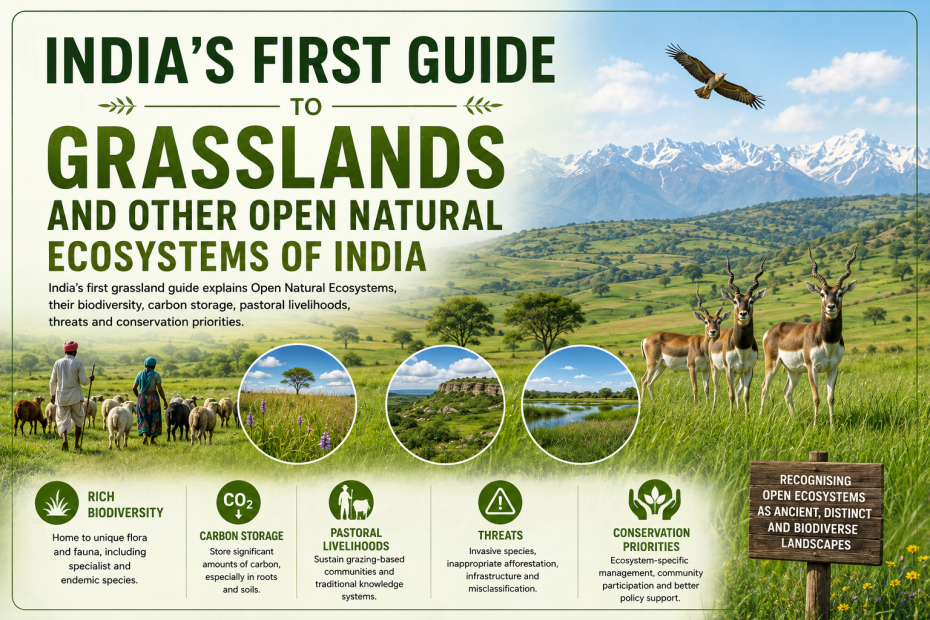
India’s environmental policy has traditionally given greater attention to forests, while many naturally open landscapes have been classified as scrub, fallow or wasteland. The Guide to Grasslands and Other Open Natural Ecosystems of India challenges this tree-centric approach. By recognising open ecosystems as self-sustaining biomes with their own ecological processes, biodiversity and livelihood systems, the guide provides a framework for conservation that is distinct from conventional forest management.
The Guide And Its Institutional Basis
- Launch at UNCCD COP17: India launched its first comprehensive guide to grasslands and other Open Natural Ecosystems at the 17th Session of the Conference of the Parties to the United Nations Convention to Combat Desertification in Ulaanbaatar, Mongolia.
- Government support: The guide was released under the aegis and direction of the Ministry of Environment, Forest and Climate Change.
- Scientific collaboration: Its preparation was led by the Ashoka Trust for Research in Ecology and the Environment in partnership with the International Union for Conservation of Nature, Centre of Excellence on Sustainable Land Management, Indian Council of Forestry Research and Education and ISRO’s Space Applications Centre.
- Changing the ecological lens: The guide rejects the assumption that landscapes without dense tree cover are necessarily degraded forests. It treats many such areas as naturally open ecosystems whose ecological integrity depends on remaining open.
What Open Natural Ecosystems Mean
- Ecological definition: Open Natural Ecosystems are terrestrial biomes in which the dominant vegetation consists of native grasses, sedges, herbs and drought-resistant low shrubs, while trees are absent, sparse or arranged in an open structure.
- Large geographical presence: These ecosystems cover more than 10% of India’s geographical area, amounting to roughly 320,000–350,000 sq km.
- Low formal protection: Less than 5% of India’s Open Natural Ecosystems fall within the formal Protected Area network of National Parks and Wildlife Sanctuaries.
- Exceptional diversity of landscapes: ONEs include alpine meadows, alluvial floodplains, sand dunes, saline flats, semi-arid savannas, thorn scrublands, rocky plateaus, riverine badlands and coastal open habitats.
The concept therefore extends beyond conventional grasslands. It provides a broader ecological category for landscapes whose natural character is open rather than forested.
Major Open Ecosystems Identified
- Thar and Banni grasslands: The arid and semi-arid landscapes of western Rajasthan and Kachchh are adapted to severe moisture stress and salinity. Grasses such as Lasiurus sindicus and Dichanthium annulatum support pastoral economies and provide habitat for the Great Indian Bustard.
- Terai-Duar savannas: Located along the Himalayan foothills of Uttar Pradesh, Bihar, West Bengal and Assam, these productive alluvial grasslands are maintained by floods and sediment deposition. Tall elephant grasses provide habitat for species such as the Greater One-horned Rhinoceros and Bengal Tiger.
- Himalayan alpine meadows: High-altitude meadows or Bugyals occur between the sub-alpine timberline and the permanent snow zone. They support cold-adapted flora, Bharal, Himalayan Ibex and seasonal pastoral transhumance.
- Deccan savannas and scrublands: These occur across the peninsular rain-shadow belt of Maharashtra, Karnataka, Telangana and Andhra Pradesh. Their shallow red and black soils support open-country fauna such as Blackbuck, Chinkara and the Indian Grey Wolf.
- Shola-grassland mosaic: High-elevation areas of the Western Ghats contain montane grasslands interspersed with stunted evergreen Shola forests. These landscapes regulate mountain hydrology and support endemic species such as the Nilgiri Tahr as well as Neelakurinji.
- Rocky plateaus: Lateritic and basaltic plateaus of the northern Western Ghats and Konkan experience seasonal waterlogging followed by severe summer desiccation. Their specialised conditions support highly localised herbs, amphibians and geckos.
- Ravines and badlands: The deeply dissected Yamuna-Chambal landscape supports dry-thorn vegetation, burrowing fauna and associated riverine biodiversity.
- Less-documented ecosystems: Theri Kaadu red sand formations of coastal Tamil Nadu, Kangayam grasslands of western Tamil Nadu and Central Nicobar grasslands demonstrate the diversity of smaller open ecosystems that have received limited conservation attention.
Why Open Ecosystems Matter
Specialist Biodiversity
- Open-habitat species: Many grassland and savanna species are adapted specifically to open terrain and cannot simply shift into closed forests when their habitats disappear.
- Flagship fauna: The Great Indian Bustard, Lesser Florican, Bengal Florican, Sociable Lapwing, Indian Grey Wolf, Striped Hyena and Indian Fox are among the species associated with these landscapes.
- Need for spatial continuity: Several open-country species depend on large and relatively contiguous habitats, making fragmentation a major conservation concern.
Pastoralism And Rural Livelihoods
- Pastoral dependence: Open ecosystems support livestock and mobile pastoral systems associated with communities such as Maldharis, Gujjars, Bakarwals, Raikas, Dhangars and Kurubas.
- Indigenous livestock diversity: These landscapes sustain breeds including Banni buffalo and Kangayam and Hallikar cattle.
- Economic role: Grasslands and rangelands contribute to fodder availability and support dairy, meat and wool-based rural economies.
Open ecosystems are therefore both ecological systems and working cultural landscapes shaped by long-term interactions between people, livestock and vegetation.
Carbon Storage And Climate Resilience
- Below-ground carbon: Grasslands store substantial quantities of carbon in dense root systems and soil organic matter rather than concentrating most of it in above-ground woody biomass.
- Resilience to surface disturbance: Soil carbon can remain stored through droughts and surface fires, giving healthy grasslands an important role in long-term carbon retention.
- Different restoration logic: Climate mitigation cannot be reduced to increasing tree cover everywhere. Protecting naturally open ecosystems may require conserving grasses and soils rather than converting them into plantations.
Fire As An Ecological Process
- Natural disturbance: Periodic low-intensity fires can form part of the ecological functioning of open ecosystems.
- Control of woody encroachment: Fire can restrict excessive growth of woody vegetation and help maintain open grassland structure.
- Nutrient cycling: Appropriate fire regimes can remove accumulated dry biomass and accelerate nutrient cycling.
- Need for ecological context: Treating every fire as inherently destructive ignores the different disturbance regimes under which ecosystems have evolved.
Major Threats To Open Ecosystems
- Wasteland classification: A substantial overlap exists between lands historically labelled as “wastelands” and native Open Natural Ecosystems. Such classification can make ecologically valuable areas appear available for conversion.
- Inappropriate afforestation: Planting dense stands of trees on natural grasslands alters light conditions, hydrology and habitat structure. Monocultures of species such as Eucalyptus, Acacia and Conocarpus may therefore damage rather than restore naturally open landscapes.
- Invasive alien species: Prosopis juliflora in arid regions, Acacia mearnsii in Shola landscapes and Lantana camara in scrub savannas can replace native grasses and reduce the quality of pasture habitats.
- Infrastructure fragmentation: Roads, solar and wind installations and power-transmission infrastructure can break up open habitats and movement corridors.
- Bird mortality: High-voltage overhead lines pose a particular threat to large, heavy-flying grassland birds such as bustards.
The underlying problem is not simply habitat loss. It is also the failure to recognise open ecosystems as distinct ecological systems before decisions about land use, restoration or infrastructure are taken.
A Different Approach To Restoration
- Recognise ONEs in land records: Native open ecosystems should be distinguished from genuinely degraded land in central and state land-use inventories.
- Reform afforestation practice: Natural grasslands and savannas should not be treated as vacant spaces for achieving tree-planting targets under programmes such as the Green India Mission or compensatory afforestation.
- Restore native vegetation: Ecological restoration should focus on indigenous grass communities and the removal or management of invasive species where necessary.
- Use landscape-level planning: Grassland conservation requires protection of larger ecological units rather than isolated patches.
The guide therefore moves restoration policy away from the idea that successful restoration always means increasing tree density.
Pastoral Communities And Conservation
- Community Forest Rights: The guide supports greater use of Community Forest Rights under the Forest Rights Act for traditional pastoral communities managing customary rangelands.
- Co-management: Local knowledge of grazing patterns, forage availability and seasonal movement can complement scientific conservation planning.
- Livelihood-sensitive protection: Conservation models need to protect biodiversity without automatically excluding pastoral economies that have long depended on these ecosystems.
- Community reserves: Conservation and Community Reserves offer possible mechanisms for extending protection beyond conventional forest-centred Protected Areas.
This approach recognises pastoralists not merely as users of grasslands but as potential partners in their long-term stewardship.
Renewable Energy And Biodiversity
- Land-use conflict: Semi-arid landscapes attractive for solar and wind energy development can also contain critical grassland habitats.
- Ecological assessment: Renewable energy projects in such landscapes require sensitivity mapping and landscape-level ecological assessment before siting.
- Bird-safe infrastructure: Measures such as underground transmission cables and bird diverters can reduce risks in important bird habitats.
- Planning principle: Climate mitigation and biodiversity conservation should be pursued together rather than allowing one environmental objective to undermine another.
Conclusion
India’s first guide to grasslands and other Open Natural Ecosystems represents a shift from a tree-centric understanding of conservation towards ecosystem-specific management. Its central message is that ecological value cannot be measured simply by the density of trees. Grasslands, savannas, alpine meadows, scrublands and other open habitats support distinctive biodiversity, store carbon, regulate water systems and sustain pastoral livelihoods.
Their conservation therefore requires accurate land classification, protection from inappropriate afforestation and fragmentation, restoration of native vegetation, community participation and ecological planning that recognises the integrity of open landscapes.