The first fortnight of September 2026 produced a wide range of developments relevant to the UPSC Civil Services Examination. Several of them concerned long-running policy questions rather than isolated events: the quality of India’s economic statistics, the working of federal institutions, the future of multilateral groupings, the governance of shared rivers, the weakening of natural carbon sinks and the public consequences of rapidly developing technologies.
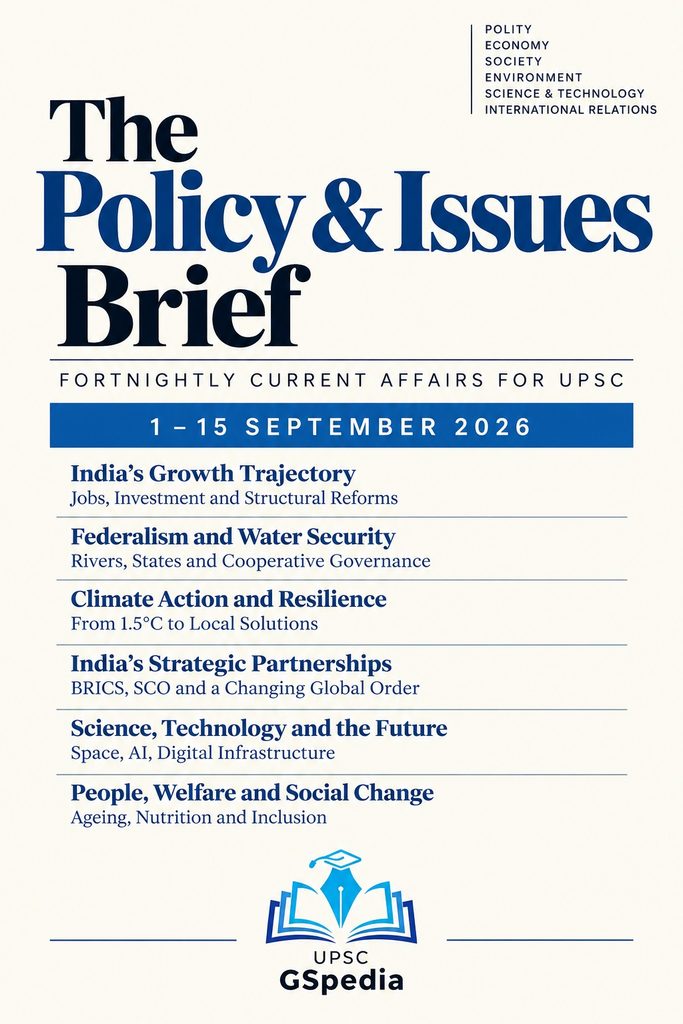
This edition of The Policy & Issues Brief organises these developments by subject and by their examination value. It contains 94 notes drawn from the fortnight’s coverage: 48 Lead Notes on major issues, 18 Digest Notes on more focused developments and 28 Prelims Facts from Micro News. The classification allows larger policy debates to receive sustained analysis while retaining smaller factual developments that may matter for Prelims.
Polity and Governance
The Polity and Governance section centres on the distribution and exercise of public authority. Decentralisation and Collaborative Development considers the gap between the constitutional promise of local self-government and the continuing limits on administrative and fiscal devolution. River Linking, Federalism and Water Security examines the constitutional and institutional questions raised when large water projects affect several States. The Bihar-Jharkhand Sone Water Settlement and the note on water data governance add focused material on inter-State coordination and the role of reliable information in public planning.
Rights and constitutional remedies form a second strand. Gram Sabha Consent and Tribal Land Rights deals with community participation in decisions affecting land and resources. Equal Consideration in Animal Welfare Law and Food Safety Enforcement and Proportionality examine how legal standards are applied in regulatory settings. Digest Notes cover Article 142 and complete justice, the unused distinguished-jurist route to the Supreme Court, the appointment of High Court Chief Justices, major constitutional doctrines and the proposed Article 371K and hill council framework for Ladakh. Together, these notes connect current disputes with constitutional design, judicial power, federalism and accountability.
Economy
The Economy section gives substantial attention to data and measurement. India’s Revised GDP Series and Statistical Credibility brings together the debate over the revised series, its methodology and the evidence used to assess economic growth. Reading India’s Unemployment Data Beyond the Headline Rate considers why a single employment indicator cannot capture the quality and structure of work. District-Level Data for India’s Unincorporated Economy adds a local and informal-sector dimension to the measurement problem.
Monetary and external-sector issues are covered through A Decade of Inflation Targeting in India, Managing Excess Banking System Liquidity and the FCNR(B) Swap Facility and Currency Risk. India’s Return to the A Sovereign Rating Band examines the rating change, the factors behind it and the limits of its transmission to the wider economy. BRICS Cross-Border Payments and CBDC Integration considers the attempt to develop payment arrangements that reduce friction in transactions among member countries.
A separate group of notes addresses structural transformation and productive capacity. These include India’s Middle Income Transition and Productive Employment, Productive Jobs through Textile Clusters, Land Fragmentation and Farm Viability, Dedicated Freight Corridors and India’s Logistics Transformation, Integrated Energy Governance for India and India’s Fintech Transformation. Valuing Marine Fish Stocks as Natural Capital widens the economic discussion by treating ecological assets as part of national wealth. The section therefore links short-term indicators with the deeper questions of jobs, infrastructure, productivity, resource use and institutional capacity.
International Relations
Multilateral institutions and India’s strategic choices are the main themes in International Relations. India and the SCO in Central Asia examines the relevance of the Shanghai Cooperation Organisation to India’s security, connectivity and regional diplomacy. India’s BRICS Presidency and Pragmatic Institutional Reform brings together questions of consensus, representation, development finance and the working of the New Development Bank. The purpose is to study these groupings as institutions with competing interests and operational constraints, rather than as lists of summits and declarations.
Water diplomacy receives separate treatment through Indus Waters Treaty after Abeyance and Transboundary River Governance Between India and China. These notes connect treaty design, hydrology, data sharing and strategic relations. Other Lead Notes examine the operational phase of India-Japan defence cooperation and the proposed rebalancing of India’s Model Bilateral Investment Treaty. RAKSHA and India’s Defence Diplomacy provides a focused account of the broader defence-engagement framework.
The Prelims-oriented items cover the Pacific Islands Forum, the Colombo Security Conclave, the India-MERCOSUR electronic certificate of origin, Nicaragua v Germany at the International Court of Justice and military exercises such as Yudh Abhyas and Samudra Laksamana. These shorter entries retain the institutional, geographical and legal facts needed to place the larger diplomatic issues in context.
Environment
Environment is the largest section in this edition. Its climate coverage begins with Managing the 1.5 Degree Celsius Climate Overshoot, which examines the implications of exceeding the temperature threshold and the roles of mitigation, carbon removal, equity and irreversible damage. Natural Carbon Sinks and Net-Zero Pathways considers the weakening capacity of forests and oceans to absorb emissions. Decarbonising India’s Steel Sector Before Carbon Lock-In, India’s Carbon Credit Trading Scheme and UK CBAM Relief connect climate objectives with industrial policy and trade measures.
Adaptation and environmental governance are addressed through Shared Himalayan Climate Governance, Why Bihar Floods Demand Basin-Wide Cooperation and Nepal Floods and the Loss and Damage Fund. Sea-Level Rise as a Human Rights Challenge considers the effect of climate change on rights and state obligations. Permafrost Thaw and Arctic Infrastructure Risk, the Delhi Declaration on Drylands and India’s Path to Blue Skies extend the discussion to frozen ground, land degradation and air-quality governance. Wildfire Smoke, Heatwaves and the Air Quality-Climate Link explains why several environmental risks must be studied together.
The ecological notes cover coral reefs, Myristica freshwater swamps, striped hyenas, migratory birds, the Great Indian Bustard, the Northern Goshawk and slumping in soft corals. Indonesia and the Pacific Ring of Fire adds a physical-geography component. India’s Geothermal Energy Transition examines another low-carbon energy option. The section consequently brings together climate policy, disaster risk, ecosystem science, conservation and environmental rights without treating them as separate news categories.
Science and Technology
The Science and Technology section focuses on the institutions and infrastructure that shape technological capacity. Preserving Human Agency in the Frontier AI Race considers the governance questions raised by advanced artificial intelligence. India’s Data Centre Infrastructure and Sustainability links digital expansion with energy, water and infrastructure demands. India’s Cyber-Physical Systems Innovation Ecosystem and Science-Industry Linkages and Strategic Power examine the relationship between research, industry and national capability.
Opening India’s Space Economy Without Privatising ISRO considers the distinction between wider private participation and the institutional role of the national space agency. EOS-05 and Satellite Orbits for Earth Observation explains how mission requirements relate to orbital choice, while the Nancy Grace Roman Space Telescope adds an astronomy component. India-France and ISRO-ESA cooperation are covered as Prelims facts connected with human and planetary spaceflight.
Other notes examine India’s traceable national time architecture, connected-vehicle communication for road safety, submarine-rescue readiness and ORV Sagar Manthan’s deep-ocean research capability. Map Projections and the Equal Earth Alternative links a current development with a foundational geography concept. The OPU-IVF breakthrough for Badri cattle provides a concise account of reproductive technology and the distinction between assisted reproduction and cloning research.
Social Issues and Internal Security
The Social Issues section examines public policy at different stages of life. Ageing India and the Health Data Gap considers whether existing information systems can support policy for an older population. Anganwadis as Nutrition and Early Learning Infrastructure studies their combined role in nutrition, care and early childhood development. Women-Focused Cash Transfers and the Welfare Design Trade-off addresses the design choices involved in targeted income support. Shorter notes cover the International Day Against Child Marriage and the inclusion of the Shekhawati havelis on India’s UNESCO Tentative List.
Internal Security includes Digital Hawala and Illicit Finance Networks, India’s Evolving Counter-Terrorism Strategy and CBRN reconnaissance vehicles for the Indian Army. The first two notes connect technological change and financial networks with enforcement and counter-terror policy. The factual note on chemical, biological, radiological and nuclear reconnaissance adds the relevant capability and terminology for Prelims.
How the Issue Supports UPSC Preparation
Each note begins with its syllabus relevance, date, context and source. Core Analysis explains the central issue and its major dimensions. Static Linkages connect the development with constitutional provisions, institutions, economic concepts, scientific processes, geographical features or international frameworks. Directly relevant Previous Year Questions are included where they clarify how UPSC has tested the subject in Prelims or Mains.
The three content types serve different purposes. Lead Notes are intended for issues that require conceptual depth and can support Mains answers. Digest Notes retain developments that need a focused explanation without the length of a lead article. Prelims Facts from Micro News preserve concise institutional, scientific, geographical and species-related information. This hierarchy keeps the larger arguments visible while preventing smaller but examinable facts from being lost.
The September 1-15 edition can therefore be read by subject, by examination stage or by theme. A reader may study the complete Environment or Economy section, revise only the micro facts, or use the linked PYQs to identify recurring areas of examination interest. The magazine’s central concern remains the same throughout: to place current developments within the wider policy and conceptual setting in which UPSC questions are framed.