
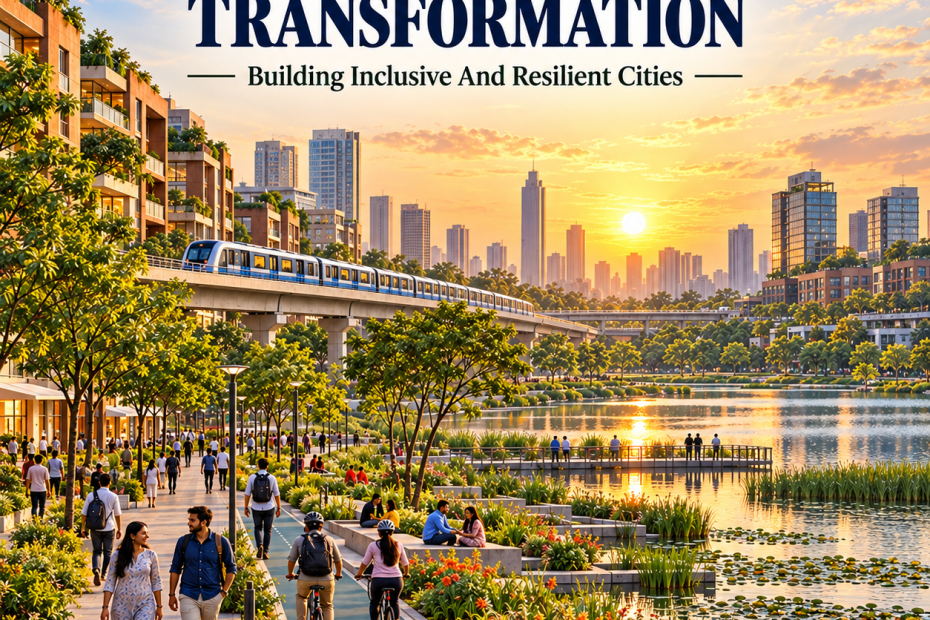
A city functions through connections between employment, housing, transport, water, waste management and its surrounding environment. Improving one component while neglecting the others can shift costs elsewhere: cheaper peripheral housing may increase commuting expenses, while new roads may obstruct drainage. India’s urban challenge is therefore to align infrastructure investment with accountable governance, social inclusion and ecological security.
Regional Growth And Connected Cities
- Economic regions: The Union Budget 2026–27 proposed ₹5,000 crore per City Economic Region over five years through competitive, reform-and-results-based financing. The emphasis on Tier-II and Tier-III cities seeks to widen economic opportunities beyond established metropolitan centres.
- Polycentric development: Several connected urban centres can share economic functions rather than concentrating every activity in one dominant city. Such planning should connect employment clusters, housing, logistics and public services across municipal boundaries.
- Odisha’s regional plan: NITI Aayog’s Bhubaneswar–Cuttack–Puri–Paradeep Economic Region covers Khordha, Cuttack, Puri and Jagatsinghpur districts. It brings together education and services, commerce, cultural tourism and port-linked industry within a common development framework.
- Shared regional systems: Economic integration requires corresponding arrangements for transport, water, drainage and environmental protection. Otherwise, municipalities may compete for investment while leaving common infrastructure responsibilities unresolved.
Infrastructure Finance And Municipal Capacity
- Urban Challenge Fund: The Cabinet approved the ₹1 lakh crore Urban Challenge Fund in February 2026. It aims to support approximately ₹4 lakh crore in total investment across urban growth, redevelopment, water and sanitation.
- Financing conditions: Central assistance covers 25% of project cost, subject to at least 50% being mobilised from market sources such as municipal bonds, bank loans and public–private partnerships. This makes project preparation, credible accounts and repayment capacity central to participation.
- Smaller-city guarantees: A ₹5,000 crore credit-repayment guarantee mechanism supports eligible smaller municipalities and urban bodies in northeastern and hilly states. For first-time loans, the central guarantee is capped at ₹7 crore or 70% of the loan amount, whichever is lower.
- Weak recurring revenues: The Economic Survey 2025–26 observes that Indian cities raise less than 0.6% of GDP in own-source revenues. Borrowing can finance construction, but repayment and maintenance require dependable revenues over subsequent years.
- Maintenance obligations: Infrastructure should be assessed through its full operating life. A sewage-treatment plant, drainage network or public park delivers lasting value only when staffing, electricity, repairs and monitoring remain adequately funded.
- Financing safeguards: Market access should be accompanied by transparent debt disclosure, realistic revenue assumptions and scrutiny of contingent liabilities. Financially weaker cities also need grants and technical assistance so that competitive funding does not favour only municipalities with stronger existing capacity.
Housing And Accessible Mobility
Housing Access
- Housing delivery: As of 9 August 2026, official reporting recorded more than 1.25 crore houses sanctioned across PMAY-U and PMAY-U 2.0, with more than 1 crore completed and delivered. These combined figures should not be treated as achievements of PMAY-U 2.0 alone.
- Women’s ownership: The same update reported 1 crore houses allotted in the name of women or under joint ownership. Such ownership arrangements can strengthen women’s asset security, although wider empowerment also depends on effective control and access to services.
- Rental provision: Affordable Rental Housing Complexes under the earlier PMAY-U framework addressed migrants and other groups requiring rental accommodation. PMAY-U 2.0 includes an Affordable Rental Housing vertical, recognising that ownership cannot meet every household’s needs.
- Affordability pressures: Knight Frank and NAREDCO’s 2025 assessment found that homes priced below ₹50 lakh represented about 17% of new launches across eight major cities during January–June 2025, compared with 52.4% in 2018. This is a selected-city market indicator rather than a national measure of affordable housing availability.
- Repayment burden: The report’s affordability analysis estimated that an economically weaker section household’s EMI-to-income ratio increased from 43% in 2020 to 60% in 2025. These estimates depend on the report’s assumptions and should not be read as the actual repayment burden of every such household.
- Location matters: Housing on cheaper peripheral land can become costly when transport, water, schools and healthcare are inadequate. Affordability should therefore include the cost of reaching employment and obtaining essential services.
Transport Integration
- Regional rapid transit: The 82.15-km Delhi–Ghaziabad–Meerut Namo Bharat corridor became fully operational in February 2026. It includes approximately 23 km of Meerut Metro operating on shared infrastructure.
- Interchange networks: Official reporting records integration with three metro lines, two railway stations and four bus terminals. These connections improve the usefulness of the corridor by linking regional travel with other transport modes.
- Transit-oriented development: TOD zones have been notified in the master plans of Ghaziabad and Meerut. The wider planning objective is to place housing, workplaces and services within convenient reach of public transport.
- Congestion costs: TomTom’s 2025 Traffic Index recorded congestion levels of 74.4% in Bengaluru and 71.1% in Pune. Its standard commuting benchmark estimated annual rush-hour time losses of 168 and 152 hours respectively; these are benchmark estimates, not measured losses for every commuter.
- Inclusive street design: Mass transit needs frequent feeder services, safe crossings, continuous footpaths and cycling access. Higher development density around stations should be matched with affordable housing and adequate water, sanitation and public space.
Land Administration And Urban Governance
- Digital land integration: Operational guidelines for DILRMP 3.0 were launched in September 2026. Its GIS-enabled Land Stack seeks to connect georeferenced maps, land records, registration information and related legal records through interoperable systems.
- Urban property records: NAKSHA supports modernisation of urban land information and property mapping. Better spatial records can assist planning and property-tax administration, but record correction and dispute resolution remain essential.
- Parcel identification: DILRMP 3.0 envisages a 14-digit Unique Land Parcel Identification Number, also called Bhu-Aadhaar. A unique identifier improves the ability to connect records; it does not, by itself, resolve competing ownership claims.
- Land readjustment: Gujarat’s town-planning approach illustrates how land pooling and plot reconstitution can provide land for infrastructure while returning reorganised plots to owners. Its application elsewhere depends on state law, fair valuation, participation and protection of affected interests.
- Municipal empowerment: Article 243W enables state legislatures to endow municipalities with powers for self-government, including functions associated with the Twelfth Schedule. Listing 18 functions in the Constitution does not automatically place each function under exclusive municipal control.
- Fiscal provisions: Article 243X provides for municipal taxation and funds through state legislation, while Article 243Y requires the State Finance Commission to review municipal finances. Effective decentralisation therefore depends on state-level laws and financial arrangements.
- Metropolitan planning: Article 243ZE provides for a Metropolitan Planning Committee to prepare a draft development plan for the metropolitan area as a whole. At least two-thirds of its members must be elected by and from elected municipal members and panchayat chairpersons in the area.
- Devolution gaps: The CAG’s 2024 compendium of audits across 18 states found that only four of the 18 municipal functions were fully devolved on average. During the respective audit assessments, municipalities in Odisha and Uttarakhand lacked full jurisdiction over any of the listed functions.
- Staffing and finance: Reporting on the compendium recorded an average 37% vacancy against sanctioned municipal posts. Its findings also placed own-source revenue at about 32% of municipal revenue on average, highlighting dependence on transfers.
- Accountability problems: When planning, water supply and land-use decisions remain divided among municipalities, state departments and parastatal agencies, citizens face difficulty identifying who is responsible. Clear mandates and answerable institutions are therefore as necessary as additional funding.
Water Security And Circular Resource Use
- Connected water management: Urban water policy should link supply, groundwater recharge, wastewater treatment and reuse. Improving one component without protecting the others can leave cities exposed to shortages, contamination and flooding.
- Water-body restoration: In July 2026, MoHUA reported that nearly 1.21 lakh acres of water bodies were being rejuvenated under AMRUT 2.0. The interventions included desilting, restoration of inlets and outlets, shoreline protection and biodiversity enhancement.
- Aquifer management: Burdwan and Vizianagaram provide examples of recharge pits linked to injection borewells. Korba and Warangal had operationalised recharge structures before the monsoon, illustrating how recharge planning can be linked to seasonal rainfall.
- Recharge safeguards: Recharge structures should follow aquifer assessment and water-quality safeguards. Deep injection should not be treated as a universally suitable response to urban flooding or groundwater depletion.
- Treated-water recovery: By February 2026, Water Resource Recovery Cells had been established in 25 states and Union Territories. Jal Hi AMRIT incentivises sustained improvements in sewage-treatment performance and treated-water quality.
- River pollution: CPCB’s 2025 assessment identified 296 polluted stretches on 271 rivers using monitoring data from 2022 and 2023. The finding indicates continuing pollution pressures, although river contamination has multiple sources and cannot be attributed exclusively to municipal sewage.
- Drinking-water safety: On 1 January 2026, NHRC took cognisance of media reports concerning seven deaths and more than 40 hospitalisations after contaminated water consumption in Bhagirathpura, Indore. The notice sought a state response; it was not a final investigation establishing every reported detail.
- Circular waste systems: Source segregation, organic-waste processing, recycling and construction-and-demolition waste recovery can reduce dependence on dumping. Processing capacity must be matched with reliable collection, environmental safeguards and demand for recovered products.
- Legacy-waste remediation: Official reporting records remediation of 3.66 crore metric tonnes of legacy waste during January–December 2025. The Dumpsite Remediation Accelerator Programme, launched in November 2025, seeks to accelerate remaining remediation under SBM-U 2.0.
Climate Resilience And Public Health
- Urban flood programmes: By August 2026, the Centre had approved Urban Flood Risk Management Programme Phase-I for seven cities and Phase-II for eleven cities. The second phase includes Guwahati, Patna, Jaipur and Lucknow, but approval and implementation should be distinguished from demonstrated risk reduction.
- Drainage failures: A CAG report published in 2025 documented reverse drainage flows affecting parts of Shivamogga. Its January 2023 inspection identified inadequate outflow arrangements and earlier correspondence dating to 2016, showing how unresolved infrastructure defects can intensify flooding.
- Warmer nights: CEEW’s 2025 study found that Mumbai and Bengaluru experienced 15 and 11 additional very warm nights per summer respectively in the recent decade compared with the preceding three decades. Reduced night-time cooling compounds heat exposure.
- Unequal vulnerability: Outdoor workers, informal-settlement residents and households with limited cooling access face particular risks. Heat and floods can reduce earnings, damage belongings and interrupt essential services.
- Adaptation examples: The World Bank’s 2025 urban-resilience report highlights Ahmedabad’s Heat Action Plan, Kolkata’s flood-warning system and Chennai’s Climate Action Plan. Their wider lesson is to connect hazard information with public health, infrastructure planning and protection of vulnerable groups.
- Particulate pollution: IQAir’s 2025 World Air Quality Report, released in March 2026, reported Loni’s annual average PM2.5 concentration at 112.5 µg/m³. This exceeded the WHO annual guideline of 5 µg/m³ by more than 22 times; IQAir’s findings should be distinguished from official Indian regulatory monitoring.
- Enforcement scrutiny: A March 2026 newspaper report citing an RTI response stated that 64 pollution complaints recorded by the relevant regional office in Faridabad during 2025 attracted no fines or environmental compensation. The report raises accountability questions, but absence of fines alone does not establish that every complaint involved a proven violation.
Lessons From Urban Initiatives
- Indore’s resource recovery: At its 2022 inauguration, the Gobar-Dhan plant was expected to produce around 17,000 kg of CNG and 100 tonnes of organic compost daily. Its model connects segregated organic waste, processing and demand for cleaner transport fuel.
- Odisha’s community participation: Jaga Mission combines settlement upgrading with organised resident participation. Implementation partner Janaagraha reports more than 1,684 settlements upgraded into Adarsh Colonies, benefiting over two lakh families, alongside approximately 3,000 Slum Dwellers Associations.
- Pimpri Chinchwad’s streets: ITDP reports implementation of more than 30 km of Healthy Streets, supported by community feedback. The municipality also raised ₹200 crore through green municipal bonds in 2025 for sustainable mobility projects.
- Gorakhpur’s reclaimed land: A remediated 40-acre dumpsite became the Kachre Se Kanchan Rapti Eco Park. Recovered materials were channelled into reuse and co-processing, while the park includes a restaurant operated by the women-led Shakti Ki Rasoi self-help group.
- Replication conditions: These initiatives demonstrate useful connections between infrastructure, finance and participation. Replication requires attention to local administrative capacity, operating costs, environmental compliance and the needs of affected communities.
Priorities For Sustainable Transformation
- Municipal devolution: States should align municipal responsibilities with funds, staff and decision-making authority. Clear responsibility for each service should be accompanied by public reporting and accessible grievance mechanisms.
- Metropolitan service agreements: Adjoining municipalities, development authorities and peri-urban panchayats should establish agreements for shared water, transport, drainage and waste systems. These should specify cost-sharing, service standards and dispute-resolution arrangements.
- Blue-green infrastructure: Wetlands, tanks, floodplains, permeable surfaces, bioswales and retention areas should form part of city planning. They can reduce runoff and heat exposure, while engineered drainage remains necessary for flows that natural systems cannot safely accommodate.
- Accessible urban growth: Mixed-use development near transit should be supported by affordable housing, rental accommodation and essential services. Public transport and walking networks should receive sustained operating support.
- Outcome-linked finance: Project payments and grants should reward verified service performance, including streetlight availability, treated-water quality and drainage functionality. Whole-life costing and maintenance provisions should precede major investment approvals.
- Shared technical capacity: Smaller municipalities should receive support for feasibility studies, environmental assessment, procurement and financial structuring. Shared professional teams and pooled projects can reduce costs while preserving accountability.
- Useful digital systems: GIS databases, sensors and digital twins can help assess utilities, traffic and climate risks. Their effectiveness depends on accurate data, trained staff, interoperable systems and clear procedures for acting on warnings.
- Coordinated utility works: A Dig-Once approach should coordinate underground utilities before roads are resurfaced. Common spatial records and work schedules can reduce repeated excavation and disruption.
- Community oversight: Residents, women’s groups, informal workers and settlement associations should participate in planning and monitoring. Their involvement can reveal service gaps that expenditure totals and project-completion figures overlook.
Smart Cities And Lasting Service Outcomes
- Completed infrastructure: MoHUA reported that 7,790 of 8,064 Smart Cities Mission projects had been completed as of 31 March 2026. The assets include command centres and infrastructure for mobility, water, waste management and public spaces.
- Coverage concerns: Parliamentary scrutiny has identified limitations arising from concentration on selected areas within cities. Improvements in designated locations should therefore be assessed alongside service conditions across the wider urban population.
- Post-mission maintenance: Following the mission’s closure on 31 March 2025, MoHUA advised Special Purpose Vehicles to complete ongoing projects and prepare operation-and-maintenance plans. Continuing institutional responsibility is essential to protect the value of completed assets.
- Outcome assessment: Urban transformation should be judged through reliable services, accessibility, environmental quality and distribution of benefits. Technology and visible infrastructure are useful when they advance these outcomes.
Conclusion
India’s urban future depends on connecting economic opportunity with affordable housing, reliable services and environmental protection. Regional planning and new financing instruments can support this transition when municipalities have adequate authority and capacity. Sustained maintenance, community participation and transparent assessment of outcomes can turn infrastructure investment into lasting improvements in urban life.