
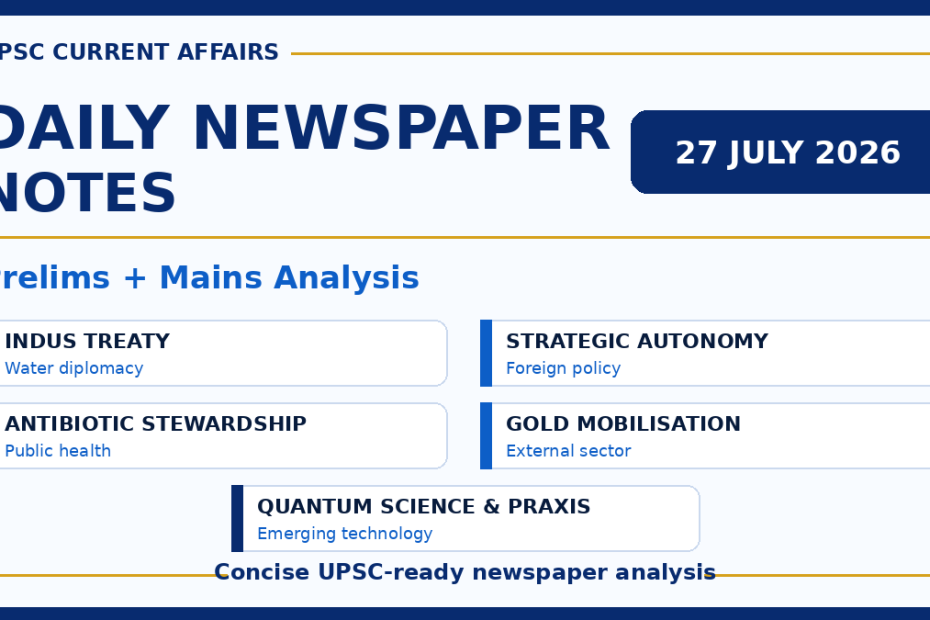
Today’s Daily Newspaper Notes examine resilience across water diplomacy, foreign policy, public health, external-sector management and emerging technology. India’s suspension of treaty cooperation on the Indus raises questions of security, hydrological change, engineering rights and international law. Strategic autonomy requires limiting asymmetric dependence on both China and the United States. Antibiotic stewardship must reconcile conservation with access, while mobilising privately held gold may ease import pressure only if trust and policy design secure genuine participation. Science coverage distinguishes experimental promise from proof in quantum-assisted peptide design and NASA’s PRAXIS concept.
Today in Five Minutes
The Indus Waters Treaty allocates the eastern rivers primarily to India and the western rivers primarily to Pakistan while permitting specified uses by both countries.
India’s “abeyance” decision is a political and legal position whose international consequences remain contested; the treaty itself provides for bilateral modification or termination.
Strategic autonomy means retaining independent choices—not maintaining equal distance from every major power.
India’s antibiotic challenge combines excessive broad-spectrum use with inadequate access to appropriate first-line medicines.
Mobilising domestic gold can reduce the current-account burden only when recycled gold actually substitutes for new imports.
NIAC Phase I funding supports feasibility analysis; it does not make PRAXIS an approved or scheduled NASA flight mission.
Articles Published Today
Reassessing the Indus Waters Treaty under New Strategic and Hydrological Conditions
Section: International Relations
India’s suspension of treaty cooperation combines counter-terrorism signalling with demands for greater water utilisation, modern hydropower engineering and climate adaptation, but also creates legal and downstream-risk obligations.
Correcting India’s Antibiotic-Use Imbalance
Section: Science & Tech
India’s antibiotic-use pattern combines excessive consumption with disproportionate reliance on resistance-prone medicines, requiring better diagnostics, Access-first prescribing, infection prevention and multisectoral surveillance.
Strategic Autonomy between U.S. Uncertainty and Dependence on China
Section: International Relations
India need not choose between dependence on an unpredictable United States and renewed vulnerability to China; strategic autonomy requires diversified partnerships, calibrated economic engagement and stronger domestic capabilities.
Mobilising Private Gold amid External-Sector Stress
Section: Economy
A voluntary gold-mobilisation scheme could reduce bullion imports and conserve foreign exchange, but participation, lawful disclosure rules and actual import substitution will determine its macroeconomic value.
Quantum-Generated Randomness in AI-Assisted Peptide Design
Section: Science and Technology
Quantum-generated inputs improved AI-designed HLA-binding peptides in a preliminary experiment, but the results neither demonstrated quantum advantage nor established immune response, safety or vaccine efficacy.
Prelims Facts From Micro News
PRAXIS and In-Situ Exploration of Planetary Rings
News Context: NASA selected PRAXIS for 2026 Phase I funding under the NASA Innovative Advanced Concepts programme. It is an early-stage study of autonomous sampling from planetary rings, not an approved flight mission.
Core Source Trigger: “PRAXIS: a NASA mission to graze planet rings,” The Hindu, July 26, 2026; user-supplied paywalled text.
Key Prelims Facts
- PRAXIS expands to Planetary Rings Autonomous EXploration with In-situ Sampling.
- NIAC Phase I supports feasibility simulations and system design; Phase II may support a physical prototype.
- In-situ sampling means examining material in its original environment rather than relying exclusively on remote sensing.
- The proposed spacecraft would remain outside the densest ring plane and use a long, deployable boom for touch-and-go sampling.
- AI would assist particle selection, collision avoidance and measurements of size, porosity and composition.
- All four giant planets possess rings; NASA describes Saturn’s rings as dominated by water ice, with particles ranging from fine grains to large bodies.
Prelims Trap: NIAC selection does not mean that NASA has approved a launch, destination or operational mission.
Reservoir Storage and Catchment Hydrology
News Context: India’s monitored reservoirs remained below the previous year’s level despite near-normal rainfall during one July week, illustrating the difference between short-period rainfall and accumulated catchment inflow.
Core Source Trigger: “Reservoir report card: 15% deficiency in monsoon, storage below 80% of normal in 54 major reservoirs,” Down To Earth, July 26, 2026
Key Prelims Facts
- On July 23, 166 monitored reservoirs held 70.432 BCM, or 38.37% of combined live-storage capacity.
- Live storage is ordinarily the usable water above the minimum drawdown level.
- Normal storage is a historical average for the corresponding date, not the reservoir’s designed capacity.
- Inflow depends on rainfall and antecedent soil conditions within the relevant catchment.
- Evaporation and releases for irrigation, hydropower and drinking water affect storage even when rainfall improves.
- A national rainfall average can conceal severe basin-level divergence.
Prelims Trap: Storage as a percentage of capacity and storage as a percentage of normal use different denominators.
Dhole Diet and DNA Metabarcoding
News Context: Genetic analysis of samples from the Tadoba–Andhari landscape identified 15 vertebrate prey species in the dhole’s diet and found little dependence on livestock.
Core Source Trigger: “What do Asiatic wild dogs or dholes in India eat?” Down To Earth, July 26, 2026
Key Prelims Facts
- The dhole, Cuon alpinus, is a social, pack-hunting member of the family Canidae.
- It is classified as Endangered on the IUCN Red List.
- Important Indian populations occur in the Western Ghats, Central India and the Northeast.
- DNA metabarcoding uses standard genetic markers to identify multiple taxa in a mixed biological or environmental sample.
- Chital and sambar were the most frequently detected prey in the study.
- Tadoba–Andhari Tiger Reserve is in Maharashtra and forms part of the Central Indian landscape.
Prelims Trap: Detection of livestock DNA does not independently prove that the sampled carnivore killed the animal; scavenging or secondary consumption may be possible.
Directorate Of Revenue Intelligence
News Context: Intelligence-led operations reported on July 25 produced seizures of foreign-origin gold and arrests across several smuggling routes.
Core Source Trigger: “DRI intensifies crackdown on gold smuggling,” PIB, July 25, 2026
Key Prelims Facts
- The Directorate of Revenue Intelligence functions under the Central Board of Indirect Taxes and Customs.
- CBIC is part of the Department of Revenue, Ministry of Finance.
- DRI investigates smuggling, customs-duty evasion and specified forms of illicit cross-border trade.
- Its principal customs-law authority arises from the Customs Act, 1962.
- Seizure places suspected goods under legal control during proceedings; confiscation follows adjudication and transfers the goods to government.
- Customs adjudication and criminal prosecution are distinct legal processes.
Prelims Trap: DRI and the Enforcement Directorate are separate agencies; ED principally administers FEMA and investigates money laundering under PMLA.
INS Sudarshini and the Azores
News Context: The Indian Navy’s sail-training ship INS Sudarshini departed Boston for Ponta Delgada in the Azores as part of its Lokayan 26 voyage.
Core Source Trigger: “Lokayan 26—Indian Naval Ship Sudarshini departs Boston, USA,” PIB, July 26, 2026
Key Prelims Facts
- INS Sudarshini is a sail-training ship used for seamanship, navigation and endurance training.
- Sail-training vessels rely substantially on wind propulsion but may carry auxiliary engines.
- Lokayan denotes a long-distance training and maritime-outreach voyage.
- Ponta Delgada is located in the Azores.
- The Azores are a volcanic archipelago and autonomous region of Portugal in the North Atlantic.
- They lie west of mainland Europe and differ from Spain’s Canary Islands near northwestern Africa.
Prelims Trap: The Azores belong to Portugal, not Spain.
Flue-Cured Virginia Tobacco and the Tobacco Board
News Context: The Department of Commerce reviewed the market position of Flue-Cured Virginia tobacco growers and auction operations in Andhra Pradesh.
Core Source Trigger: “Department of Commerce Reviews Flue-Cured Virginia Tobacco Market Situation in Andhra Pradesh,” PIB, July 26, 2026
Key Prelims Facts
- Flue-curing dries leaves in enclosed barns using heated air conducted through pipes or flues.
- The leaves are not directly exposed to smoke, unlike fire-cured tobacco.
- FCV tobacco is also called Virginia or bright-leaf tobacco and is used mainly in cigarette blends.
- The Tobacco Board is a statutory body under the Department of Commerce.
- It was established under the Tobacco Board Act, 1975.
- The Board regulates specified aspects of Virginia-tobacco production, curing and auction marketing.
Prelims Trap: Flue-curing and fire-curing are different processes; only the latter directly exposes leaves to smoke.
Mains Practice Questions
India’s reassessment of the Indus Waters Treaty reflects legitimate security, developmental and hydrological concerns, but geographical leverage must remain compatible with legal credibility and downstream responsibility. Critically examine.
Explain the treaty’s allocation and dispute-resolution architecture.
Analyse security, climate, hydropower and sediment-management concerns.
Evaluate legal, diplomatic and lower-riparian implications.
Strategic autonomy does not require equidistance from major powers; it requires the capacity to prevent external dependence from determining national choices. Analyse in the context of India’s relations with the United States and China.
India’s antimicrobial-resistance problem arises from both excessive broad-spectrum use and inadequate access to appropriate first-line treatment. Examine.
Can mobilisation of privately held gold materially strengthen India’s external sector? Evaluate the necessary transmission mechanism, institutional design and risks of an immunity-based disclosure scheme.
Emerging-technology claims must distinguish proof of concept from technological advantage and practical application. Discuss with reference to quantum-assisted biomedical design and PRAXIS.
UPSC Prelims Quiz
Practice exam-oriented current affairs questions daily and track your preparation effectively.
Attempt Quiz →