India has unveiled a comprehensive national counterterrorism policy and strategy, titled Prahaar, to establish a coordinated, rights-based, and intelligence-driven approach to preventing and responding to terrorism.
Launch And Purpose Of The Prahaar Strategy
Formal adoption of a national counterterror framework:
On February 23, 2026, the Ministry of Home Affairs released India’s first unified national counterterrorism policy and strategy, named Prahaar. The framework is designed to comprehensively address terrorist activity by preventing attacks and denying terrorists, their financiers, and supporters access to funds, weapons, and safe havens.
Multi-stage and intelligence-driven orientation:
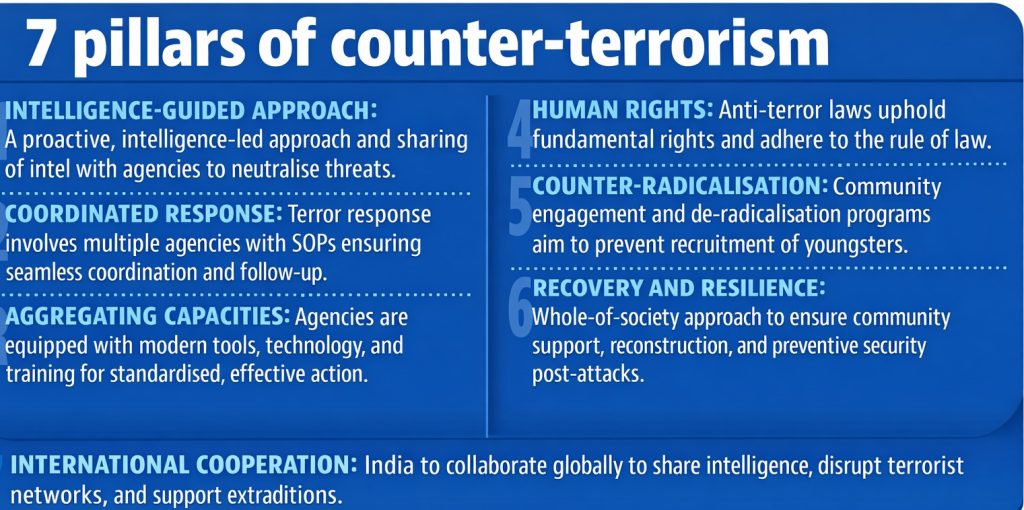
The strategy outlines a seven-stage model that prioritises intelligence-led prevention, rapid and coordinated responses by central and state agencies, advanced technological integration, prevention of radicalisation and recruitment, sustained international engagement, societal participation, and strict adherence to human rights and rule-of-law principles.
Institutional Consultation And Policy Development
Extensive inter-agency collaboration:
The eight-page policy document was prepared in consultation with the Intelligence Bureau, Research and Analysis Wing, NATGRID, the National Investigation Agency, other central intelligence organisations, state and Union Territory anti-terror units, and counterterrorism specialists.
Alignment with international norms:
The policy reiterates India’s commitment to global cooperation in building consensus on the definition of terrorism and in upholding the rights of victims. It emphasises continued efforts toward a comprehensive international framework on terrorism while implementing the objectives of Prahaar domestically.
Normative Principles And Ethical Positioning
- Terrorism not linked to identity: The document underscores India’s long-standing position that terrorism must not be associated with any religion, ethnicity, nationality, or civilisation, while affirming solidarity with victims of terror violence.
- Commitment to rule of law and justice: The strategy emphasises that India’s counterterrorism approach is rooted in just laws, equal application of legal provisions, and protection of fundamental rights.
Assessment Of The Terror Threat Landscape
- Cross-border and sponsored terrorism: India continues to face persistent threats from groups supported across borders, including jihadist organisations and their front entities that plan, coordinate, and execute attacks.
- Presence of global terrorist networks: International extremist organisations such as al-Qaeda and the Islamic State have attempted to incite violence in India through sleeper cells and online propaganda.
- Regional instability and ungoverned spaces: Sporadic instability in India’s neighbourhood has created ungoverned areas, with some regional actors historically employing terrorism as a tool of state policy.
Emerging Modalities Of Terrorist Operations
- Use of advanced technologies: Handlers operating from foreign territories are utilising modern tools, including drones, to facilitate terror-related activities, particularly in Punjab and Jammu and Kashmir.
- Convergence of terrorism and organised crime: Terror outfits increasingly rely on transnational criminal networks, including Indian gangsters based abroad, for logistics, financing, and recruitment.
- Cyber and robotic threats: The misuse of drones, robotics, and cyber capabilities by state and non-state actors remains a growing concern, alongside persistent cyber-attacks by criminal groups and hostile states.
Seven Pillars Of Prahaar
Pillar One: Proactive and Intelligence-Guided Prevention
- Primacy of intelligence collection and sharing: The first pillar accords highest importance to intelligence gathering and its timely dissemination for threat neutralisation.
- Institutional coordination mechanisms: Central agencies and state police forces collaborate through platforms such as the Multi-Agency Centre and Joint Task Force on intelligence within the Intelligence Bureau.
Pillar Two: Coordinated And Swift Response
- Multi-level stakeholder engagement: Responding to terror incidents involves coordinated action by agencies at central, state, and district levels.
- Standard operating procedures for coordination: The Home Ministry has issued SOPs for apex-level coordination, covering intelligence flow, analysis, and follow-up action through MAC-based mechanisms.
Pillar Three: Capability Enhancement And Standardisation
- Modernisation of tools and training: The strategy emphasises acquiring advanced technology and weaponry, alongside training personnel in new tactics and skills.
- Uniformity across agencies: Standardised processes and a move toward uniform anti-terror structures in states aim to ensure synergy in a multi-agency environment.
Pillar Four: Protection of Human Rights
- Legal safeguards for citizens: Indian laws, including anti-terror legislation, provide explicit protection of human rights.
- Rule-based enforcement: All counterterror actions are to be carried out within the framework of the rule of law.
Pillar Five: Preventing Radicalisation and Recruitment
- Disruption of extremist outreach: Security agencies actively obstruct efforts by terrorist groups to recruit Indian youth.
- Community-based interventions: Measures include engagement with community and religious leaders, NGOs, moderate preachers, de-radicalisation initiatives, and addressing socio-economic vulnerabilities such as poverty and unemployment.
Pillar Six: International Cooperation
- Bilateral and multilateral engagement: Intelligence sharing and agency-level cooperation have facilitated disruption of terror networks, extradition of fugitives, and pursuit of UN terrorist designations.
Pillar Seven: Recovery and Societal Resilience
- Whole-of-society approach: Public-private partnerships support faster recovery and strengthen resilience following attacks.
- Integrated rehabilitation mechanisms: Doctors, psychologists, lawyers, NGOs, and community leaders assist in sensitisation and reintegration, while civil administration leads reconstruction and police reinforce preventive security.
Legal And Institutional Reforms
- Periodic updating of laws: The domestic counterterror legal framework requires regular amendments to address evolving threats.
- Uniformity among state and UT units: Greater consistency in structure, resources, training, and investigative methodologies across state and Union Territory counterterror units is emphasised.