
The Shanghai Cooperation Organisation occupies a distinctive place in India’s foreign policy because it brings India into the same institutional framework as China, Russia, Pakistan, Iran and four Central Asian republics. It is neither a military alliance nor a supranational integration project. Instead, it operates as an intergovernmental platform in which security cooperation, economic engagement, connectivity, technology and wider regional issues are pursued through consensus. For India, the SCO is therefore best understood as an instrument of continental diplomacy that combines practical regional interests with strategic autonomy in an increasingly multipolar international order.
Foundations And Evolution
- Origins in the Shanghai Five: The SCO emerged from efforts to stabilise China’s borders with Russia and the newly independent Central Asian republics. China, Kazakhstan, Kyrgyzstan, Russia and Tajikistan concluded a military confidence-building agreement in 1996 and an agreement on mutual reduction of armed forces in 1997, creating the mechanism known as the Shanghai Five.
- Transition to a regional organisation: The Dushanbe Declaration of July 4, 2000 envisaged a broader regional organisation. After Uzbekistan joined, China, Kazakhstan, Kyrgyzstan, Russia, Tajikistan and Uzbekistan formally established the SCO in Shanghai on June 15, 2001.
- Charter framework: The SCO Charter was signed at St Petersburg on June 7, 2002 and entered into force on September 19, 2003. The organisation subsequently expanded far beyond its original border-security focus to political coordination, economic cooperation, connectivity, technology, health, culture, education, environment and disaster management.
- India’s entry: India became an observer in 2005 and a full member in 2017 alongside Pakistan. Iran joined as a full member in 2023 and Belarus became the tenth member in 2024, substantially widening the organisation’s Eurasian reach.
Present Membership And External Partners
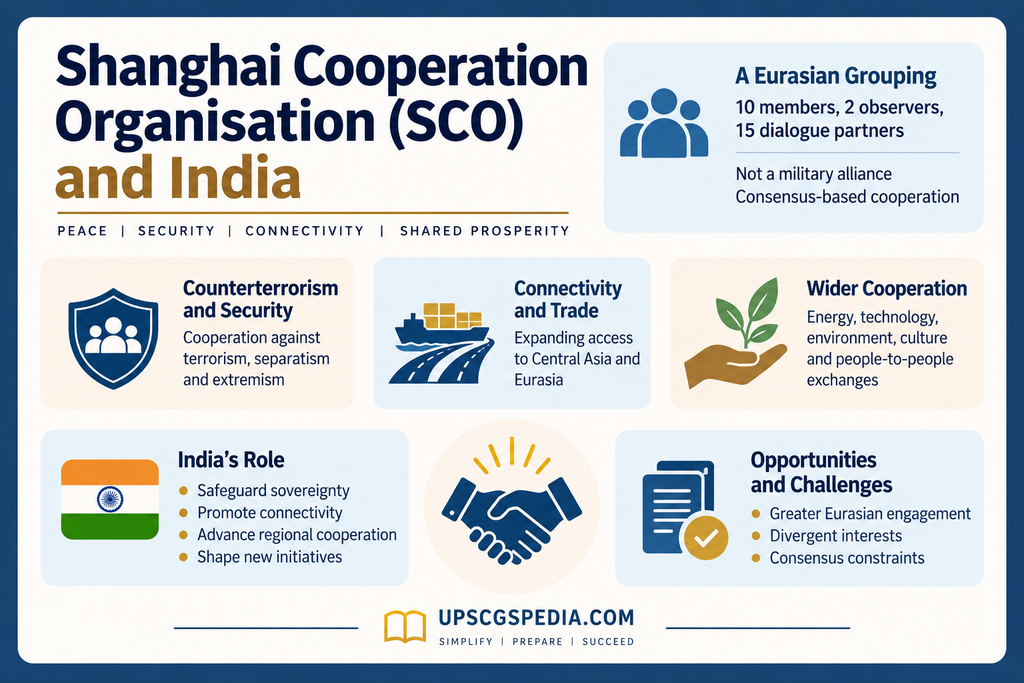
- Ten full members: As of September 2026, the members are Belarus, China, India, Iran, Kazakhstan, Kyrgyzstan, Pakistan, Russia, Tajikistan and Uzbekistan.
- Observer states: Afghanistan and Mongolia are observers. Afghanistan’s status is particularly relevant because of its importance to regional security, narcotics control and connectivity.
- Dialogue partners: The 15 dialogue partners are Armenia, Azerbaijan, Bahrain, Cambodia, Egypt, Kuwait, Laos, Maldives, Myanmar, Nepal, Qatar, Saudi Arabia, Sri Lanka, Türkiye and the United Arab Emirates. Laos received this status at the 2025 Tianjin summit.
- Turkmenistan distinction: Turkmenistan is not an SCO member. Kazakhstan, Kyrgyzstan, Tajikistan and Uzbekistan are members, meaning only four of the five Central Asian republics belong to the organisation.
- Scale of the grouping: The SCO’s institutional estimates place its ten members at roughly 36 million sq km, with a population above 3.4 billion, about one-fourth of world GDP and more than 15% of international trade. Such figures vary according to year, dataset and measurement, so they should always be used with their date and source.
Principles And Institutional Architecture
The Shanghai Spirit
- Normative foundation: The “Shanghai Spirit” rests on mutual trust, mutual benefit, equality, consultation, respect for cultural diversity and pursuit of common development.
- Sovereign equality: Charter principles emphasise sovereignty, territorial integrity, inviolability of borders, non-aggression, non-interference and peaceful settlement of disagreements. These principles have particular relevance to India’s position on regional connectivity.
- Non-bloc character: The SCO does not define itself as a military-political alliance or a supranational economic-integration organisation. This allows India to participate without treating membership as an exclusive geopolitical alignment.
- Consensus-based decisions: Decisions are generally taken by consensus rather than majority voting. Consensus protects the formal equality of members and prevents India from being routinely outvoted, but it can also prevent collective action when national interests diverge.
Principal Institutions
- Council of Heads of State: It is the highest decision-making body and normally meets annually.
- Council of Heads of Government: It focuses particularly on economic and practical cooperation and adopts the organisation’s annual budget. The wider institutional framework also includes the Council of Foreign Ministers, Council of National Coordinators and specialised ministerial mechanisms.
- Expanding institutional network: The SCO reports 29 Charter bodies and more than 40 specialised interaction mechanisms covering areas from security and defence to trade, transport, culture, education and health.
- Two permanent bodies: The SCO Secretariat is located in Beijing, while the Executive Committee of the Regional Anti-Terrorist Structure is located in Tashkent. Both began functioning in January 2004.
- Supporting mechanisms: The Business Council, Interbank Consortium, Youth Council and SCO Forum complement the formal institutional structure but should not be confused with the two permanent intergovernmental bodies.
Regional Anti-Terrorist Structure
- Core security mechanism: RATS provides an institutional framework for cooperation against the SCO’s traditional “three evils” of terrorism, separatism and extremism.
- Legal basis: Its functioning is linked to the SCO Charter, the Shanghai Convention on Combating Terrorism, Separatism and Extremism and the agreement establishing RATS. Cooperation includes counterterrorism exercises and intelligence and law-enforcement coordination.
Official Languages And Charter Reform
- Traditional position: Russian and Chinese have historically been the SCO’s official and working languages.
- English-language initiative: At the Bishkek summit on September 1, 2026, leaders approved a Protocol on Amendments and Additions to the SCO Charter, while India stated that its proposal concerning English as an official language was reflected in the Bishkek Declaration. The material available up to September 6, 2026 does not establish that all legal steps required for the Charter amendment to enter into force had already been completed.
Why The SCO Matters For India
Access To Continental Eurasia
- Extended neighbourhood: India regards Central Asia and Eurasia as an important extended neighbourhood. SCO membership provides regular institutional engagement with Kazakhstan, Kyrgyzstan, Tajikistan and Uzbekistan as well as Russia and Iran.
- Complementing Central Asian diplomacy: This engagement operates alongside India’s separate India-Central Asia mechanisms. The Fourth India-Central Asia Dialogue in June 2025 again emphasised regional connectivity and greater use of the International North-South Transport Corridor.
- Addressing geographical constraints: India’s physical access to Central Asia remains difficult. Chabahar Port and the International North-South Transport Corridor provide important alternative routes towards Afghanistan, Central Asia, Russia and wider Eurasian markets.
- Platform rather than solution: SCO membership gives India a political forum for continental connectivity diplomacy, but it cannot by itself overcome transport, customs, commercial and geopolitical barriers to India-Central Asia trade.
Counterterrorism And Regional Security
- Direct Indian interest: Cross-border terrorism, terrorist financing, online radicalisation, narcotics, illicit arms, organised crime, drone-based smuggling and cyber-enabled threats make the SCO’s security architecture particularly relevant to India.
- No double standards: At the 2025 SCO Defence Ministers’ meeting, India called for action against perpetrators, organisers, financiers and sponsors of terrorism and argued against double standards in addressing cross-border terrorism.
- Wider threat spectrum: SCO security cooperation now covers narcotics, organised crime, information security, border management and emerging threats including drones, cyberattacks and hybrid warfare.
- New security institutions: The 2025 Tianjin summit approved agreements concerning an SCO Anti-Drug Centre and a Universal Centre for Countering Challenges and Threats to the Security of SCO Member States. The 2026 Bishkek summit subsequently approved provisions relating to these mechanisms.
- Political limitation: Institutional mechanisms do not automatically create common threat perceptions. Members may disagree over the identification, sponsorship and political interpretation of particular threats, limiting the effectiveness of collective security action.
Afghanistan And Regional Stability
- Observer status: Afghanistan remains an SCO observer rather than a full member. Its location between Central and South Asia makes its stability important for terrorism, narcotics, humanitarian conditions and regional connectivity.
- Indian perspective: At the 2026 Bishkek summit, India linked Eurasian security with peace and stability in Afghanistan and reiterated its development and humanitarian engagement with the Afghan people.
- Security-connectivity link: Stability in Afghanistan can facilitate regional commerce and reduce security spillovers, while instability can strengthen terrorist recruitment, narcotics flows and transnational crime. The SCO can facilitate coordination among regional actors, but it cannot substitute for an Afghan political settlement.
Strategic Autonomy And Multipolarity
- Multiple partnerships: India participates in the SCO alongside China and Russia while maintaining separate strategic relationships and institutions outside the grouping. This reflects an issue-based approach rather than exclusive bloc alignment.
- Presence in Eurasian diplomacy: Participation allows India to remain involved in continental rule-setting, resist formulations inconsistent with its interests and advance its own initiatives rather than leave Eurasian institutional space primarily to China and Russia.
Security Connectivity And Opportunity
India’s approach was increasingly expressed at the 2025 Tianjin summit and the 2026 Bishkek summit through three pillars — Security, Connectivity and Opportunity. The formulation seeks to move the SCO from broad declarations towards practical outcomes.
Security From Declarations To Cooperation
- Counterterrorism ecosystem: India seeks action not only against terrorist attacks but also against financing, recruitment, radicalisation, safe havens and sponsorship. At Bishkek in 2026, it called for dismantling the entire support ecosystem of terrorism.
- Technology-enabled threats: India has highlighted drones used for trafficking weapons and narcotics, cyberattacks and hybrid threats, linking SCO security cooperation with the wider problems of organised crime, cyber security and the terror-drug nexus.
- Consensus constraint: The 2025 Defence Ministers’ meeting failed to produce an agreed joint statement after India declined to accept language it considered inadequate on terrorism. The episode demonstrated how consensus enables a member to block an unacceptable formulation but also prevents collective outcomes when threat perceptions diverge.
- Operational value of RATS: Intelligence sharing, exercises, training and law-enforcement cooperation can continue even amid political disagreement, but stronger collective action becomes difficult when members differ over attribution or sponsorship of terrorism.
Connectivity With Sovereignty
- Qualified support for connectivity: India supports physical and digital connectivity that expands trade and links markets but insists that infrastructure respect sovereignty and territorial integrity. At Bishkek, it also advocated simpler customs procedures, digital documentation and more efficient logistics.
- CPEC objection: India’s position is directly linked to its opposition to the China-Pakistan Economic Corridor because parts of the corridor traverse territory claimed by India. Participation in the SCO therefore does not imply acceptance of every regional connectivity project.
- Alternative corridors: India promotes Chabahar and the INSTC as sovereignty-respecting multimodal alternatives for improving access to Afghanistan and Central Asia.
- Indian connectivity model: India’s position is not opposition to connectivity itself. It favours consultation, respect for territorial integrity, open access, commercial viability and diversified transport routes while resisting corridors that compromise sovereignty or create unacceptable strategic dependence.
Trade And Economic Cooperation
- No common economic market: The SCO should not be confused with a customs union, common market or free-trade bloc. Economic cooperation remains intergovernmental and takes place through ministerial mechanisms, infrastructure projects, business networks and voluntary arrangements among interested members.
- Existing financial institutions: The SCO Business Council and Interbank Consortium already operate within the economic architecture. They are distinct from the proposed SCO Development Bank.
- Development Bank proposal: Consultations intensified in 2024 over a Development Bank, Development Fund and an Investment Fund, while by November 2025 the organisation referred to a political decision to create a Development Bank “by interested parties.” It should therefore not be treated as a long-established operational institution comparable to the New Development Bank.
- National currency settlements: A 2022 Road Map provides for gradually increasing the use of national currencies in mutual settlements. This represents incremental financial cooperation rather than creation of a common SCO currency or unified monetary system.
- India’s trade approach: At the September 2025 SCO Trade Ministers’ meeting, India supported a WTO-centred, open, fair, inclusive and non-discriminatory trading system while stressing export diversification, resilient supply chains, Digital Public Infrastructure and secure e-commerce.
- Technology-oriented economic agenda: SCO cooperation has expanded to DPI, e-commerce, cross-border data issues, customs modernisation, multimodal transport, logistics and artificial intelligence. Its economic framework also includes an Energy Cooperation Development Strategy up to 2030.
- Potential for India: Energy, pharmaceuticals, digital services, startups, innovation, agriculture and logistics provide possible areas of cooperation with resource-rich Eurasian economies. Limited transport connectivity, geopolitical frictions, regulatory differences, sanctions affecting some members and weak common financing mechanisms continue to constrain deeper integration.
Environment And Sustainable Development
- Broader agenda: The SCO now addresses biodiversity, waste management, climate cooperation, the Green Belt Programme, protected areas, ecotourism, disaster monitoring, infectious diseases, food security and climate-resilient agriculture.
- Shared vulnerabilities: Central and South Asia face interconnected challenges involving mountains, glaciers, water, extreme events, food systems and energy transitions. The Bishkek summit also addressed climate, nuclear safety, energy conservation, emergency assistance and drug-abuse prevention.
- Widening concept of security: The SCO’s evolution reflects an understanding of regional security in which ecological, health, energy and disaster risks increasingly interact with conventional security concerns.
India’s Agenda-Setting Role
The 2023 Indian Chairmanship
- First presidency: India held its first presidency of the SCO Council of Heads of State in 2022–23, culminating in the 23rd SCO Summit on July 4, 2023, held virtually under Indian chairmanship.
- SECURE framework: India defined SECURE as Security, Economic development, Connectivity, Unity, Respect for sovereignty and territorial integrity, and Environmental protection. It combined security and development with India’s sovereignty-based approach to regional connectivity.
- Five new pillars: India introduced cooperation in Startups and Innovation, Traditional Medicine, Youth Empowerment, Digital Inclusion and Shared Buddhist Heritage.
- Institutional continuity: A Special Working Group on Startups and Innovation was created with India as its permanent chair, while an Expert Working Group on Traditional Medicine also acquired continuing institutional form.
Digital And Developmental Diplomacy
- Digital Public Infrastructure: India promoted DPI and digital inclusion during its chairmanship. A DPI concept for interested members was adopted in New Delhi in May 2023, alongside cooperation on e-government, payments, e-commerce and bridging the digital divide.
- BHASHINI: India offered its AI-based language platform BHASHINI as an example of using technology to promote linguistic inclusion.
- Regional public goods: By focusing on digital platforms, startups, affordable innovation and traditional medicine, India has sought to build influence in fields where institutional capabilities and public goods matter more than conventional military or infrastructure-financing weight.
Cultural And Civilisational Diplomacy
- Varanasi initiative: Varanasi became the first SCO Tourism and Cultural Capital for 2022–23. Indian chairmanship also included activities related to shared Buddhist heritage, films, food, crafts, young scientists, authors and startups.
- Civilisational links: India uses Buddhist and wider historical connections between South Asia and Central Asia to complement security and state-level diplomacy with stronger people-to-people engagement.
- Continuation in 2026: The Bishkek outcome reflected Indian-backed initiatives including a Civilisation Dialogue Forum, Young Scientist Forum and Young Author’s Conclave. India also offered to host the first SCO Civilisation Dialogue Forum later in 2026.
Central Asian Priorities
- Preserving the regional core: India has argued that the SCO should continue to protect the interests and aspirations of Central Asian states even as membership expands into South Asia, Iran and Eastern Europe.
- Strategic significance: Supporting Central Asian agency helps prevent the organisation from becoming solely an arena for larger-power rivalry and gives India greater space for direct cooperation with Kazakhstan, Kyrgyzstan, Tajikistan and Uzbekistan.
Recent Institutional Developments
Tianjin Summit And Strategy To 2035
- Long-term strategy: At the 25th Council of Heads of State meeting in Tianjin on September 1, 2025, members approved 24 documents, including the Tianjin Declaration and the SCO Development Strategy until 2035.
- Functional expansion: Tianjin also produced agreements concerning the Anti-Drug Centre and Universal Centre for Countering Challenges and Threats, granted dialogue-partner status to Laos and transferred the chairmanship from China to Kyrgyzstan for 2025–26.
- Importance for India: The Strategy to 2035 raises a larger question about whether the SCO develops primarily into a practical security and development platform or acquires stronger geopolitical bloc characteristics. India’s approach favours functional cooperation, sovereign equality and preservation of the non-bloc character.
Bishkek Summit And Institutional Reform
- Twenty-fifth anniversary: The 26th SCO Council of Heads of State met in Bishkek from August 31 to September 1, 2026, marking the organisation’s 25th anniversary. Its agenda covered politics, security, trade, investment, energy, industry, ecology, tourism, technology and institutional reform.
- Major decisions: The summit approved 28 documents, including the Bishkek Declaration and a Protocol on Amendments and Additions to the SCO Charter. It also approved provisions for the Universal Centre and the Anti-Drug Centre’s Executive Committee and an SCO Secretariat memorandum with the African Union Commission.
- India’s three pillars: India presented Security, Connectivity and Opportunity as the basis for more outcome-oriented cooperation — linking security with the full terrorism ecosystem, connectivity with sovereignty and digital facilitation, and opportunity with technology, startups and people-to-people relations.
- Indian initiatives: Proposals relating to English as an official language, the Civilisation Dialogue Forum, Young Scientist Forum and Young Author’s Conclave were reflected in the summit outcome. The legal distinction between approval of a Charter-amendment protocol and its completed entry into force remains important.
- New chairmanship: Pakistan assumed the SCO chairmanship for 2026–27 under the theme “Turning Vision into Action: Connectivity, Innovation and Shared Prosperity,” while Lahore became the SCO Tourism and Cultural Capital for 2026–27.
- Current office-holders: The latest summit material identifies Nurlan Yermekbayev as SCO Secretary-General and Ularbek Sharsheev as head of the RATS Executive Committee. These are time-sensitive office-holder facts.
Expansion And Institutional Heterogeneity
- Wider Eurasian reach: Successive enlargement has connected Eastern Europe, Russia, Central Asia, China, South Asia and Iran within one institution, while the SCO also maintains external relationships with bodies including the UN system, ASEAN, CIS, CSTO, ECO, CICA, EAEU and the League of Arab States.
- Greater diversity of interests: Members differ in political systems, economic priorities, security perceptions, Western relationships, connectivity preferences and bilateral disputes. As membership expands, consensus becomes harder to translate into deep collective commitments.
- Central paradox: Enlargement has increased the SCO’s geopolitical significance faster than its institutional cohesion. It can therefore be a highly consequential diplomatic forum without becoming an equally integrated economic or security bloc.
Opportunities And Constraints For India
Strategic Opportunities
- Eurasian access: The SCO provides a rare platform for simultaneous engagement with the four member Central Asian republics, Russia, China, Iran and Pakistan, preserving diplomatic channels even where bilateral relations are difficult.
- Security cooperation: RATS and the newer security and anti-drug institutions can improve intelligence exchange and law-enforcement cooperation against terrorism, radicalisation, drugs, organised crime and cyber-enabled threats.
- Diversified connectivity: Continued emphasis on Chabahar, INSTC, customs digitalisation and multimodal logistics can reduce disadvantages arising from India’s constrained direct overland access to Eurasia.
- Institutional agenda-setting: India’s 2023 initiatives demonstrate that influence can also be built by creating durable working mechanisms in startups, traditional medicine, digital inclusion and cultural diplomacy.
- Selective economic cooperation: Trade facilitation, resilient supply chains, DPI, e-commerce, energy and technology provide areas of cooperation without requiring India to accept deep supranational economic integration.
Structural And Political Challenges
- India-Pakistan divide: Divergent approaches to cross-border terrorism remain an immediate obstacle, illustrated by the failure to agree on a joint statement at the 2025 Defence Ministers’ meeting.
- India-China trust deficit: India must cooperate economically within an organisation in which China has considerable weight while ensuring that general connectivity language is not interpreted as acceptance of CPEC or other projects affecting its sovereignty claims.
- Consensus dilemma: Consensus safeguards India against adverse majority decisions but also allows other members to block Indian priorities, encouraging lowest-common-denominator outcomes.
- Weak economic institutionalisation: The Interbank Consortium exists, but a fully operational Development Bank and integrated transport, payment and investment systems remain under development. The SCO consequently falls well short of a unified economic integration project.
- Dilution through enlargement: Expansion increases diplomatic reach but brings a wider range of national interests and disputes into the organisation, making common positions harder to define.
- Risk of bloc politics: Growing geopolitical polarisation can challenge the SCO’s declared non-bloc identity. For India, preserving that identity is important because an explicitly anti-Western orientation would constrain its strategic flexibility and issue-based multilateralism.
A Practical Indian Approach
- Functional security cooperation: India can prioritise measurable cooperation against terrorist financing, radicalisation, narcotics routes, cybercrime, drone trafficking, organised crime and cross-border networks rather than judging effectiveness primarily by declarations.
- Common counterterrorism standards: India can continue pressing for rejection of double standards while linking regional action to UN-centred counterterrorism obligations, giving its concerns a broader multilateral basis.
- Interoperable connectivity: Greater emphasis on Chabahar, INSTC, customs simplification, electronic documentation, efficient ports and transparent multimodal transit can promote regional commerce without requiring every member to accept a single geopolitical corridor.
- Project-based economic cooperation: DPI, startups, pharmaceuticals, traditional medicine, agricultural technology, logistics, energy efficiency and secure e-commerce offer practical areas of cooperation without premature comprehensive integration.
- Regional public goods: India can use its capabilities in digital infrastructure, startups, traditional medicine, disaster-resilient infrastructure and cultural connections to build influence that is not dependent solely on financial or military power.
- Environmental cooperation: Glaciers, mountains, biodiversity, disaster-risk reduction, climate adaptation, food security and efficient energy systems offer relatively less contentious fields for Central and South Asian cooperation.
- People-to-people engagement: Civilisational dialogue, academic and youth exchanges, tourism, startups, Buddhist heritage and greater linguistic accessibility can broaden India’s engagement beyond government-to-government relations.
Conclusion
For India, the SCO is most useful neither as an alliance nor as a substitute for bilateral diplomacy, but as an instrument of sustained continental engagement. Its value comes from keeping India institutionally present in Central Asia and wider Eurasia, creating mechanisms for cooperation on shared transnational threats and providing space for India to advance its own connectivity, technological and developmental priorities. Its effectiveness will remain constrained by divergent geopolitical interests and consensus politics. India’s long-term interest therefore lies in strengthening practical cooperation while preserving sovereign equality, strategic autonomy and the organisation’s non-bloc character.
In the light of the above statement point out the role of India in mitigating the problems.