
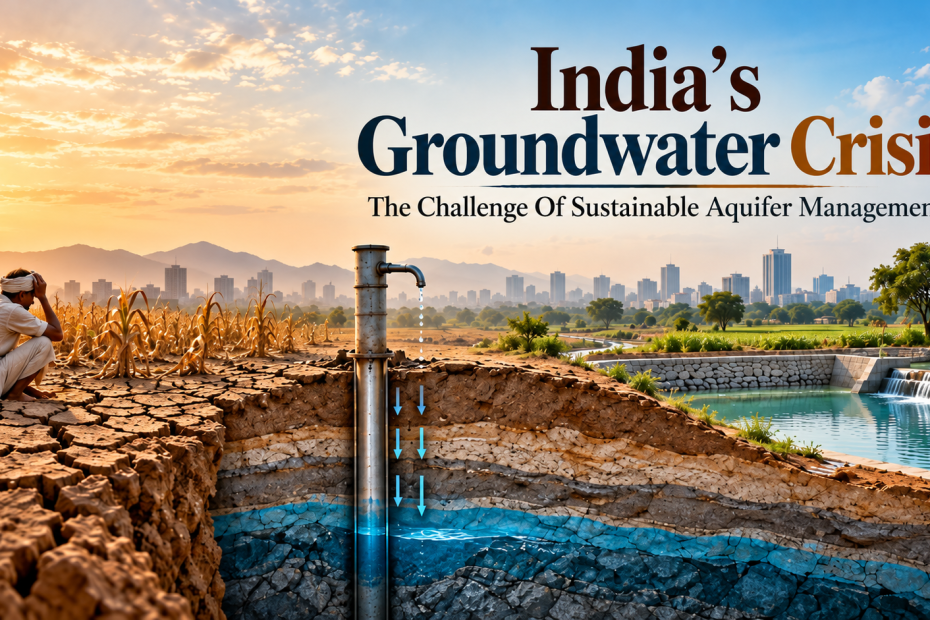
Groundwater provides an essential buffer against seasonal rainfall and unreliable surface-water supply. Unlike a reservoir, however, an aquifer is largely invisible, and its depletion may become evident only when wells deepen, pumping costs rise or water quality deteriorates. India’s challenge is therefore not simply a shortage of groundwater at the national level. It is a combination of excessive withdrawals in particular locations, uneven recharge, contamination and fragmented management of a resource on which farms, households and industries depend.
The Scale And Geography Of Groundwater Stress
The 2025 Assessment Reveals Uneven Groundwater Stress
The Central Ground Water Board (CGWB), in coordination with States and Union Territories, conducts the Dynamic Ground Water Resources Assessment. Its 2025 findings provide the following national estimates:
- Annual groundwater recharge: 448.52 billion cubic metres (BCM).
- Annual extractable groundwater resource: 407.75 BCM.
- Annual groundwater extraction: 247.22 BCM.
- Stage of groundwater extraction: 60.63%.
- Over-exploited assessment units: 730 out of 6,762 units, or 10.80%.
The national extraction stage conceals regional disparities: The stage of groundwater extraction represents the ratio of annual withdrawal to annual extractable groundwater resources, expressed as a percentage. A national figure below 100% does not establish sustainability everywhere, as groundwater availability in one aquifer cannot automatically compensate for depletion in another.
Northwestern States record particularly high extraction levels: The 2025 assessment reports extraction stages of 156.36% in Punjab, 147.11% in Rajasthan and 136.75% in Haryana. Annual withdrawals exceed their assessed annually extractable groundwater resources, although the underlying causes and aquifer conditions differ.
Groundwater assessment categories indicate the severity of local stress: Assessment units are classified as safe, semi-critical, critical, over-exploited or saline. This classification demonstrates the importance of aquifer-level management rather than relying exclusively on national or State averages.
Regional Aquifer Characteristics Shape Groundwater Availability
- Alluvial aquifers support intensive irrigation in northwestern India: Extensive aquifers have enabled agricultural expansion, particularly in paddy–wheat cultivation regions. Repeated extraction has placed considerable pressure on groundwater reserves.
- Hard-rock aquifers have limited and uneven storage capacity: In much of peninsular India, groundwater occurs in weathered and fractured rock formations. Storage and well yields may vary considerably over short distances, making local extraction and recharge planning particularly important.
- Coastal aquifers face the risk of saline intrusion: Excessive freshwater withdrawal can disturb the balance between groundwater and seawater, allowing saline water to move inland. However, inland geological conditions and irrigation practices can also cause salinity; not every saline well indicates seawater intrusion.
Why Groundwater Is Being Depleted
Agriculture Remains The Principal Driver Of Groundwater Demand
- Agriculture accounts for the overwhelming majority of groundwater extraction: Government figures released in August 2026, based on the 2025 assessment, place irrigation use at approximately 215 BCM, or 87% of total extraction. Domestic use accounts for about 11%, while industry accounts for about 2%.
- The expansion of tubewells has increased agricultural dependence on groundwater: Tubewells have improved irrigation reliability and supported higher food production. However, assured crop procurement, cultivation practices, subsidised electricity and privately financed pumping have encouraged intensive extraction in several regions.
- Falling water levels can create a cycle of deeper extraction: When withdrawals exceed sustainable availability, farmers may respond by drilling deeper borewells or installing more powerful pumps. Individual decisions can intensify depletion across a shared aquifer.
- Crop suitability depends on local water availability: Water-intensive crops are not equally unsuitable everywhere. Their sustainability depends on rainfall, soil, surface-water availability, aquifer characteristics and seasonal irrigation requirements.
Urban Expansion Reduces Natural Recharge
- Impervious surfaces restrict groundwater infiltration: Buildings, roads and paved spaces reduce the area available for rainwater to enter the soil. Encroachment on ponds, wetlands and drainage channels further weakens natural recharge processes.
- Growing urban demand increases pressure on aquifers: Residential, commercial and industrial expansion raises groundwater requirements, particularly where municipal water supply is inadequate or unreliable.
- Urban flooding can coexist with groundwater scarcity: Intense rainfall may produce substantial surface runoff without adequately replenishing underground reserves. Effective recharge depends on soil conditions, open spaces, drainage design, aquifer characteristics and water quality.
Climate Variability Complicates Groundwater Recovery
- Rainfall distribution influences recharge efficiency: Groundwater replenishment depends not only on total rainfall but also on its intensity, duration, timing and interaction with local soil and geological conditions.
- Extreme rainfall does not necessarily produce proportionate recharge: Short, intense downpours may generate substantial runoff, while prolonged dry periods increase irrigation requirements. Higher temperatures may also raise crop-water demand.
- Recent global assessments indicate persistent regional water-storage stress: The World Meteorological Organization’s September 2026 assessment identified persistent groundwater deficits during 2022–2025 in parts of India, particularly the northwest. It separately recorded recurring below-normal terrestrial water storage in the Ganges–Indus headwater region during 2021–2025.
- Terrestrial water storage is broader than groundwater: It includes groundwater, rivers, lakes, soil moisture, snow and ice. Changes in total terrestrial water storage cannot therefore be attributed exclusively to aquifer depletion.
Groundwater Quality Is A Parallel Crisis
- Groundwater availability does not guarantee drinking-water safety: A well may provide sufficient quantities of water while containing chemical contaminants that make it unsuitable for consumption.
- The 2025 groundwater quality report identifies widespread contamination risks: Based on 2024 monitoring, the CGWB reported nitrate exceedance in 20.7% of tested samples and fluoride exceedance in 8.05%. Approximately 28.32% of samples exceeded the applicable drinking-water standard for at least one monitored parameter.
These figures describe monitoring samples and should not be interpreted as equivalent percentages of all groundwater sources in India.
Major Groundwater Contaminants And Their Implications
- Nitrate contamination is associated with agricultural and domestic pollution: Fertilisers, sewage and other human activities can contribute to elevated concentrations. The BIS drinking-water limit is 45 mg/L.
- Fluoride contamination is primarily linked to geological conditions: Fluoride-bearing minerals can release fluoride into groundwater in susceptible geological settings. The permissible drinking-water limit is 1.5 mg/L, and prolonged excessive exposure may cause dental or skeletal fluorosis.
- Arsenic contamination affects parts of the northern alluvial plains: Geogenic arsenic occurs in portions of the Indo-Gangetic and Brahmaputra plains. Its distribution depends on local geochemical conditions, and long-term exposure can create serious health risks.
- Salinity affects drinking water and agricultural productivity: Elevated dissolved salts can reduce drinking-water acceptability, affect soil conditions and damage infrastructure. Salinity may result from seawater intrusion, geological processes or irrigation-related salt accumulation.
Irrigation suitability and drinking-water safety require different assessments: The CGWB report identifies 94.30% of samples as excellent under the Sodium Adsorption Ratio criterion, which measures sodium-related soil hazard. This does not establish that the same samples are potable or free from other irrigation-quality problems.
Consequences For Agriculture, Society And The Environment
Groundwater Depletion Threatens Agricultural Resilience
- Declining groundwater availability reduces irrigation reliability: Groundwater supports cultivation when rainfall is delayed or canal supplies are inadequate. Falling water levels can affect dry-season cropping, yields and farmers’ ability to manage rainfall shocks.
- Smallholders face disproportionately high adjustment costs: Wealthier cultivators may be able to deepen wells or invest in powerful pumps, while small and marginal farmers face greater difficulty meeting rising drilling and energy expenses.
- Shared aquifers transmit the effects of individual extraction: Pumping by one group of users may lower water availability for neighbouring farms, making groundwater depletion a collective resource-management problem.
- Food security depends on the sustainability of major irrigation regions: Reduced irrigation reliability in food-producing areas can affect agricultural output, production costs and supply-chain resilience.
Groundwater Stress Creates Wider Economic And Urban Risks
- Water scarcity threatens water-dependent economic activity: Groundwater stress can disrupt manufacturing, services, construction and household supply. Pumping from greater depths also increases energy requirements.
- Water-dependent sectors have substantial economic importance: A World Bank assessment published in March 2026 notes that water-dependent sectors contribute roughly half of India’s economic value added and employ nearly 70% of its workforce. These figures concern broader water dependence rather than groundwater alone.
- Excessive withdrawal can contribute to land subsidence: In susceptible geological settings, sustained extraction lowers pore-water pressure and may compact underground sediments. The resulting ground settlement can damage buildings, roads and buried infrastructure.
- Land subsidence depends on local geological conditions: Its occurrence and severity vary according to aquifer composition, extraction history and sediment properties; groundwater stress does not automatically produce subsidence in every city.
Groundwater Depletion Damages Connected Ecosystems
- Groundwater supports rivers, springs and wetlands: Where these systems depend on groundwater discharge, falling water levels can reduce dry-season streamflow, spring discharge and wetland moisture.
- Coastal saline intrusion can degrade freshwater ecosystems: Changes in the groundwater–seawater balance may affect freshwater availability, agricultural land and coastal habitats.
- Aquifer conservation requires integrated water management: Groundwater, surface water, soils and dependent ecosystems form connected hydrological systems and should not be managed independently.
What Sustainable Groundwater Management Requires
Groundwater Management Must Reflect Local Aquifer Capacity
- Aquifer characteristics should determine extraction and recharge strategies: Alluvial, hard-rock, coastal and mountain aquifers differ in storage, transmissivity, recharge behaviour and vulnerability. Management must therefore be adapted to local hydrogeological conditions.
- National Aquifer Mapping provides the scientific foundation for management: The National Aquifer Mapping and Management Programme (NAQUIM) completed mapping approximately 25 lakh square kilometres of India’s identified mappable area in 2023.
- NAQUIM 2.0 focuses on finer-scale groundwater challenges: It prioritises problem-specific studies, including water-stressed regions, urban aquifers, coastal areas, springsheds and locations affected by groundwater contamination.
- Aquifer mapping must translate into operational decisions: Mapping can guide well siting, extraction planning, recharge design and drinking-water source protection. Scientific information alone cannot prevent over-extraction without effective implementation.
Agricultural Water Demand Must Be Managed
- Crop planning should reflect agro-climatic and hydrogeological conditions: Cropping systems should be aligned with rainfall, soil, available irrigation and local groundwater capacity, while accounting for farmer incomes, procurement arrangements and market access.
- Micro-irrigation can improve water application efficiency: Drip and sprinkler systems can reduce unnecessary application where technically suitable. However, actual aquifer savings depend on whether improved efficiency is accompanied by expansion of irrigated area or cropping intensity.
- Power-supply reforms can address incentives for excessive pumping: Metering, feeder management and carefully designed alternatives to electricity subsidies may encourage efficient groundwater use while protecting smallholders’ irrigation needs.
- Surface-water integration can reduce groundwater dependence: Canals, appropriately treated wastewater and other suitable sources can supplement irrigation where feasible, subject to reliability, quality and environmental considerations.
- Aquifer-level withdrawal is the relevant measure of sustainability: Lower water application at an individual field does not automatically translate into reduced groundwater extraction across the wider agricultural system.
Recharge Measures Must Be Scientifically Designed
- Watershed restoration can improve groundwater replenishment: Ponds, check dams, percolation tanks, restored wetlands and suitable infiltration structures can increase recharge under favourable conditions.
- Recharge structures must reflect local hydrogeology: Site selection should consider geology, slope, infiltration capacity, available water and the characteristics of the receiving aquifer.
- Artificial recharge must protect groundwater quality: Polluted stormwater or untreated wastewater should not be introduced into underground water-bearing formations.
- Reservoir desiltation and groundwater recharge serve different purposes: Removing sediment may improve surface-storage capacity where justified, but does not automatically increase aquifer recharge.
- Urban recharge requires integration with land-use planning: Protection of shallow aquifers, restoration of water bodies, conservation of open spaces and improved stormwater management can support groundwater replenishment.
Collective Governance Is Essential For Shared Aquifers
- Individual pumping decisions create collective consequences: Multiple users may draw from the same aquifer, making groundwater management dependent on coordinated extraction and shared rules.
- Community water budgeting can improve resource allocation: Village-level water planning, transparent monitoring and public access to groundwater information can help communities align withdrawals with available resources.
- Groundwater regulation involves both central and State authorities: Groundwater is principally managed by States. The Central Ground Water Authority (CGWA), constituted under Section 3(3) of the Environment (Protection) Act, 1986, regulates specified abstraction activities under the applicable framework.
- Atal Bhujal Yojana demonstrated participatory groundwater management: Implemented in 80 water-stressed districts across seven States, the programme combined community-based water-security planning with demand-side measures.
- Shared aquifers require coordination across administrative boundaries: Common monitoring and cooperative planning can help prevent uncoordinated extraction by neighbouring districts and States.
Lessons From Community-Led Groundwater Management
- Hiware Bazar demonstrates the value of community water budgeting: The Maharashtra village combines watershed treatment, annual water budgeting, restrictions on agricultural tubewells and cropping decisions linked to water availability. Its experience illustrates how collective rules can complement recharge infrastructure.
- Ralegan Siddhi illustrates integrated watershed development: Soil and water conservation, rainwater harvesting, check dams and percolation structures have contributed to its long-standing watershed-management model. Community organisation remains central to sustaining these interventions.
- Sumsuih highlights the importance of springshed management: The Mizoram initiative combines local participation with hydrogeological understanding to identify recharge zones and improve spring-water management. Mountain springs require protection of their recharge areas rather than interventions confined to the visible spring outlet.
Community institutions determine the long-term effectiveness of physical interventions: Recharge structures perform more effectively when users understand the resource, agree on extraction practices and collectively maintain management arrangements.
Conclusion
India’s groundwater challenge is best understood at aquifer scale. National averages can coexist with acute local depletion, and abundant water may still be unusable because of contamination. Lasting water security depends on integrating agricultural demand, scientifically designed recharge, urban planning, quality monitoring and community governance. Protecting groundwater also protects the resilience of food production, livelihoods and connected ecosystems.