
Many UPSC aspirants recognise a familiar difficulty: they understand a topic in a textbook but find it harder to explain a debate involving that topic. Knowing the meaning of federalism does not automatically explain disagreements over delimitation. Knowing the structure of the judiciary does not, by itself, explain why access to justice remains difficult.
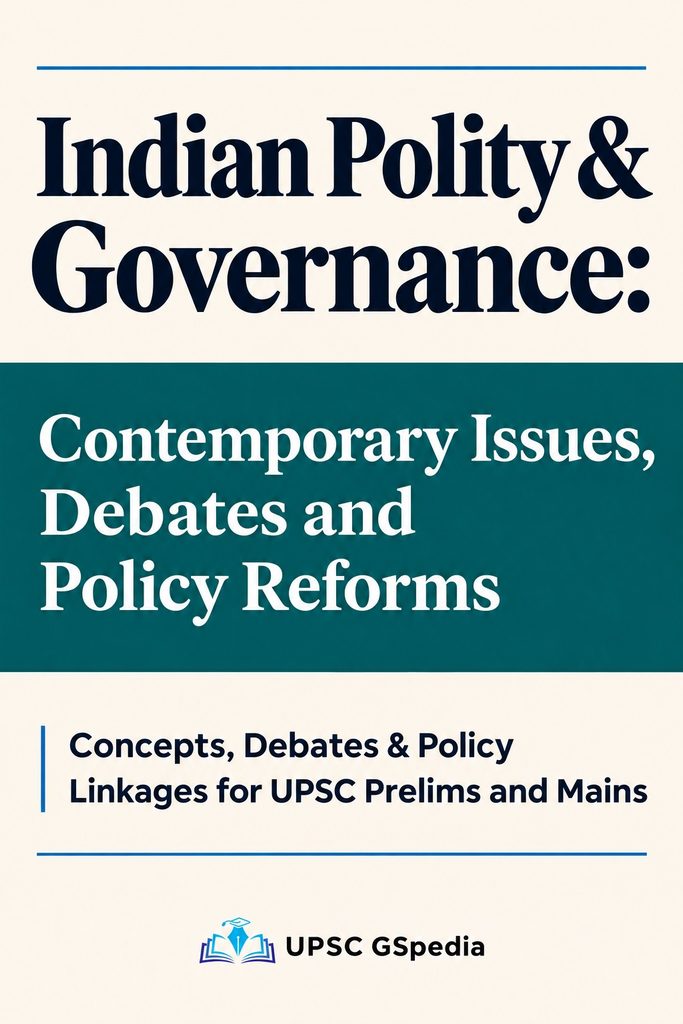
Indian Polity & Governance: Contemporary Issues, Debates and Policy Reforms addresses this stage of preparation. Across thirty-five chapters, it connects constitutional foundations with contemporary questions. The purpose is to help readers understand how familiar concepts operate when institutions face competing demands, practical constraints and calls for change.
Building On Static Textbooks
Foundational textbooks provide the concepts, provisions and institutional structure needed to study Indian polity. This book is designed to be read alongside that foundation. It develops the next set of questions: why has a particular issue become contested, which interests are involved and how should different proposals be assessed?
For example, studying the Election Commission establishes its role in conducting elections. Examining its independence takes the discussion further, into how appointments, working arrangements and accountability affect its functioning. Similarly, learning about Panchayats introduces local democracy; studying their powers, finances and responsibilities explains the difficulties of making that democracy effective.
The difference lies in the purpose of the discussion. The book uses contemporary debates to deepen understanding of the subject and show how its different parts connect.
Making Complex Issues Easier To Follow
Contemporary issues often reach students as separate news reports, judgments, announcements and opinion pieces. Each may explain one development while leaving the reader to reconstruct the larger background. This can make preparation fragmented, particularly when a debate involves several institutions or competing rights.
The chapters bring background, concepts and arguments into a connected explanation. The discussion of the Uniform Civil Code, for instance, relates family law to equality, individual choice and cultural diversity. The treatment of delimitation connects population change with representation and the concerns of States.
This approach helps readers identify the central question before considering different responses. It also makes distinctions clearer, such as the difference between giving an institution formal authority and enabling it to exercise that authority effectively.
The range of chapters also helps readers recognise connections across topics. Elections link political equality with public trust; language policy connects identity with educational opportunity; and public finance shapes the ability of governments to fulfil their responsibilities. Revisiting these relationships can make revision more coherent because the same foundational idea becomes visible in several different settings.
Supporting Aspirants Who Study Independently
Self-study becomes difficult when a resource assumes knowledge that the reader has not yet developed. Unexplained terms and abrupt shifts between facts can interrupt understanding. Students may collect more material without becoming more confident about the issue itself.
This book places explanation at the centre of the chapter. Readers encounter the background needed to understand a debate, the concepts that organise it and the reasons behind competing positions. They can follow the discussion at their own pace and return to a particular section when a connection remains unclear.
Short summaries and examination-focused sections help readers review what they have studied. The aim is to reduce the work of piecing together scattered explanations and leave more time for comprehension, revision and answer practice.
For an independent learner, a further benefit is being able to test understanding against competing arguments. A reader can ask why one position appears persuasive, what it leaves unresolved and whether another approach addresses that difficulty. This encourages informed, independent judgment instead of relying on a ready-made conclusion for every question.
Connecting Prelims Knowledge With Mains Analysis
Prelims preparation benefits from clear concepts and careful distinctions. Mains preparation requires the ability to use that knowledge to explain a problem, examine different views and discuss possible responses. These are connected learning tasks.
The book supports both by relating factual material to the questions it helps answer. Chapters on courts consider access, delay and institutional capacity. Chapters on Parliament examine how representation and scrutiny work in practice. Discussions of local government connect constitutional recognition with the resources needed to deliver services.
For answer writing, such connections help students move beyond listing advantages and disadvantages. They provide reasons for an argument and clarify the conditions under which a suggested reform might work.
The discussion also encourages care when suggesting reforms. A proposal may have a reasonable stated objective but face difficulties in implementation. Recognising those difficulties helps students write answers that explain what improvement requires, including public participation, adequate resources and ways to correct mistakes. This makes the analysis more specific to the issue being examined.
Understanding Governance Through Everyday Concerns
The coverage extends beyond the major constitutional institutions. Tribal land, forest rights, heritage conservation, food safety, advertising and digital land records show how governance affects communities and everyday decisions.
These subjects make the relationship between rights and implementation easier to understand. Recognising a right, recording information or announcing a standard is one stage; ensuring that people can use the protection is another. Studying both helps aspirants develop a fuller account of public policy and its consequences.
The First Book In A Wider Series
This is the first book in UPSCGSPEDIA’s series on contemporary issues. More books will be launched to extend the approach across other major areas of UPSC preparation. The series comprises:
- Indian Polity & Governance: Contemporary Issues, Debates and Policy Reforms
- Indian Economy & Development: Contemporary Issues, Debates and Policy Reforms
- International Relations & Geopolitics: Contemporary Issues, Debates and Policy Reforms
- Indian Society & Social Justice: Contemporary Issues, Debates and Policy Reforms
- Environment & Climate Change: Contemporary Issues, Debates and Policy Reforms
- Science & Technology: Contemporary Issues, Debates and Policy Reforms
Using The Book In A Study Plan
A useful approach is to read a chapter after revising the relevant foundational topic. First identify the problem and the concepts involved. Then note the main arguments, the difficulties of implementation and the reasoning behind proposed reforms.
After reading, explain the issue in a few sentences and attempt a short answer. Return to the chapter to check whether the explanation has missed an important distinction or opposing view. Used this way, the book supports active learning and helps independent aspirants turn subject knowledge into clearer understanding and more considered answers.
Download the book from here.